Air pollution is no longer just a health crisis but an economic one. Here's how
/ 3 min read
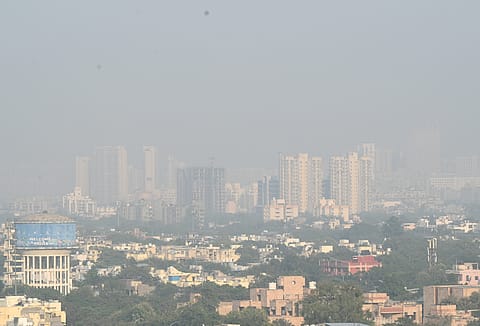
Air pollution, Delhi | Credits: Getty Images
Air pollution is no longer just a health crisis but an economic one. Here's how
Air pollution in India is not just a health crisis but a significant economic burden, costing nearly $100 billion annually, or 2.5% of GDP. In cities like Delhi, pollution drastically reduces consumer footfall and productivity, leading to substantial business losses. Experts argue that addressing air pollution is crucial for economic resilience and growth.
This summary is AI-generated, and Fortune India is not responsible for its content or any associated copyright issues.
The cost of polluted air is showing up in GDP, business losses and daily livelihoods
Air pollution, Delhi | Credits: Getty Images
Air pollution is estimated to drain close to $100 billion from India’s economy each year — nearly 2.5% of GDP — once health impacts and lost productivity are factored in. The burden is especially heavy in major cities, where pollution-linked losses run into tens of thousands of crores annually.
In Delhi, the impact is visible on the ground. Ridhima Kansal, Director at Rosemoore, said air pollution functions like an unrecognised tax on the city’s retail economy, steadily eroding business viability. “Delhi’s retail economy is losing revenue and deteriorating the feasibility of conducting business,” she said.
According to Kansal, severe pollution episodes have led to a sharp fall in daily footfall across Delhi’s markets, from an estimated 300,000–400,000 visitors to around 100,000. “This represents a 60–70% drop in shopper traffic, resulting in daily business losses exceeding ₹2,500 crore over this period,” she said. She added that small and medium retailers lack the reserves to absorb sustained losses, pushing many towards business failure.
Kansal said national estimates put the economic cost of air pollution at around $100 billion, or 2.5% of India’s GDP, driven by unproductive labour, absenteeism and reduced consumer spending. “Of this, about $22 billion is directly attributable to reduced consumer footfall, highlighting how pollution weakens demand as well as productivity,” she said.
At the city level, the losses are structural rather than marginal. From a circular economy perspective, pollution reflects wasted resources — fuel lost in congested traffic, materials wasted in inefficient construction, energy wasted in poorly designed buildings, and ultimately wasted human potential. Poor air quality turns capable workers into underperforming assets, affected by fatigue, illness and reduced cognitive efficiency, quietly eroding Delhi’s productivity base.
Anup Garg, Founder and Director of the World of Circular Economy (WOCE), said air pollution is often framed as a health or environmental issue, but is fundamentally an economic one. “In reality, it is one of the largest and least acknowledged economic inefficiencies facing Indian cities today,” he said.
Garg pointed to global cities such as Amsterdam, Copenhagen and Singapore as evidence that high growth and clean air are not mutually exclusive. “By closing loops across energy, mobility, materials and waste systems, and embedding emissions data into everyday decision-making, these cities have reduced pollution while strengthening economic resilience and competitiveness,” he said.
“For businesses, clean air must be treated as economic infrastructure, not just corporate social responsibility,” Garg added. “Emissions, energy consumption, logistics efficiency, generator dependence and waste burning should be managed as core operational KPIs, just like cost, quality and safety. What gets measured gets managed.”
Cleaner operations are now closely linked to ESG disclosures, supply-chain eligibility and export competitiveness. Companies that cut emissions are not merely acting responsibly; they are reducing future risk. Clean air, experts argue, is not a constraint on growth but a prerequisite for resilient and productive economies.
Raghunandan Saraf, Founder and CEO of Saraf Furniture, said Delhi’s air pollution is both a growing health crisis and an ongoing fiscal drain on the city. “Studies have attempted to quantify the economic damage caused by toxic air, particularly in Delhi, where productivity losses and health impacts are especially severe,” he said.
Saraf cited estimates suggesting that air pollution can erode between 3% and 5% of Delhi’s GDP when healthcare costs, lost productivity and premature deaths are taken into account. He referred to one assessment that estimates economic losses of around $3.5 billion, or roughly ₹30,000 crore, over a six-month period in Delhi, driven largely by pollution-related mortality and reduced labour output.
{{#most-powerful-women-snapshot-individual.slug}} {{/most-powerful-women-snapshot-individual.slug}} {{^most-powerful-women-snapshot-individual.slug}} {{/most-powerful-women-snapshot-individual.slug}} {{#showRanking}} {{current-rank}} {{/showRanking}} {{#photo.0.url}}
{{name}}
“It is estimated that around 24,000 premature deaths in a six-month period were attributable to exposure to PM2.5 and NO2,” Saraf said. “The productivity losses linked to these deaths alone account for a significant share of the estimated economic damage.”
Delhi remains one of India’s leading hubs for services, industry and innovation. But experts warn that unchecked air pollution represents a form of hidden economic leakage, undermining long-term growth and financial wellbeing. Addressing air pollution, they argue, is not only an environmental imperative — it is an economic one.
NEXT STORY