Budget 2026: See it as a roadmap for the future, not for immediate sops
/ 4 min read
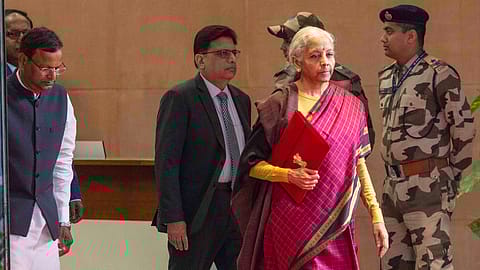
Nirmala Sitharaman, Budget 2026 | Credits: Narendra Bisht
Budget 2026: See it as a roadmap for the future, not for immediate sops
Budget 2026 is presented as a strategic roadmap for India's future, focusing on resilience and long-term economic growth rather than immediate market appeasement. Despite a negative market reaction, the Budget aims to fortify the economy against global uncertainties, emphasizing self-reliance and fiscal discipline, with initiatives like the India Semiconductor Mission 2.0 and support for MSMEs.
This summary is AI-generated, and Fortune India is not responsible for its content or any associated copyright issues.
It’s high time we learnt to see the Union Budget as a foundation for the future, a statement of ambition for the India of tomorrow
THIS STORY FEATURES
Nirmala Sitharaman, Budget 2026 | Credits: Narendra Bisht
Every year, experts on television come forward and say how irrelevant the Union Budget is becoming—how it is what happens in between the Budgets which is important. Indeed, if that is the case, then it makes sense not to look at the Budget for what it needs to do in the immediate context; rather, the Budget must be viewed increasingly as a statement of intent, a roadmap for the economy and how the government intends to build the India of the future.
To that end, Finance Minister Nirmala Sitharaman’s ninth consecutive Budget scores well. Stock market players may not agree—at the end of trading, the 30-share BSE Sensex shed a hefty 1,547 points, and the Nifty 50 lost 495 points. The Budget did precious little for the market to rejoice, increasing the securities transaction tax (STT) on futures and the STT on options premium and exercise of options in a bid to curb speculative activity further. Buybacks will also be taxed as capital gains. While that simplifies the mode of taxing buybacks, this has also had a negative effect on market sentiment.
But moving away from the immediate context, the Budget aims to set the foundation for India’s Viksit Bharat ambition, and ringfence the economy from the vagaries of the current turbulence in the global economy. That, in the Finance Minister’s own words, is the “First Kartavya (duty)”—to accelerate and sustain economic growth by enhancing productivity and competitiveness and building resilience to volatile global dynamics. The operative word here must be “resilience”. This is a Budget for a Resilient India, an India which seeks to stand up against external economic threats and carve its own destiny.

This is not just a grandiose dream—the Budget aims to put the building blocks in place for that ambition. To be fair, the past year has seen the government do its fair bit to spur domestic consumption while ensuring stability against global vagaries. Starting from the previous Budget’s big tax relief of ₹1 lakh crore and the GST 2.0 reliefs, the government has then struck landmark free trade agreements (FTAs) with the United Kingdom and, recently, the European Union (EU) to ensure India has easier access to markets other than the United States. Ringfencing is a key element of the government’s current economic strategy, and Budget 2026 takes the same theme forward.
Take, for instance, the India Semiconductor Mission 2.0, the Scheme for Rare Earth Permanent Magnets, research, mining, processing and manufacturing, or even the scheme for reviving 200 legacy industrial clusters. All these must be seen as efforts towards increasing the move towards self-reliance.
Let’s look at some of the pain points which the Budget seeks to address. MSMEs get a good degree of attention, with steps like the ₹10,000 crore dedicated SME Growth Fund. MSMEs will also get liquidity and much-needed professional support through “Corporate Mitras”—professionals who will help MSMEs in tier II and III towns to meet compliance requirements at affordable costs. Manufacturing and services also get a boost by way of a slew of initiatives including tax reforms, as does tourism, a sector which can create jobs. There are also a number of measures aimed at addressing the ease of doing business.
To me, what is most commendable is the Finance Minister’s ability to stick to the fiscal math despite an enormously challenging year. As promised, the fiscal deficit has been pegged at 4.4% of GDP in the revised estimates (RE) for 2025-26, in line with the Budget Estimates (BE) for the fiscal. Fiscal consolidation is clearly an important deliverable for the government to maintain the credibility and predictability of the economy, and the BE for 2026-27 has now been pegged at 4.3% of GDP. The Budget also aims to reach a debt-GDP ratio of 50+/-1% by 2030. This ratio is at 56.1% in FY26 and is expected to drop to 55.6% by FY27.
Despite the challenges to the economy, the Budget has hiked public capex for FY27 to ₹12.2 lakh crore (from the BE FY26 figure of ₹11.2 lakh crore), signalling the government’s intent to continue frontloading capex as much as possible to boost growth in the absence of significant private sector capex spending. Private sector capacity utilisation is around 75%, and it needs to stay at consistently higher levels of 80-85% to justify fresh capital investments from the private sector.
Clearly, there’s enough work to do for the government and the FM as global dynamics change rapidly in an uncertain world. The quicker the government ringfences the economy against geopolitical uncertainties the better. Most of the steps enumerated in this Budget will not materialise tomorrow. Some reforms take time, others may get done quicker. This Budget is a roadmap. And a roadmap is a guide to a journey. Not a destination in itself.
Follow Fortune India
NEXT STORY