The FAQs are AI-generated, and Fortune India is not responsible for its content or any associated copyright issues.
Crude volatility could slow the capex cycle and raise inflation risks: Zuari Industries MD Athar Shahab
/ 4 min read
Shahab flags risks to inflation, capex and margins as crude volatility exposes structural vulnerabilities
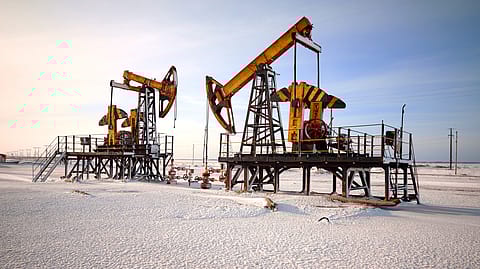
A $1 increase in crude prices adds roughly ₹18,000 crore to the import bill, and a ₹1 depreciation in the rupee adds another ₹20,000 crore | Credits: Getty Images
India’s heavy dependence on imported energy leaves it highly exposed to the ongoing Iran–Israel-US tensions, with risks spilling beyond oil into inflation, investment and corporate margins, says Athar Shahab, Managing Director of Zuari Industries. In an interview, Shahab warns that sustained crude volatility could slow the capex cycle, compress margins across key sectors and force companies to prioritise resilience over growth, even as it underscores the urgency of long-term energy security reforms. Edited excerpts:
How do you assess India’s macroeconomic risks from the current situation in West Asia?
The Iran–Israel conflict, in my view, is not a one-off shock but part of a broader phase of persistent geopolitical volatility. For India, the primary channel of impact is energy. With 85% import dependence, even moderate disruption can have outsized consequences.
A $1 increase in crude prices adds roughly ₹18,000 crore to the import bill, and a ₹1 depreciation in the rupee adds another ₹20,000 crore. These two variables alone can quickly widen the current account deficit and complicate inflation management.
More importantly, the impact does not remain confined to oil. Higher energy prices transmit across the economy - into logistics, fertilisers and industrial inputs - eventually feeding into both core and food inflation. This is where the real macro risk lies: a sustained increase in the cost structure of the economy, which can dampen growth while keeping inflation elevated.
In that sense, the situation bears resemblance to past systemic shocks like 2008 or Covid - not in origin, but in the breadth of economic transmission.
Do you think repeated geopolitical shocks like this will push India to accelerate structural shifts such as energy security and supply chain diversification?
Recommended Stories
Repeated shocks are certainly accelerating the recognition of structural vulnerabilities, but the transition itself is neither immediate nor frictionless. India’s petroleum import bill of ₹18 lakh crore represents a persistent external exposure. In periods of volatility, this becomes a direct macroeconomic risk, affecting both inflation and external balances.
There is a clear policy direction towards reducing this dependence - through electrification, ethanol blending, bioenergy and diversification of supply chains. However, these are long-gestation transitions. They require sustained capital investment, policy continuity and ecosystem development.
In the near term, the economy remains exposed. Which is why the current phase should be seen less as a catalyst and more as a stress test. It underlines that energy security is not just a long-term sustainability goal - it is central to macroeconomic stability.
Do you see supply chain disruptions or higher logistics costs slowing down India’s capex cycle?
RANK
COMPANY NAME
REVENUE
(INR CR)
(INR CR)
{{#current-rank}} {{current-rank}} {{/current-rank}} {{^current-rank}} {{rank}} {{/current-rank}} {{name}} {{#revenue}} {{revenue}} {{/revenue}} {{^revenue}} {{noi}} {{/revenue}}
Yes, there is a credible risk of moderation in the capex cycle if current conditions persist.
Rising crude prices directly increase logistics costs - both maritime and inland- while supply chain disruptions introduce uncertainty in procurement timelines. This combination raises project costs and complicates execution.
From a financing perspective, this affects project viability. Cost overruns, delays and uncertainty around completion timelines reduce return visibility and increase risk perception.
As a result, both developers and lenders become more cautious. Projects are reassessed, timelines are stretched and new investments are evaluated more conservatively.
So while the capex cycle may not reverse, its pace is likely to slow, and execution risks will become more pronounced.
From an investment perspective, do you expect private sector capex to be deferred in the near term, or does India still offer enough resilience to sustain investment momentum?
In the near term, a deferment or at least a slowdown in private sector capex is likely.
The current environment introduces multiple uncertainties - input cost volatility, demand visibility and execution risk, which make it difficult to commit capital with confidence. Even where investments proceed, they are likely to be phased and tightly controlled.
This places greater responsibility on government capex. However, the emphasis must shift from scale to efficiency. In a volatile macro environment, poorly prioritised or inefficient capital deployment can exacerbate fiscal and inflationary pressures rather than support growth.
India’s long-term fundamentals remain intact, but the near-term reality is one of caution. This is not a phase for aggressive expansion - it calls for calibrated investment, disciplined execution and careful prioritisation.
With crude prices rising and input costs under pressure, how do you see this impacting margins across sectors like infrastructure, fertilisers and engineering?
Margins across these sectors are inherently sensitive to energy and commodity costs, so the impact is both immediate and structural.
In fertilisers, the linkage is direct. Gas prices determine production economics, and for products such as DAP and NPK, a significant portion of raw materials is imported. Price volatility or supply disruptions translate almost immediately into margin compression or higher subsidy requirements.
In infrastructure and engineering, the transmission is slightly lagged but equally material. Fuel and logistics costs increase project execution expenses, while many contracts - particularly fixed-price EPC contracts - do not allow full pass-through. This creates stress on project viability and contractor margins.
Beyond margins, the more critical impact is behavioural. As cost uncertainty rises, companies become more conservative in capital allocation. Investment decisions are deferred, scaled down or reprioritised. This eventually feeds into slower order inflows and weaker visibility across the EPC value chain.
So while margin pressure is the first-order effect, the second-order impact on investment activity is likely to be more consequential.
What strategies should companies adopt to navigate this phase of global uncertainty and demand slowdown?
The priority in such an environment is not growth, but resilience.
First, companies need to actively de-risk their operating models - by diversifying supply chains, reducing dependence on specific geographies or inputs and building flexibility into sourcing arrangements.
Second, capital discipline becomes critical. Balance sheet strength, liquidity management and cash flow visibility take precedence over expansion. Companies that preserve financial flexibility are far better positioned to withstand prolonged uncertainty.
Third, execution efficiency becomes a key differentiator. When margins are under pressure, operational discipline - cost control, project management and productivity- becomes the primary lever for sustaining performance.
This is a phase where conservative decision-making is not a weakness - it is a necessary response to elevated uncertainty.