Davos 2026: German Chancellor Friedrich Merz backs India-EU FTA as antidote to protectionism
/ 2 min read
German Chancellor Friedrich Merz positions the India-EU free trade pact as a rules-based response to rising protectionism, as Brussels and New Delhi move closer to sealing a landmark agreement
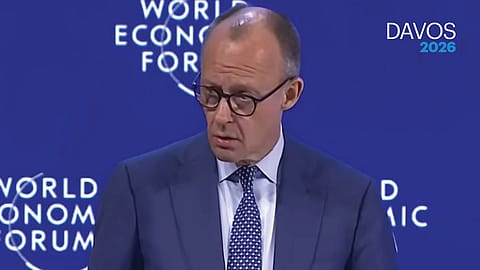
Referring to his recent visit to India, the German chancellor said the shifting global balance could work in favour of open economies | Credits: Youtube/WEF
German Chancellor Friedrich Merz on Thursday pitched the proposed India–European Union (EU) Free Trade Agreement (FTA) as a unifying force for major economies amid growing uncertainty in global trade.
Speaking at the World Economic Forum (WEF) Annual Meeting in Davos, Merz said the agreement reflects a broader push by “like-minded countries” to reinforce rules-based economic engagement over unilateral trade barriers.
Linking the India-EU negotiations to the current geopolitical climate, Merz argued that the “era of great powers” offers scope for deeper cooperation among economies that favour predictability and regulation.
“In a few days, the President of the European Commission will travel to India to establish the principles of a free trade agreement between the subcontinent and the European Union,” he said.
Terms it an opportunity for countries favouring free trade
Referring to his recent visit to India, the German chancellor said the shifting global balance could work in favour of open economies. “I was in India a week ago, and I have no doubt whatsoever that the era of great powers presents an opportunity for all of us and for all countries that favour regulations above arbitrary rule and see benefit in free trade than in protectionism and isolationism,” Merz said.
He noted that discussions between India and the EU are now moving towards defining the core principles of the agreement, signalling political intent on both sides to push negotiations forward.
Merz also underlined his focus on driving higher growth in Europe and said the EU was joining forces with new partners, citing parallel efforts to conclude trade agreements with Mexico and Indonesia.
‘Mother of all deals’ and signing timeline
Earlier at Davos, European Commission President Ursula von der Leyen described the pact as “the mother of all deals”, saying it would create a market of nearly 2 billion people, accounting for about a quarter of global GDP, and provide Europe with a crucial first-mover advantage in one of the world’s fastest-growing regions.
European Council President António Costa and von der Leyen will visit India from January 25 to 27 as chief guests at the Republic Day celebrations and to co-chair the India-EU Summit, where the two sides are expected to announce the conclusion of negotiations.
Notably, the European Union is India’s largest trading partner, with bilateral goods trade reaching $135 billion in FY24. The proposed agreement is expected to deepen ties across sectors at a time when global trade faces renewed disruptions, including from US President Donald Trump’s tariff policies.
Follow Fortune India
NEXT STORY