Decoding Budget 2026: Experts see cautious optimism as government stays reform-focussed
/ 3 min read
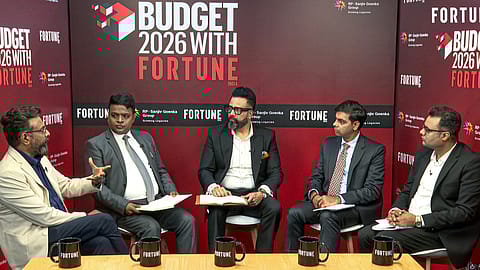
Rohit Garg, Partner, Shardul Amarchand Mangaldas, Krishan Arora, Partner, Indirect Tax, Grant Thornton Bharat, and Raghav Madan, Director, Deloitte India speaking at a panel discussion on Budget 2026 hosted by Fortune India | Credits: Fortune India
Decoding Budget 2026: Experts see cautious optimism as government stays reform-focussed
The Union Budget 2026, presented by Finance Minister Nirmala Sitharaman, emphasizes calibrated reforms and investment-led growth to boost India's global competitiveness. Experts view the budget as a pragmatic balance amid global uncertainty, focusing on trade facilitation, easing litigation, and infrastructure investment, while maintaining cautious optimism for sustained economic growth.
This summary is AI-generated, and Fortune India is not responsible for its content or any associated copyright issues.
Largely in line with expectations, Budget 2026 reinforces the government’s preference for calibrated reforms, investment-led growth, and ease of doing business, say experts.
Rohit Garg, Partner, Shardul Amarchand Mangaldas, Krishan Arora, Partner, Indirect Tax, Grant Thornton Bharat, and Raghav Madan, Director, Deloitte India speaking at a panel discussion on Budget 2026 hosted by Fortune India | Credits: Fortune India
Finance Minister Nirmala Sitharaman presented the Union Budget 2026 in Parliament on Sunday, laying out a set of measures aimed at boosting India’s global competitiveness, advancing Atmanirbhar Bharat and widening participation in economic growth.
Largely in line with expectations, Budget 2026 reinforces the government’s preference for calibrated reforms, investment-led growth and ease of doing business. While sections of industry were hoping for bolder moves, especially on customs duty rationalisation and dispute resolution, experts said the Budget strikes a pragmatic balance amid global uncertainty.
Reviewing the proposals, Krishan Arora, Partner–Indirect Tax at Grant Thornton Bharat, said the government has continued its stated intent of rationalising customs duties, though in a measured way.
“Instead of sharp tariff cuts across fewer slabs, the approach this year is clearly targeted. Sectors such as textiles, leather, energy, nuclear and defence have seen duty corrections aligned with the broader goal of strengthening domestic manufacturing and exports,” Arora said during a panel discussion on Budget 2026 hosted by Fortune India.
He added that exemptions and duty tweaks on key raw materials would help build integrated manufacturing ecosystems, particularly in sectors linked to the production-linked incentive (PLI) framework—even though the Budget did not announce any new PLI schemes.
Customs reforms tilt towards facilitation
Rather than headline-grabbing tariff cuts, the Budget places strong emphasis on trade facilitation. Proposals include expanding trusted importer programmes and strengthening the Authorised Economic Operator (AEO) framework to enable faster clearances through differentiated risk assessment.
“The focus on trusted importers and quicker cargo clearance is a meaningful step in reducing friction in cross-border trade,” Arora said. “If the proposed single-window customs system is implemented effectively over the next two years, it could significantly improve India’s import-export processes.” However, he cautioned that execution will be key.
On the much-anticipated customs amnesty, Arora said the relief offered was narrower than expected. “A comprehensive one-time amnesty could have helped resolve large volumes of litigation. What we have instead is partial relief through penalty rationalisation—useful, but not a complete clean-up.”
Direct tax: easing litigation, not cutting rates
On the direct tax side, Rohit Garg, Partner at Shardul Amarchand Mangaldas, said expectations of major tax rate changes were already low, given that the new Income Tax Act is scheduled to take effect from April 1, 2026.
“What stands out is the attempt to tackle litigation fatigue,” Garg said, noting that nearly 500,000 appeals are pending at the first appellate level. “Streamlining dispute resolution is essential for both taxpayers and the tax administration.”
He also welcomed moves to decriminalise minor offences and allow courts to settle certain prosecutions through fines. “Reducing the fear of prosecution and improving certainty will significantly boost investor confidence, especially among foreign taxpayers,” Garg added.
{{#most-powerful-women-snapshot-individual.slug}} {{/most-powerful-women-snapshot-individual.slug}} {{^most-powerful-women-snapshot-individual.slug}} {{/most-powerful-women-snapshot-individual.slug}} {{#showRanking}} {{current-rank}} {{/showRanking}} {{#photo.0.url}}
{{name}}
Other positive signals, he said, include revisions to safe harbour rules, incentives for data centres and greater clarity on taxation of emerging sectors—key factors for global investors seeking predictability.
Manufacturing, infra and capital allocation
From a broader macro perspective, Raghav Madan, Director at Deloitte India, described Budget 2026 as one of continuity rather than disruption.
“The government has stayed the course on investment-led growth, particularly in infrastructure,” Madan said. “While the 9% rise in capital expenditure to ₹12.2 lakh crore is modest, the focus areas—railways, logistics, waterways and freight corridors—are well targeted.”
He also highlighted the long-term impact of incentives for global capability centres (GCCs) and data centres. “India produces over 20% of the world’s data but hosts only about 3% of global data centre capacity. Encouraging investment here is as much about data security and jobs as it is about infrastructure,” he said.
On asset monetisation, Madan pointed to plans to monetise CPSE land and real estate through REITs as value-unlocking opportunities, though challenges remain. “Most CPSE assets are not investment-grade yet. Making them market-ready will require sustained effort, including strengthening institutions like the National Land Monetisation Company,” he said.
A tone of cautious optimism
Overall, experts agreed that Budget 2026 reflects a pragmatic response to global volatility, geopolitical tensions and shifting trade dynamics.
“This isn’t a big-bang reform Budget,” Madan said, “but it addresses key pain points—litigation, trade facilitation, infrastructure financing and investor confidence. If executed well, it can help sustain India’s growth momentum.”
Summing up the sentiment, Arora said: “The direction is right. What the economy now needs is consistent execution and follow-through through the year.”
Follow Fortune India
NEXT STORY