E20 petrol may reduce fuel economy by up to 5% in some vehicles, but benefits outweigh the impact: Oil Ministry
/ 2 min read
Government says India's ethanol blending programme has saved ₹1.97 lakh crore in foreign exchange, cut crude oil imports by 316 lakh tonnes and helped reduce 952 lakh tonnes of carbon emissions since FY15.
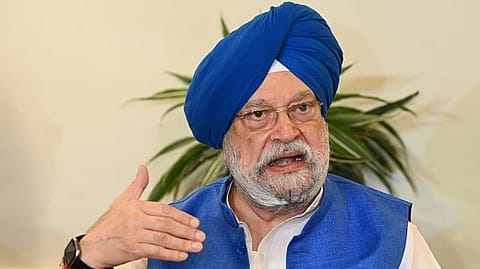
Hardeep Singh Puri, Union Minister of Petroleum and Natural Gas. | Credits: Getty Images
Petrol blended with 20% ethanol (E20) may reduce fuel economy by 3-5% in certain vehicles, but the overall gains in engine performance, energy security and emissions reduction far outweigh the marginal impact on mileage, the Ministry of Petroleum and Natural Gas said on Friday.
In a detailed question-and-answer document aimed at addressing concerns surrounding the Ethanol Blended Petrol (EBP) Programme, the ministry defended the nationwide rollout of E20 fuel, describing it as a cleaner, higher-quality and more efficient alternative to conventional petrol. It said the transition followed years of scientific validation, extensive vehicle testing, consultations with automobile manufacturers and investments in domestic ethanol production infrastructure.
Government cites savings of ₹1.97 lakh crore, lower crude imports
The ministry said India's ethanol blending journey began with pilot projects in 2001, followed by the introduction of 5% ethanol-blended petrol in select regions in 2006. While blending levels remained around 1.5% until 2014, the pace accelerated after the National Policy on Biofuels was introduced in 2018 and the feedstock base was widened beyond sugarcane.
According to the ministry, India achieved 10% ethanol blending in 2022 ahead of schedule and reached the 20% blending target during the 2025-26 ethanol supply year after significant investments in ethanol production capacity, storage and supply chain infrastructure.
Highlighting the programme's economic impact, the ministry said ethanol blending has helped save more than ₹1.97 lakh crore in foreign exchange, displaced nearly 316 lakh tonnes of crude oil imports, reduced around 952 lakh tonnes of carbon dioxide emissions, and transferred over ₹1.66 lakh crore to farmers since the 2014-15 ethanol supply year.
Automakers report no major issues with E20 compatibility
Responding to concerns over the impact of E20 on vehicles, the ministry said the fuel underwent extensive testing covering engine durability, drivability, corrosion resistance, emissions, fuel systems and material compatibility before being introduced nationwide.
It added that automobile manufacturers, including Maruti Suzuki and Hero MotoCorp, have not reported E20-related corrosion, abnormal wear or deterioration in component life under real-world operating conditions.
The ministry acknowledged that some vehicles may experience a 3-5% decline in fuel efficiency because ethanol contains lower energy per litre than petrol. However, it argued that E20 offers several performance benefits, including a higher octane rating, superior anti-knock properties, faster combustion, improved pick-up, smoother acceleration and cleaner engine operation, while also lowering lifecycle carbon emissions.
Multiple fuel grades would raise logistics costs, says ministry
Rejecting suggestions to offer pure petrol, E10 and E20 simultaneously at fuel stations, the ministry said operating parallel nationwide supply chains across more than 100,000 retail outlets would significantly increase logistics costs and complicate fuel distribution.
The ministry also clarified that E20 is not designed to reduce retail fuel prices. Ethanol procurement prices are fixed at remunerative levels to support farmers and may, at times, exceed petrol prices when global crude oil prices remain subdued.
{{#most-powerful-women-snapshot-individual.slug}} {{/most-powerful-women-snapshot-individual.slug}} {{^most-powerful-women-snapshot-individual.slug}} {{/most-powerful-women-snapshot-individual.slug}} {{#showRanking}} {{current-rank}} {{/showRanking}} {{#photo.0.url}}
{{name}}
Urging consumers not to be influenced by misinformation, the ministry said the E20 programme has been validated by vehicle manufacturers, testing agencies, oil marketing companies and regulators, and remains central to India's strategy of reducing crude oil imports, strengthening energy security and lowering transport-sector emissions.
NEXT STORY