Explained: Former finance secretary Subhash Garg questions India’s 7.8% GDP growth; why economists disagree
/ 3 min read
In an interview with NDTV, Garg suggested that if last year’s GDP had not been revised down from roughly ₹86 lakh crore to ₹80 lakh crore, the growth in current-price terms would have been around 2.6%
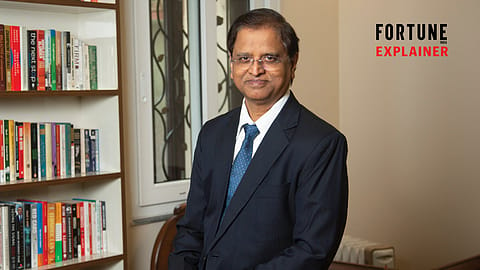
Finance and Economic Affairs Secretary Subhash Chandra Garg.
India’s economy grew 7.8% in real terms in the first quarter of FY27, according to the revised GDP series. But the headline growth figure has come under scrutiny after former Finance and Economic Affairs Secretary Subhash Chandra Garg questioned the sharp revision in the GDP figure for the corresponding quarter of the previous year on Wednesday.
The debate centres on the base used to calculate growth. Garg has pointed out that nominal GDP for Q1 FY26, which was earlier estimated at around ₹86.05 lakh crore, has now been placed at around ₹80 lakh crore under the revised series.
What did Garg say?
In an interview with NDTV, Garg suggested that if last year’s GDP had not been revised down from roughly ₹86 lakh crore to ₹80 lakh crore, the growth in current-price terms would have been around 2.6%.
“I think this is a serious question which we should really examine. The growth of 7.8% in this quarter on the face of it looks very good,” Garg said.
He also questioned the fact that Q1 FY26 real GDP data were originally released under the old series, while the figure now being used as the base comes from the new series.
The Ministry of Statistics and Programme Implementation (MoSPI) has retrospectively revised Q1 FY26 nominal GDP from around ₹86.05 lakh crore to ₹80 lakh crore, a reduction of about ₹6.05 lakh crore. Garg's concern is that such a substantial change in the previous year's GDP has an impact on the base against which current growth is measured.
Economists say the comparison is flawed
Sujan Hajra, Executive Director and Chief Economist at Anand Rathi, agreed that the ₹6.05 lakh crore difference is large and deserves an explanation. However, he said the revision does not establish that last year's GDP was deliberately reduced to inflate the latest growth figure.
In a detailed LinkedIn post, Hajra pointed out that GDP revisions are normal because initial quarterly estimates rely on incomplete information, proxies and extrapolations. Corporate filings, government accounts, tax returns and surveys become available at different times, leading to revisions as better data emerge.
He also noted that Q1 FY26 was unusually difficult to estimate, with the quarter including the announcement and deferral of Trump tariffs, Operation Sindoor, and the 12-day Israel-Iran war, along with sharp oil-price volatility.
Importantly, Hajra said not every expenditure component was revised down. Private consumption and fixed investment fell, while government consumption, valuables and exports increased. Lower imports also supported GDP.
The statistical discrepancy moved from minus ₹0.69 lakh crore to positive ₹0.65 lakh crore, an upward change of ₹1.34 lakh crore.
{{#most-powerful-women-snapshot-individual.slug}} {{/most-powerful-women-snapshot-individual.slug}} {{^most-powerful-women-snapshot-individual.slug}} {{/most-powerful-women-snapshot-individual.slug}} {{#showRanking}} {{current-rank}} {{/showRanking}} {{#photo.0.url}}
{{name}}
“If the sole objective were to depress the previous year’s denominator, the discrepancy would have been the easiest balancing item to use. The numbers show the opposite,” Hajra said.
Why the GDP series matters
Hajra's key argument is that the ₹86.05 lakh crore figure belonged to the old 2011-12-base GDP series. India has since shifted to a 2022-23 base, alongside changes in methodology, coverage, data sources and price deflators.
Under the new framework, Q1 FY26 GDP was estimated at ₹80.32 lakh crore. Subsequent revisions moved it to ₹80.44 lakh crore and then ₹80 lakh crore.
According to Hajra, nearly 95% of the ₹6.05 lakh crore difference emerged when the statistical framework itself changed.
“One cannot combine ₹86.05 lakh crore from the superseded series with ₹88.27 lakh crore from the new series to construct an alternative growth rate. That changes the measuring scale between the denominator and numerator,” he said.
Subramanian backs the new-series argument
Former Chief Economic Adviser Krishnamurthy V Subramanian also criticised Garg's 2.6% calculation, saying it compares nominal GDP figures from different series.
“Take a nominal GDP number from the old series and compare it with a nominal GDP number from the new series. Divide one by the other and proclaim 2.6% ‘growth.’ That is comparing apples with oranges,” Subramanian said in a post on X.
He also argued that using nominal GDP arithmetic to challenge a real GDP growth rate ignores the methodology used to calculate real growth.
“Error #2: Use nominal GDP arithmetic to challenge a real GDP growth rate of 7.8%, while ignoring double deflation, a globally accepted methodology that India now adopts, and the actual constant-price estimates,” he said.
Subramanian further rejected the suggestion that routine revisions amount to manipulation, saying historical estimates are revised as new and better information becomes available.
Follow Fortune India
NEXT STORY