Explained: What is a Super El Niño, and how could it disrupt India’s farms, food prices, and economy?
/ 4 min read
Any weather-related disruption to agricultural output can quickly feed into food inflation. When the supply of key crops tightens, prices across wholesale and retail markets tend to rise, directly affecting household budgets
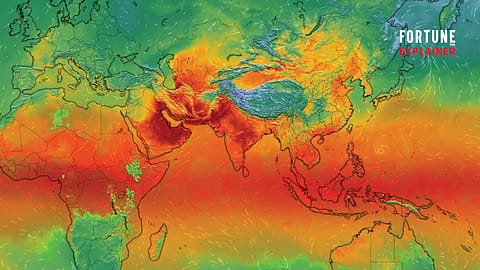
In this Fortune India explainer, let us understand what a Super El Niño is, why it develops, and what impact it could have on India and the Indian economy.
You may have heard that a Super El Niño is developing and could pose significant challenges for India. If the predictions of weather forecasting agencies come true, it could lead to below-average rainfall, lower agricultural production, higher inflation, and broader economic consequences.
In this Fortune India explainer, let us understand what a Super El Niño is, why it develops, and what impact it could have on India and the Indian economy.
What is El Nino?
El Nino is a climate phenomenon or a weather pattern where sea surface temperatures in the eastern and central tropical Pacific Ocean become warmer than the normal days.
The Pacific Ocean is the largest and deepest ocean on the earth. As a result, changes in its temperature and weather patterns can influence climate conditions across the world. The changes are largely described as negative weather patterns.
According to the US National Oceanic and Atmospheric Administration (NOAA), El Niño conditions in the tropical Pacific Ocean are underway and a sharp rise in sea surface temperatures over the past few months is now visible. Sea surface temperatures across the central and tropical Pacific have exceeded the 0.5°C-above-normal threshold used by US scientists to officially classify an El Niño event.
The opposite phase, known as La Niña, is characterised by cooler-than-normal sea surface temperatures in the Pacific Ocean and is generally associated with stronger monsoon rainfall over India.
Why this time El Nino is ‘Super’?
A ‘Super’ El Niño occurs when the warming of Pacific Ocean waters becomes exceptionally strong and sustained.
For example, according to NOAA's June estimates, "There is a 63% chance of a very strong El Niño during November-January, that would rank among the largest El Niño events in the historical record going back to 1950," the agency said.
The last major Super El Niño events, in 1997-98 and 2015-16, were associated with significant disruptions to global weather and economic activity.
How could a Super El Niño affect India?
India’s national weather forecasting body Indian Meteorological Department (IMD) has also confirmed that the El Nino-led weather changes are occurring and the phenomenon is officially developed. Climate models suggest El Niño could strengthen further over the course of the June-September southwest monsoon season.
“The atmosphere has responded to the warming sea surface temperatures, and the coupled ocean-atmosphere system now exhibits characteristics consistent with El Nino conditions,” IMD had said.
{{#most-powerful-women-snapshot-individual.slug}} {{/most-powerful-women-snapshot-individual.slug}} {{^most-powerful-women-snapshot-individual.slug}} {{/most-powerful-women-snapshot-individual.slug}} {{#showRanking}} {{current-rank}} {{/showRanking}} {{#photo.0.url}}
{{name}}
Experts say the phenomenon could result in below-average monsoon rainfall, drought conditions in some regions, and excessive rainfall in others. Several significant droughts in India, notably in 2002, 2009 and 2015, coincided with strong El Niño conditions. A key consequence of El Niño is higher temperatures, which could lead to prolonged and more severe heat spells across northern, central and western India.
How could El Niño impact the Indian economy?
India's agriculture remains closely tied to the performance of the monsoon, with nearly half of the country's cultivated land lacking assured irrigation. Any delay in rainfall, uneven distribution or a prolonged shortfall could disrupt the sowing of major kharif crops, including rice, pulses and oilseeds.
Below-normal rainfall can also strain water resources by reducing inflows into reservoirs, limiting groundwater replenishment, and weakening river flows. This may create challenges for both irrigation and drinking water supply in several regions. The impact could extend beyond the farm sector. Lower crop production resulting from a weak monsoon often leads to tighter supplies, increasing the likelihood of higher prices for essential food items such as cereals, vegetables, and pulses.
Any weather-related disruption to agricultural output can quickly feed into food inflation. When the supply of key crops tightens, prices across wholesale and retail markets tend to rise, directly affecting household budgets.
“We need to think of climate events like El Niño not just as weather anomalies, but as economic risks with ripple effects. From delayed rains to droughts to disrupted harvests, it affects the price of every meal on every plate. The current El Niño, the strongest in 7 years, has already caused a 36% reduction in Peruvian anchoveta, which single-handedly accounts for 20% of global fishmeal. The impact: a sharp spike in production cost and procurement risk for aquaculture players globally. Contextually, El Niño in ’23-’24 caused a 117% increase in global fishmeal prices. Relying on a fragile supply chain is no longer an option. We need to accelerate the commercial adoption of stable, low-impact alternatives,” said Ankit Alok Bagaria, CEO & Co-Founder at Loopworm.
Pressure on consumers and ordinary households
Essential kitchen staples such as tomatoes, onions, and potatoes often see sharp price increases during periods of lower production. Pulses, including tur and moong, can become more expensive if output declines while reduced oilseed harvests may push up edible oil prices. Rice and sugar prices could also come under pressure if adverse weather conditions affect yields.
For consumers, this can translate into a noticeable increase in monthly expenses. A household that typically spends around ₹8,000 on groceries may see its food bill rise by several hundred rupees if inflation accelerates.
The impact is not limited to food prices. Below-normal rainfall can reduce water levels in reservoirs, affecting hydropower generation. In such situations, power utilities may be forced to rely more heavily on alternative and often more expensive sources of electricity, adding to overall economic costs.
Follow Fortune India
NEXT STORY