Exports log six-month high of 18% in May; good growth despite global challenges, says commerce secretary
/ 3 min read
Trade deficit narrowed marginally on a month-on-month basis compared to $28.38 billion recorded in April
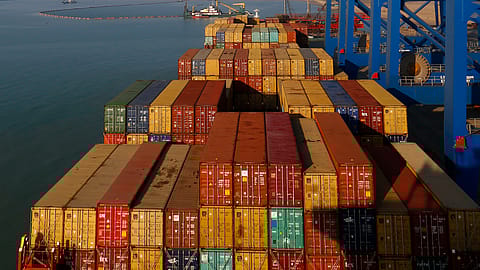
Imports grew 20.6 per cent year-on-year to a three-month high of $73.41 billion in May, widening the trade deficit from a year ago | Credits: Fortune India
India's exports climbed to a six-month high of 18 per cent to $45.2 billion in May, while trade deficit widened to $28.21 billion, driven by increased imports of petroleum products amid higher crude oil prices.
However, the trade deficit narrowed marginally on a month-on-month basis compared to $28.38 billion recorded in April. The trade gap stood at $22.56 billion in May last year.
Imports grew 20.6 per cent year-on-year to a three-month high of $73.41 billion in May, widening the trade deficit from a year ago.
Commerce Secretary Rajesh Agrawal said that despite global geopolitical uncertainties, the country's exports are registering good growth.
The May export numbers are “one of the highest”, he said, adding that going by the trend, this year will be good for exports.
The key drivers of exports include electronic goods (up 11.62 per cent to USD 5.09 billion), petroleum products (up 54.89 per cent to USD 8.42 billion), engineering items (24.48 per cent to USD 12.31 billion) and pharmaceuticals (6.63 per cent to USD 2.62 billion).
However, exports of tea, tobacco, spices, cashew, marine products, leather and textiles recorded negative growth in May.
During April-May 2026-27, exports rose 16.09 per cent to USD 88.91 billion, while imports jumped 15.14 per cent to USD 145.35 billion. The trade deficit stood at USD 56.44 billion during the period.
Gold imports during the first two months of this fiscal year surged 60 per cent to USD 9.04 billion.
Oil imports in May rose 53.8 per cent to USD 22.67 billion due to high prices, which hovered at around USD 100 per barrel in that month. These imports rose 16.5 per cent to USD 41.3 billion during April-May 2026-27.
Similarly, electronic imports were up 35.5 per cent to USD 21.31 billion in May.
{{#most-powerful-women-snapshot-individual.slug}} {{/most-powerful-women-snapshot-individual.slug}} {{^most-powerful-women-snapshot-individual.slug}} {{/most-powerful-women-snapshot-individual.slug}} {{#showRanking}} {{current-rank}} {{/showRanking}} {{#photo.0.url}}
{{name}}
Agrawal said the country's exports to West Asia in May this year have almost reached the level of last May despite disruptions in that region.
India's exports to West Asia in May was marginally down at USD 5.30 billion against USD 5.38 billion in May 2025. India has used three ports (Duqm, Sohar and Salalah) of Oman to push the shipments in that region.
The data comes as US President Donald Trump announced that the US and Iran have finalised a deal to end their 107-day war, which triggered a global energy crisis. The peace agreement is scheduled to be signed on June 19 in Switzerland.
The US-Iran conflict has severely impacted the movement of ships carrying cargoes in international waters, particularly through the Strait of Hormuz.
On the impact of the peace deal, the secretary said, "We hope it's a sustained deal which brings peace in the region...The deal has been in offing for last more than a month, and now that it has come, it should be a deal which can be sustained." The opening of the Strait of Hormuz and peace in the region would be positive for India's trade, he said.
Meanwhile, as per government estimates, services exports stood at USD 36.76 billion in May, and imports were USD 19.06 billion.
Commenting on the data, Federation of Indian Export Organisations (FIEO) President S C Ralhan said the recent diplomatic breakthrough in West Asia, with regard to the emerging peace framework involving the US, Iran and the broader regional stakeholders, is a positive development for global trade, shipping and supply chains.
"The reported reopening of the Strait of Hormuz and the de-escalation of geopolitical tensions are expected to improve the movement of goods, stabilise freight and insurance costs, and enhance predictability in international trade flows, but also for our Indian exporters, thereby further providing a boost to our exports in the coming months as GCC is one of our key markets," he said.
The depreciating Indian rupee is also helping the country's exports. It has depreciated nearly 5 per cent so far this year.
The rupee closed Monday's session 60 paise higher at 94.58 against the US dollar as crude oil prices dropped below USD 83 per barrel following the announcement of the West Asia peace deal
NEXT STORY