Govt committed to meet fiscal deficit target of 4.3% in FY27; macro stability top priority: Finance Ministry
/ 2 min read
MoS Finance Pankaj Chaudhary told the Lok Sabha that the government has also ensured adequate availability of fertilisers and other essential agricultural inputs.
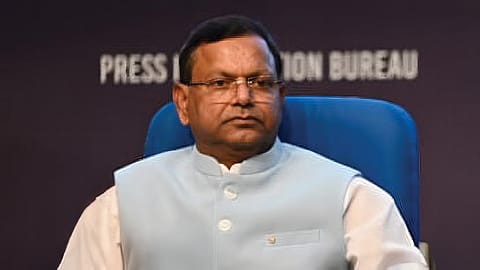
Union Minister of State for Finance Pankaj Chaudhary.
The Finance Ministry today said the government is committed to fiscal deficit target of 4.3% of GDP for the current financial year. The ministry also said moderation in the crude oil prices is likely to ease imported inflation, while adding that macroeconomic stability remains the top priority.
“On the fiscal front, the government remains committed to the budgeted fiscal deficit target of 4.3 per cent of GDP for 2026-27,” minister of state for finance Pankaj Chaudhary today said in a written reply in Lok Sabha.
“However, the government continues to closely monitor evolving global developments and their implications for the Indian economy, and take appropriate policy measures, as warranted, to safeguard macroeconomic stability,” he added.
Chaudhary said the moderation in crude oil prices and easing of global supply chain pressures are expected to reduce imported inflationary pressures, moderate input and logistics costs, and support India's fiscal and inflation outlook. “The Reserve Bank of India has projected Consumer Price Index (CPI) inflation at 5.1 per cent for 2026-27, while noting that the inflation outlook remains subject to upside risks from global commodity price movements and supply chain disruptions,” he added.
“As per Federal Reserve, the Global Supply Chain Pressure Index has declined from 1.84 in April 2026 to 1.25 in June 2026, reflecting an improvement in global supply chain conditions,” he added.
On the measures taken by the government in the wake of the Iran crisis, Chaudhary informed Lok Sabha that the government has adopted a comprehensive and multi-pronged approach to safeguard the economy against external geopolitical uncertainties.
“Energy security has been strengthened through diverse strategies such as diversification of crude oil import sources, expansion of strategic partnerships, augmentation of strategic petroleum reserves, promotion of alternative fuels, domestic production of critical energy inputs, and implementation of coal and lignite gasification scheme,” he said.
“Demand-side initiatives, such as encouraging LPG consumers to shift to PNG, have also been undertaken to optimise energy use. Emergency Credit Line Guarantee Scheme (ECLGS) 5.0 has been introduced. In addition, the government is strengthening trade resilience by expanding its network of Free Trade Agreements and Comprehensive Economic Partnership/Cooperation Agreements,” he added.
Chaudhary said the government has also ensured adequate availability of fertilisers and other essential agricultural inputs through assured gas supplies, diversification of import sources, advance procurement and maintenance of buffer stocks.
NEXT STORY