Govt frontloads record ₹4.51 lakh crore capex by July, highest in five years, as economy grows 7.8%
/ 3 min read
The government spent ₹4.51 lakh crore on capital expenditure during April-July 2026, accounting for a record 36.9% of the full-year Budget Estimate of ₹12.22 lakh crore
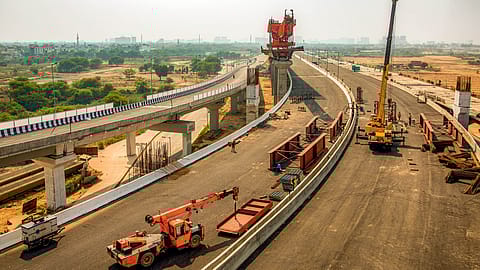
Credits: Sanjay Rawat
The Centre’s record frontloading of capital expenditure in the first four months of FY27 has added weight to the government’s investment-led growth strategy, coming alongside India’s stronger-than-expected 7.8% GDP expansion in the April-June quarter.
According to the estimates of the Controller General of Accounts of India, the government spent ₹4.51 lakh crore on capital expenditure during April-July 2026, accounting for a record 36.9% of the full-year Budget Estimate of ₹12.22 lakh crore. This compares with ₹3.47 lakh crore, or 30.9% of the annual allocation, spent during the corresponding period of FY26.
The pace of spending marks the highest frontloading of capital expenditure in the five-year period covered by the data. By July, the government had utilised 23.5% of its annual capex allocation in FY25, 31.7% in FY24 and 27.8% in FY23.
The sharp increase in public infrastructure spending comes at a time when India’s economy grew 7.8% in the first quarter of FY27, compared with 6.9% in the corresponding period last year. Investment, measured through gross fixed capital formation, rose 11.9% during the quarter, highlighting the growing role of capital formation in supporting economic growth.
With nearly 37% of the annual capex target already utilised by July, the government appears to be frontloading infrastructure spending to support growth amid global economic uncertainties.
India’s economy recorded its fastest first-quarter growth
According to government data, as the economy registered growth of 7.8%, this marks the fastest first-quarter growth in five years in FY27, with a sharp surge in investment and continued strength in the services sector.
A comparison of the revised quarterly GDP series released by the Ministry of Statistics and Programme Implementation (MoSPI) shows that Q1 FY27 growth of 7.8% was the highest among the comparable first-quarter periods from FY23 to FY27.
GDP growth had stood at 6.6% in Q1 FY23, rising to 7.5% in FY24 before moderating to 6.7% in FY25 and 6.9% in FY26.
Investment growth jumps to 11.9%
The sharp acceleration in investment appears to have been one of the biggest drivers of the latest economic growth.
Gross Fixed Capital Formation (GFCF), a key measure of investment in the economy, grew 11.9% in Q1 FY27, sharply higher than the 5.8% growth recorded in the corresponding quarter of the previous financial year.
The latest growth was also the fastest among the comparable five-year periods. GFCF growth had stood at 8% in Q1 FY23, 6.5% in FY24 and 4.9% in FY25, before recovering to 5.8% in FY26.
{{#most-powerful-women-snapshot-individual.slug}} {{/most-powerful-women-snapshot-individual.slug}} {{^most-powerful-women-snapshot-individual.slug}} {{/most-powerful-women-snapshot-individual.slug}} {{#showRanking}} {{current-rank}} {{/showRanking}} {{#photo.0.url}}
{{name}}
The data suggests that India's latest growth acceleration was driven more strongly by investment than consumption.
Private Final Consumption Expenditure (PFCE) grew 7.1% in Q1 FY27, compared with 6.8% in the corresponding quarter last year. While consumption remained robust, the pace of growth was significantly lower than the 11.9% expansion in investment.
The services sector also played a crucial role in powering the economy, with the tertiary sector expanding 10% in Q1 FY27, the fastest growth among the comparable first-quarter periods.
Agriculture growth moderates
Agriculture and allied activities grew 3.6% in Q1 FY27, slower than the 4.4% expansion recorded in the corresponding quarter last year.
Agriculture growth has remained relatively volatile over the past five years, ranging from 2.6% in Q1 FY24 to 4.5% in Q1 FY23.
Follow Fortune India
NEXT STORY