The FAQs are AI-generated, and Fortune India is not responsible for its content or any associated copyright issues.
How Air India and IndiGo are tiding over the fuel hike crisis
/ 3 min read
Indian aviation under strain as fuel costs, rupee weakness and airspace disruptions force capacity cuts and weigh on airline profitability.
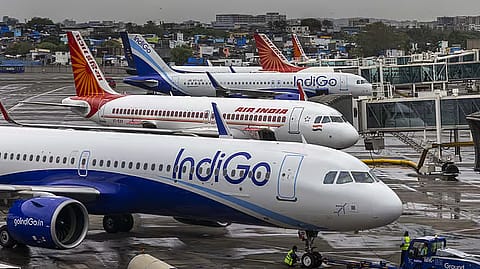
Representational Image | Credits: File photo
It’s been a rough year for India’s airlines. In many ways, mirroring the pandemic.
As with global airlines, India’s airlines are also battling serious fuel price hikes, amid uncertainty in the global economy due to the war in West Asia. But crucially for India’s airlines, it’s also the closure of airspace in various regions, particularly over Pakistan, that has thrown international operations into crisis.
Last month, the Federation of Indian Airlines (FIA), an industry body representing Air India, IndiGo, and SpiceJet, which together account for more than 90% of the domestic market, wrote to the center seeking urgent intervention as the crisis deepened. “The airline industry in India is under extreme stress and is on the verge of closing down or of stopping its operations,” the federation said.
The ongoing crisis has also left India’s airlines gasping for breath. InterGlobe Aviation, the parent of IndiGo, reported a net loss of Rs 2,536 crore for the quarter ended March 31, 2026, on May 29, largely due to a weaker rupee and soaring fuel prices. The company reported net profit of Rs 3,068 crore in the year-ago period. The airline has already announced plans to pass on fuel hikes to passengers.
Already, India’s air passenger traffic is only expected to grow by a tad, between 0% and 3%, during 2025-26, with net losses for the aviation industry pegged at ₹17,000-18,000 crore during FY27. Air India, India’s second-largest airline, has reported a loss of ₹26,000 crore for the last fiscal.
Amidst that, in April 2025, oil companies had hiked ATF prices by more than 115%, with the rates doubling to a record ₹2.07 lakh per kilolitre. Soon after, the government capped the price hike at ₹15 per litre to ensure partial pass-through and avoid a steep rise.
So, what are airlines doing to tide over the ongoing crisis?
Air India
Earlier this month, Air India announced the rationalisation of its services on select international routes between June and August 2026.
“The adjustments have been made in response to a combination of factors, including continued airspace restrictions over certain regions and record-high jet fuel prices for international operations, which significantly impact the commercial viability of certain planned services,” the airline said in a statement. These changes are aimed at improving network stability and reducing last-minute inconvenience to passengers.
The airline will now operate more than 1200 international flights every month from about 2,500 earlier, which includes i33 flights per week to North America, 47 flights per week to Europe, 57 flights per week to the UK, 08 flights per week to Australia, 158 flights per week to the Far East, Southeast Asia and SAARC regions, and 07 flights per week to Mauritius (Africa).
On domestic routes, the airline has temporarily rationalized operations, reducing flight frequencies on select routes between June and August 2026. Since the crisis began unfolding in February, Air India, like other airlines, has been adding a fuel surcharge to fares.
{{#most-powerful-women-snapshot-individual.slug}} {{/most-powerful-women-snapshot-individual.slug}} {{^most-powerful-women-snapshot-individual.slug}} {{/most-powerful-women-snapshot-individual.slug}} {{#showRanking}} {{current-rank}} {{/showRanking}} {{#photo.0.url}}
{{name}}
“In continuation of our previously announced adjustments to select international services between June and August 2026, we have temporarily rationalised operations on certain domestic routes during the same period, with a reduction in frequencies on select routes,” Air India said in a statement.
IndiGo
IndiGo plans to reduce domestic capacity by 5-7 percent. IndiGo has also trimmed international capacity by 17 percent.
“The Middle East developments have had a meaningful impact on our international operations, disrupting flights to the region as well as to Europe,” Gaurav Negi, the chief financial officer of IndiGo, said on May 29. “Together, these markets represent around 18 percent of our total capacity and approximately 160 daily flights, and this weighed on utilization and revenues towards the end of the quarter. On capacity, we were tracking broadly in line with our planned growth trajectory, with capacity going up by around 10% year‑on‑year through January and February.”
But the geopolitical tensions in the Middle East have meant that overall capacity growth for the quarter came in at only 3%, below the initially planned capacity.
In April this year, IndiGo had announced surcharges ranging from ₹900 to ₹10,000 per sector depending on distance and region. The company has not announced a hike since. “For us it is very clear that we need to take fares up to protect ourselves against some of these additional costs that are showing up and for the moment what we are discovering is that the fares are sticking, the demand is there,” Rahul Bhatia, the founder and managing director of IndiGo, said on May 29.
Frequently Asked Questions
NEXT STORY