India flags US 100% tariff threat, warns of impact on bilateral ties and global energy market
/ 2 min read
India flags concerns over Washington’s new sanctions law, warning that higher tariffs could strain bilateral ties and disrupt the international energy market.
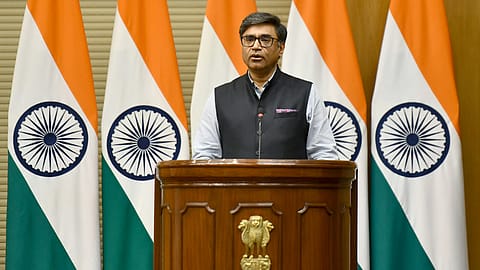
Foreign Secretary Vikram Misri | Credits: PIB
India has conveyed its concerns to a visiting US Congressional delegation over Washington’s move that could pave the way for tariffs of up to 100% on countries purchasing Russian oil, with the Ministry of External Affairs (MEA) warning of potential implications for bilateral ties and the international energy market.
MEA spokesperson Randhir Jaiswal said Foreign Secretary Vikram Misri raised the issue during his meeting with the bipartisan US Congressional delegation led by Brian Mast, Chairman of the US House Foreign Affairs Committee. The meeting took place in New Delhi on Sunday amid heightened uncertainty over the impact of the newly enacted US sanctions legislation.
“As we have told you, the US Congressional delegation that is here had a meeting with the Foreign Secretary. During that meeting, among other issues, the Foreign Secretary reiterated to them our concerns regarding what we believe could be the impact of this on our bilateral relations, as well as the impact it could have on the energy situation in the international market,” Jaiswal said.
India raises concerns over new US sanctions law
The discussions assume significance after US President Donald Trump signed the Lindsey O Graham Sanctioning Russia and Iran Act of 2026 into law. The legislation gives the US President the authority to impose tariffs of up to 100% on countries that continue to purchase Russian oil and gas under specified conditions. India and China are among the major buyers of Russian energy.
However, the legislation does not automatically trigger a 100% tariff on Indian exports. Any such measure would depend on the US administration invoking the provisions of the law.
Energy security remains key concern
For New Delhi, the issue is closely linked to energy security, given India's dependence on imported crude and its significant purchases of Russian oil. India has maintained that its energy sourcing decisions are guided by market dynamics and the need to ensure secure and affordable supplies.
The government had earlier said it would take all necessary measures to protect its trade and economic interests while continuing to diversify its energy sourcing.
India-US ties face fresh trade uncertainty
The latest development adds another layer of uncertainty to India-US economic relations, as Washington's tariff measures could have implications for Indian exporters if additional duties are eventually imposed.
The US is India's largest export destination, with Indian goods exports to the country rising to $42.79 billion during April-August, compared with $40.39 billion in the year-ago period, as per industry estimates.
The Congressional delegation's discussions with Misri also covered energy security, counter-terrorism, freedom of navigation and the broader trajectory of India-US relations, according to the MEA.
Follow Fortune India
NEXT STORY