India manufacturing PMI slips to 53.5 in July, lowest since August 2021 as growth moderates
/ 2 min read
Growth in overall sales, input purchases, and employment moderated during the month.
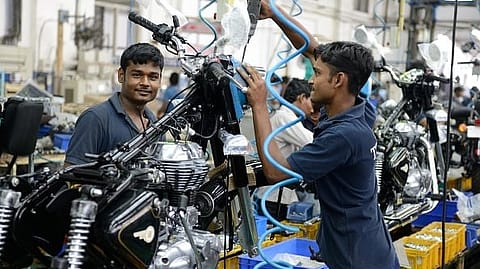
New export orders emerged as a bright spot, rising at a faster pace amid improved demand from overseas markets. | Credits: Getty Images
India's manufacturing sector continued to expand in July, supported by resilient domestic demand and stronger export orders, although the pace of growth eased to its weakest level in nearly four years, according to the latest HSBC India Manufacturing Purchasing Managers' Index (PMI).
The seasonally adjusted HSBC India Manufacturing PMI slipped to 53.5 in July from 54.2 in June, marking the lowest reading since August 2021 and falling below the long-term series average of 54.2. A reading above 50 indicates expansion in manufacturing activity.
The survey showed that manufacturers continued to benefit from resilient demand, with sustained growth in new orders supporting another increase in production. However, growth in overall sales, input purchases, and employment moderated during the month.
New export orders emerged as a bright spot, rising at a faster pace amid improved demand from overseas markets. Survey respondents cited stronger orders from Canada, Egypt, Indonesia, Kenya, Nepal, South Africa, Thailand, and the UAE.
Despite remaining in expansion territory, growth in new business was the second-slowest in more than four years, with firms attributing sales gains to advertising efforts and resilient demand. However, increasingly challenging market conditions and weaker customer interest for key products weighed on overall momentum.
Manufacturing output continued to rise in July, although the pace of expansion remained among the softest since mid-2022. Consumer goods producers recorded noticeably weaker growth in both output and new orders, while intermediate and capital goods manufacturers posted relatively stronger performances.
Manufacturers also continued to rebuild inventory buffers by increasing purchases of inputs, although the pace of input buying slowed to a 31-month low. Supply chain conditions improved significantly during the month, with supplier delivery times shortening at one of the fastest rates recorded in the survey's history. This helped firms increase inventories of both purchased inputs and finished goods, with post-production stock levels recording the strongest rise in more than 11 years.
Employment growth weakened for the third consecutive month, with job creation slowing to the weakest pace in the current 29-month period of uninterrupted hiring. Outstanding business increased only marginally, although the pace of backlog accumulation was the strongest in a year.
On the inflation front, input cost pressures eased to a five-month low despite higher transportation costs. Manufacturers continued to raise selling prices at a moderate pace, broadly in line with June.
Business confidence improved modestly from June's recent low as firms remained optimistic about stronger demand, infrastructure spending and new client enquiries. Many companies also expressed hope that improving market conditions and ongoing marketing initiatives would support future growth.
Pranjul Bhandari, Chief India Economist at HSBC, said easing supplier delivery times indicate that supply chain disruptions continue to unwind, although renewed tensions in the Middle East have created uncertainty over the sustainability of these improvements.
{{#most-powerful-women-snapshot-individual.slug}} {{/most-powerful-women-snapshot-individual.slug}} {{^most-powerful-women-snapshot-individual.slug}} {{/most-powerful-women-snapshot-individual.slug}} {{#showRanking}} {{current-rank}} {{/showRanking}} {{#photo.0.url}}
{{name}}
She said that manufacturers are rebuilding inventories of both raw materials and finished goods to reduce exposure to potential supply disruptions. At the same time, resilient output growth and stronger export orders point to healthy overseas demand. While input cost inflation moderated, output price inflation picked up, suggesting firms are increasingly passing on higher costs to protect margins.
NEXT STORY