The FAQs are AI-generated, and Fortune India is not responsible for its content or any associated copyright issues.
India-UK FTA needs stronger arbitration architecture, says Chief Justice Surya Kant
/ 4 min read
India has described it as its most comprehensive trade deal so far, with New Delhi saying nearly 99% of Indian exports to the UK will get zero-duty access, while India will reduce or eliminate tariffs on 90% of UK tariff lines, with 85% becoming tariff-free over a decade.
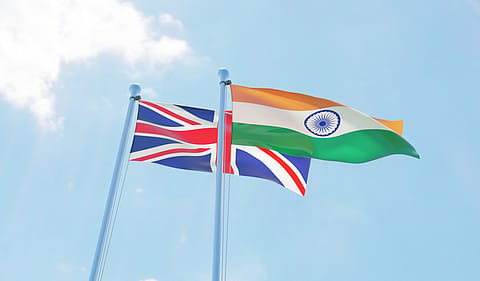
The country has received $35.3 billion in Foreign Direct Investment (FDI) from April 2000 and September 2024. | Credits: Getty Images
Chief Justice of India Surya Kant on Friday said that the India-UK free trade agreement will need a far stronger arbitration and mediation framework if its commercial promise is to be realised, saying trade ambition cannot rest on tariff schedules and investment announcements alone. Speaking at the Indian Council of Arbitration’s conference on “Arbitrating Indo-UK Commercial Disputes” in London, Kant said the agreement is expected to raise bilateral trade by an estimated $34 billion a year in the near future, but cautioned that “ambitions are realised in contracts, not in communiqués.”
“The Indo-UK economic partnership cannot be strengthened by trade agreements, tariff schedules, and investment announcements alone. It also needs an ADR architecture that converts commercial confidence into day-to-day practice,” Kant said. He added that a trade corridor becomes meaningful only when businesses know they will not be “priced out, delayed out, forced into a process they had no real power to choose” if a dispute arises.
Kant’s central message was that the next wave of Indo-UK commerce will come not only from large groups, but increasingly from “pharmaceutical suppliers, fintech firms, clean energy businesses, digital platforms, and mid-market manufacturers on both sides.” If ADR systems remain too expensive or cumbersome for such businesses, he warned, “that might fail the very commercial partnership that are meant to support,” calling for an “equal level playing field for all.”
What the India-UK deal covers
The India-UK FTA was concluded in May 2025 and signed in July 2025 after about three years of stop-start negotiations. India has described it as its most comprehensive trade deal so far, with New Delhi saying nearly 99% of Indian exports to the UK will get zero-duty access, while India will reduce or eliminate tariffs on 90% of UK tariff lines, with 85% becoming tariff-free over a decade.
The tariff cuts include politically sensitive sectors. India agreed to reduce duties on British whisky from 150% to 75% initially and then to 40% over ten years, while automobile tariffs above 100% are to be cut to 10% under a quota system. In return, sectors such as textiles, footwear, marine products, gems and jewellery, engineering goods, auto parts and organic chemicals are among those expected to benefit on the Indian side. Sensitive agricultural items such as dairy and some farm products remain outside the duty-concession framework.
The deal also goes beyond goods. It opens wider access in services, including IT, financial services, professional services and education, and includes a Double Contribution Convention under which Indian workers temporarily posted to the UK and their employers are exempt from paying UK social security contributions for three years. Officials have said this could save around 20% of salary costs and benefit more than 60,000 Indian IT employees alone, while employer savings could exceed ₹4,000 crore.
Why ADR is becoming central
That is why Kant pressed not just for bigger arbitration centres, but for more practical reforms. He proposed a joint Indo-UK arbitrator accreditation and cross-training programme to create a pool of practitioners fluent in both systems. He also called for a swift protocol for technology licensing disputes, fintech partnership breakdowns and similar cross-border cases, with capped fees, documentary procedures, online hearings where appropriate, a short mediation window and a defined timetable for final determination.
Kant also made the case for linking arbitration with mediation through hybrid mechanisms, especially where disputes arise within continuing commercial relationships such as joint ventures, distribution networks, technology partnerships and infrastructure contracts. “The best outcome is often not a winning award but a preserved commercial relationship,” he said, adding that protocols must be “properly safeguarded for confidentiality and impartiality.”
Other speakers at the conference broadened that message. Sir Geoffrey Vos, Master of the Rolls and Head of Civil Justice of England and Wales, spoke about the changing role of technology and artificial intelligence in dispute resolution and stressed the need to preserve trust, fairness and efficiency in legal systems.
Kartik Pande, India’s Deputy High Commissioner to the UK, said the Indian government remains fully committed to promoting ADR for faster dispute resolution. Brett Dixon, vice president of The Law Society of England and Wales, emphasised legal cooperation, institutional engagement and effective dispute resolution as critical to business confidence and commercial partnerships.
N.G. Khaitan, president of the Indian Council of Arbitration and senior partner at Khaitan & Co, said global investors have placed trust in India as one of the safer places to do business and stressed the need to promote arbitration for quicker resolution of commercial disputes. Arun Chawla, director general of ICA, described arbitration as a “silent infrastructure of growth,” adding that both India and the UK are investing in strengthening their arbitration ecosystems.
{{#most-powerful-women-snapshot-individual.slug}} {{/most-powerful-women-snapshot-individual.slug}} {{^most-powerful-women-snapshot-individual.slug}} {{/most-powerful-women-snapshot-individual.slug}} {{#showRanking}} {{current-rank}} {{/showRanking}} {{#photo.0.url}}
{{name}}
India’s wider FTA strategy
Kant’s remarks also sit within a much broader trade-policy shift. The government said in March that India now has nine FTAs spanning 38 countries, beginning with Mauritius in 2021 and followed by the UAE CEPA in 2022, the Australia ECTA in December 2022, the EFTA trade pact signed in March 2024 and entering into force in October 2025, the UK deal in July 2025, Oman in December 2025, New Zealand in December 2025 and the India-EU FTA negotiations concluding on January 27, 2026.
The EU agreement is especially relevant because it would give India another major trade corridor with a developed market bloc. The European Commission says the EU is India’s largest trading partner, with goods trade worth about €120 billion, and that the agreement could eliminate or reduce tariffs on more than 96% of EU goods exports to India while potentially doubling EU goods exports to India by 2032.
Follow Fortune India
Frequently Asked Questions
NEXT STORY