Indian economy remains resilient despite global shocks; Govt committed to macro stability: Shaktikanta Das
/ 2 min read
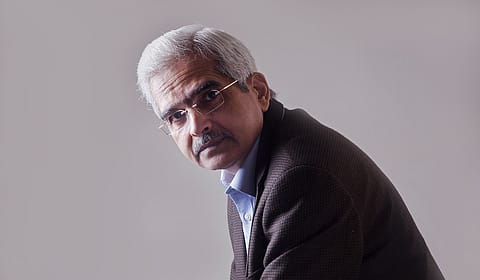
Shaktikanta Das | Credits: Sanjay Rawat
Indian economy remains resilient despite global shocks; Govt committed to macro stability: Shaktikanta Das
Shaktikanta Das emphasised India's economic resilience amid global challenges, highlighting the government's commitment to macroeconomic stability. Despite global shocks like the pandemic and Ukraine conflict, India remains the fastest-growing major economy, contributing significantly to global GDP growth. Prudent monetary policies have curbed inflation, and fiscal consolidation is progressing, ensuring future economic stability.
This summary is AI-generated, and Fortune India is not responsible for its content or any associated copyright issues.
India is projected to contribute about a fifth of the global GDP growth in the current fiscal, says Das.
Shaktikanta Das | Credits: Sanjay Rawat
Shaktikanta Das, Principal Secretary-2 to Prime Minister Narendra Modi, has said the Indian economy continues to remain resilient amid multiple and overlapping global shocks, and the government has a "rock solid" commitment to macroeconomic and financial sector stability.
"Our idea of Aatma Nirbharta is based on a tripod of stability, reforms, and some schemes that address certain structural gaps in our economy," Das said in his address at the inaugural Bibek Debroy Memorial Lecture in New Delhi today.
"For a little over one decade, India has maintained a rock-solid commitment to macroeconomic and financial sector stability. And this stability is the bedrock on which our growth story is based," Das, who was earlier Governor of the Reserve Bank of India, added.
"In fact, despite multiple and overlapping global shocks like Covid-19 pandemic, conflict in Ukraine, and other such flash points which disrupted economic activity and trade and led to high inflation, high public debt, low growth and synchronised monetary policy tightening the world over, the Indian economy remains resilient and is expected to be the fastest-growing major economy in the world," he said.
Das said India is projected to contribute about a fifth of the global GDP growth in the current fiscal. "In 2025-26, real GDP is projected to grow by 7.4% as per the projections of the National Statistics Office (NSO). Further, India is projected to contribute around 18% to the global GDP growth in 2025-26," he said.
Pointing to inflation, which touched an all-time low of 0.25% in October 2025, Das said it was the impact of the "prudent" monetary and supply side measures.
"Further, inflation has been brought under control with prudent monetary and supply side measures. When the global commodity prices spiked post the supply shocks due to the war in Ukraine, India responded with resolute monetary tightening and supply side measures. As a result, inflation has now sharply declined. Such low inflation has provided major relief to the consumers and supports economic stability and growth," Das added.
Das said fiscal consolidation is progressing well and will provide headroom for counter-cyclical measures in the future. "Fiscal consolidation is also progressing well with the central government's fiscal deficit falling from 9.2% in 2020-21 to 4.8% in 2024-25," he said.
"General government debt-to-GDP ratio declined to 81.6% in 2024-25 from the peak of 88.4% in 2020-21," Das said, adding that during the pandemic, governments across the world resorted to monetary and fiscal expansion.
He pointed out that what distinguishes India with regard to both monetary and fiscal expansion is that the country was able to roll it back in time and that makes it different from other countries. "As a result of this, today the Indian economy remains very stable from the macroeconomic point of view as well as the stability point of view," he said adding that this commitment to fiscal prudence is restoring headroom for future counter-cyclical policies and keeping public debt level sustainable.
Follow Fortune India
NEXT STORY