India’s industrial output rises to 5.1% in May on strong electricity demand; capital goods growth accelerates
/ 3 min read
According to MoSPI, industrial growth was led by a 5.5% expansion in manufacturing and a sharp 9.9% rise in electricity and gas supply.
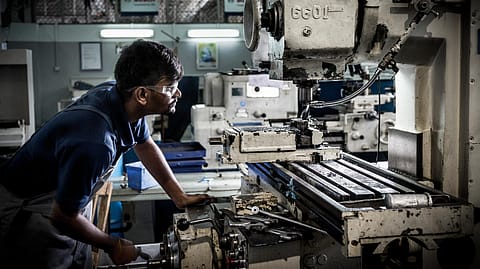
Manufacturing grew 5.5% while water supply, sewerage, and waste management recorded growth of 5.5%. | Credits: Narendra Bisht
India’s industrial output growth edged up to 5.1% year-on-year in May 2026 from 4.9% in April, supported by strong growth in electricity and gas supply and steady manufacturing activity, according to data released by the National Statistics Office (NSO) on Monday.
The latest reading marks the second monthly Index of Industrial Production (IIP) release under the revised base year series of 2022–23.
According to the Ministry of Statistics and Programme Implementation (MoSPI), industrial growth was led by a 5.5% expansion in manufacturing and a sharp 9.9% rise in electricity and gas supply. “In May 2026, the Index of Industrial Production recorded a 5.1% year-on-year growth, supported by 5.5% growth in the manufacturing sector and strong growth of 9.9% in the electricity and gas supply sector,” the NSO said.
The Quick Estimate of IIP stood at 122.7 in May 2026 compared with 116.7 in the corresponding month last year.
Sector-wise, mining and quarrying continued to remain under pressure and contracted 1.6% during the month. Manufacturing grew 5.5% while water supply, sewerage, and waste management recorded growth of 5.5%.
The IIP release also reflects methodological changes introduced under the new industrial series.
MoSPI launched the revised IIP series with base year 2022–23 earlier this month using the Wholesale Price Index (WPI) as the deflator. Subsequently, the Department for Promotion of Industry and Internal Trade (DPIIT) introduced the Output Producer Price Index (Output PPI), which is now being incorporated into industrial output calculations and is expected to influence future growth estimates and revisions.
Within manufacturing, 16 out of 23 industry groups recorded positive growth in May. The strongest contributors included: manufacture of motor vehicles, trailers and semi-trailers: 14.5%, manufacture of electrical equipment: 20.8%, and manufacture of basic metals: 4.6%.
Passenger cars, auto components, and commercial vehicles supported growth in the automobile segment, while electrical equipment was driven by demand for switchgear, transformers and power management systems. In metals, products such as hot-rolled steel coils, plates and alloy steel bars contributed to output expansion.
Use-based classification data showed broad-based improvement across investment and consumption-linked categories.
Capital goods emerged as the fastest-growing segment with a 12.9% expansion, signalling continued investment activity. Intermediate goods grew 5.8%, infrastructure and construction goods rose 5.9%, while consumer durables and consumer non-durables expanded 7.2% and 3.6%, respectively. Primary goods registered a relatively modest growth of 2.6%.
{{#most-powerful-women-snapshot-individual.slug}} {{/most-powerful-women-snapshot-individual.slug}} {{^most-powerful-women-snapshot-individual.slug}} {{/most-powerful-women-snapshot-individual.slug}} {{#showRanking}} {{current-rank}} {{/showRanking}} {{#photo.0.url}}
{{name}}
Dipti Deshpande, Principal Economist, Crisil Ltd, said, "Industrial growth, as measured by the Index of Industrial Production (IIP), grew to 5.1% in May from 4.9% in April, above the fiscal 2026 average of 4.3%. Electricity growth surged to 11.1% (vs 5.5%), led by higher demand amid heatwaves. Domestic demand remained resilient, with the consumer sectors clocking a cumulative growth of 5.1% (vs 2.5%). High-frequency data shows urban demand was the driver of domestic demand. However, manufacturing growth moderated to 5.5% (vs 6.1%) as industrial production in segments such as coke and petroleum was impacted by the West Asia conflict."
She said, "We expect industrial production to turn somewhat softer in the coming months. Manufacturing and construction face high-cost pressure on key imported inputs. Even if shipping resumes through the Strait of Hormuz, repairs to the damaged oil and gas infrastructure in West Asia will take time and elevated war risk premiums, among other factors, would keep pressure on input costs. Another significant risk to industry is the forecast of a below-normal monsoon, which could dampen rural demand. The all-India rainfall has been 42% below normal until June 29. Against this backdrop, we expect gross domestic product (GDP) growth to slow to 6.6% this fiscal from 7.7% last fiscal."
Rahul Agrawal, Principal Economist at ICRA, said the improvement in headline industrial growth was largely driven by electricity generation amid elevated temperatures and a favourable base effect.
He said that electricity alone contributed nearly 57 basis points to the increase in headline IIP between April and May. However, Agrawal pointed out that manufacturing growth moderated to 5.5% from 6.1% in April despite a supportive base, with 15 of 23 manufacturing sub-segments witnessing slower momentum.
Mining output, meanwhile, contracted for the fifth consecutive month, although the pace of decline moderated. Agrawal added that the shift from WPI to Output PPI as the deflator for a large portion of the IIP basket could materially alter growth trends across sectors and may also have implications for future GDP revisions.
According to Nirmal K. Minda, President, ASSOCHAM, growth in key industries such as motor vehicles, electrical equipment, and basic metals further supported the positive industrial momentum, said Mr.
"Overall, the latest IIP data indicates resilient industrial momentum, driven by strong manufacturing and investment-led sectors. Going forward, sustaining this growth trajectory will require continued policy support to strengthen industrial capacity, accelerate private investment, and address the weakness in mining output to ensure broad-based and durable industrial growth during FY 2026–27," stated Minda.
Follow Fortune India
NEXT STORY