India's middle class to drive 93% of spending; 500 cities to emerge as new growth hubs: Sitharaman
/ 2 min read
Citing an OECD study, the finance minister said India is expected to overtake China in terms of the size of its middle-class population between 2030 and 2035, aided by policy measures aimed at boosting incomes and financial inclusion.
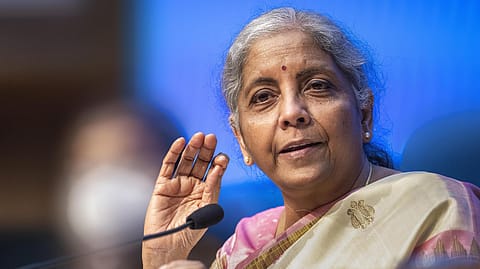
Nirmala Sitharaman, Union Minister for Finance and Corporate Affairs | Credits: Narendra Bisht
India's middle class will account for 93% of the country's consumer spending and nearly 500 cities are set to emerge as new centres of economic activity, Finance Minister Nirmala Sitharaman said on Friday, stressing the growing role of smaller cities in driving economic growth.
Speaking at a panel discussion on "How to promote the rise of a new middle class" at the Rencontres Economiques d'Aix-en-Provence in France, Sitharaman said the middle class now constitutes about 31% of India's population and has been expanding at an annual rate of 6.3% since the country's economic liberalisation.
Middle class to power India's consumption story
"We think 93% of all spending in India will be because of the middle class or the slightly affluent consumers," Sitharaman said, adding that the country's middle class is no longer concentrated in metropolitan centres but is increasingly spread across tier-II and tier-III cities.
"This has resulted in wealth distribution spreading beyond metropolitan cities. We see the middle class not just as beneficiaries of growth, but actually as the engines of growth. It is their consumption which is making the economy grow," she said.
Citing an OECD study, the finance minister said India is expected to overtake China in terms of the size of its middle-class population between 2030 and 2035, aided by policy measures aimed at boosting incomes and financial inclusion.
Nearly 500 cities emerging as new economic hubs
Highlighting India's post-pandemic growth trajectory, Sitharaman said the country continues to remain the world's fastest-growing major economy, driven largely by domestic consumption.
She added that nearly 500 cities are poised to emerge as the country's next centres of economic activity, reflecting the broadening of economic growth beyond traditional metropolitan regions.
According to the minister, government initiatives such as financial inclusion, GST rate rationalisation, collateral-free loans for small businesses and the Pradhan Mantri Awas Yojana are helping expand the size of India's middle class.
Government betting on AI-led skilling
Addressing concerns over artificial intelligence replacing jobs, Sitharaman said the government is investing heavily in AI-focused skilling initiatives to prepare the workforce for emerging opportunities.
"AI skilling camps are being organised in partnership with the private sector at the district level," she said, adding that continuous upskilling is enabling the middle class to benefit from India's evolving digital economy.
MSMEs, GCCs driving the next phase of growth
Highlighting the growing role of small businesses, Sitharaman said micro, small and medium enterprises contribute nearly 40% of India's exports and are increasingly adopting AI-driven business models while seeking skilled professionals with expertise in AI solutions.
{{#most-powerful-women-snapshot-individual.slug}} {{/most-powerful-women-snapshot-individual.slug}} {{^most-powerful-women-snapshot-individual.slug}} {{/most-powerful-women-snapshot-individual.slug}} {{#showRanking}} {{current-rank}} {{/showRanking}} {{#photo.0.url}}
{{name}}
She also pointed to India's emergence as a preferred destination for Global Capability Centres (GCCs) and data centres, saying companies continue to expand operations in the country because of its large pool of skilled talent capable of supporting AI-led growth and digital transformation.
NEXT STORY