The FAQs are AI-generated, and Fortune India is not responsible for its content or any associated copyright issues.
India’s office realty boom faces funding crunch as $2.3 billion dry powder covers only 14% of demand: Knight Frank India
/ 2 min read
Knight Frank India says institutional capital is struggling to keep pace with record office demand, widening the supply gap across the country’s commercial real estate market
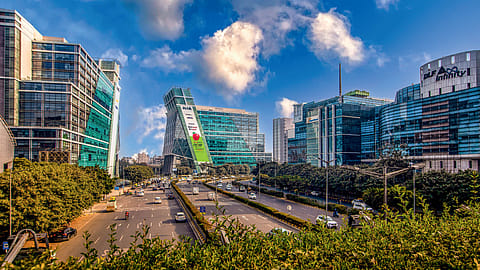
A view of a multinational corporate office complex in India, reflecting sustained demand growth in the country’s commercial real estate sector. | Credits: Photograph by Sanjay Rawat
India’s commercial real estate market may be witnessing record occupier demand, but a shortage of deployable institutional capital is emerging as the sector’s biggest growth bottleneck.
According to a new report by Knight Frank India, just US$ 2.3 billion in deployable “dry powder” remains available with real estate-focused Alternative Investment Funds (AIFs)—an amount that can support only around 12.2 million sq. ft. of office development. That translates to barely 14% of India’s annual office demand, which hit 86.4 million sq. ft. in 2025.
Demand is surging faster than developers can build
The report, India Real Estate Investment—AIFs, Platforms and the Funding Gap, highlights how occupier demand is now consistently outpacing fresh supply across India’s top office markets. Between 2021 and 2025, real estate-focused AIFs received capital commitments worth US$ 14.5 billion.
However, only US$ 7.9 billion was actually raised, while nearly USD 5.7 billion has already been deployed. The result is a tightening development pipeline at a time when India’s office leasing momentum remains among the strongest in the Asia-Pacific region.
Over the last five years, office transactions across the country’s top eight cities touched 307.7 million sq. ft., significantly ahead of the 236.1 million sq. ft. of new supply delivered during the same period. Consequently, the office supply-to-demand ratio has dropped sharply from 1.40 in 2008 to just 0.63 in 2025—the lowest level recorded so far.
India’s office market remains deeply undercapitalised
The funding imbalance becomes even sharper in comparison with other APAC markets. Knight Frank’s analysis shows India has institutional capital availability of just US$ 23.2 per sq. ft. of office demand, compared with US$ 604.9 in Japan, US$ 2,240.2 in Singapore, and US$ 5,711.5 in Australia.
“India’s commercial real estate has entered a phase where occupier demand is outpacing the availability of institutional capital,” said Shishir Baijal, chairman and managing director at Knight Frank India.“At a time when India recorded over 86 million sq. ft. of office demand and more than 72 million sq. ft. of warehousing demand, the available dry powder can support barely a fraction of future supply creation,” he added.
The real estate opportunity now lies in bridging the capital gap
Baijal said the widening mismatch between demand and capital availability is also creating a long-term investment opportunity for domestic and global investors looking at India’s commercial real estate sector.
The consultancy believes expanding domestic institutional participation, broadening India’s REIT market, and simplifying tax structures for foreign investors could help unlock deeper capital flows into commercial real estate.
Follow Fortune India
Frequently Asked Questions
NEXT STORY