India's retail inflation rises to 4.38% in June, breaches RBI's 4% target
/ 3 min read
Food inflation also picked up, with the Consumer Food Price Index rising 5.32% year-on-year in June.
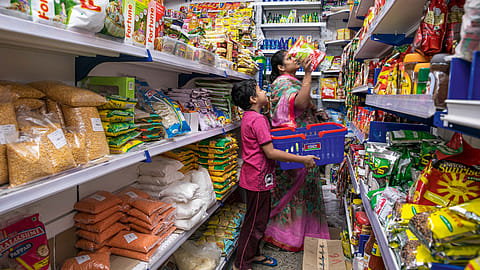
Within the CPI basket, the food and beverages category registered inflation of 5.05%, while restaurants and accommodation services recorded 6.91%. | Credits: Fortune India
India's retail inflation, measured by the Consumer Price Index (CPI), accelerated to 4.38% in June 2026, up from 3.93% in May, breaching the Reserve Bank of India's (RBI) medium-term target of 4%, according to provisional data released by the Ministry of Statistics and Programme Implementation (MoSPI) on Monday.
The latest reading marks a return above the RBI's inflation target after headline inflation remained below 4% in May. The central bank is mandated to keep inflation at 4%, with a tolerance band of 2 percentage points on either side. Retail inflation in rural areas stood at 4.74%, compared with 3.92% in urban India.
Food inflation
Food inflation also firmed up, with the Consumer Food Price Index (CFPI) rising 5.32% year-on-year in June. Rural food inflation came in at 5.45%, while urban food inflation was 5.09%.
Housing inflation
Housing inflation remained relatively muted at 2.10%, with rural and urban housing inflation recorded at 2.66% and 1.90%, respectively.
Within the CPI basket, the food and beverages category registered inflation of 5.05%, while restaurants and accommodation services recorded 6.91%. Inflation in personal care, social protection and miscellaneous goods and services remained elevated at 16.72%.
Among individual food items, ginger recorded the sharpest annual price increase, with inflation surging to 50.41% in June from 32.50% in May. Tomato prices rose 31.92% year-on-year, while inflation in raisin (kishmish) and monacca stood at 20.52%.
Commenting on the inflation print, Aditi Nayar, Chief Economist at ICRA Ltd, said the June CPI inflation was marginally higher than the rating agency's estimate of 4.3%, driven by higher prices in the food and beverages, transport, and restaurants segments.
"Inflation in food and beverages crossed the 5% mark for the first time in the new CPI series in June 2026, amid a steep rainfall deficit of 40%," Nayar said. She noted that retail food prices have continued to harden in July, reflecting seasonal trends, and that most food items have seen a sequential increase in year-on-year inflation.
ICRA expects food inflation to edge up further in July, with the food and beverages component likely to rise above June's 5.1%. Higher fuel prices could also feed into broader inflation through increased transportation and input costs, pushing headline CPI inflation to around 4.6% in July, she said.
Nayar, however, said the narrowing rainfall deficit by July 12 due to improved monsoon activity is a positive development for the ongoing kharif season. Adequate rainfall during July and August remains critical, as the two months account for the bulk of seasonal rainfall and sowing of key crops such as pulses, oilseeds and coarse cereals. On monetary policy, ICRA expects the RBI's Monetary Policy Committee (MPC) to maintain the status quo on interest rates in its August meeting.
Dipti Deshpande, Senior Director and Principal Economist, Crisil Ltd, said, "India’s retail inflation crossed the 4% mark for the first time since January 2025, with CPI inflation rising to 4.4% in June from 3.9% in May. While both food and non-food components contributed to the increase, the latter had a larger impact. Food inflation contributed 185 basis points (bps) to headline while non-food inflation contributed 250 bps. Within food, apart from a fading favourable base effect, high summer temperatures continued to normalise food inflation from the records low levels seen earlier. Looking ahead, uneven rainfall so far, a below-normal monsoon forecast, and the onset of El Niño conditions could put pressure on food prices. Crisil’s Deficient Rainfall Impact Parameter also indicates building stress across most crops barring coarse cereals, soybean, and sugarcane. However, ample buffer stocks and timely policy intervention should help tame sharp spikes in food inflation."
{{#most-powerful-women-snapshot-individual.slug}} {{/most-powerful-women-snapshot-individual.slug}} {{^most-powerful-women-snapshot-individual.slug}} {{/most-powerful-women-snapshot-individual.slug}} {{#showRanking}} {{current-rank}} {{/showRanking}} {{#photo.0.url}}
{{name}}
According to Deshpande, on the non-food side, although global crude oil prices have eased from recent peaks, they remain significantly higher year-on-year. "Crisil Intelligence expects Brent crude prices to average $82–87 per barrel this fiscal, roughly 20% higher than a year ago. Higher domestic fuel prices are also likely to exert broader inflationary pressure as rising input and transportation costs are passed through the economy. It is also important to note that the disinflationary support from GST rationalisation measures is likely to persist only until the end of the current quarter," she said.
Rajeev Sharan, Head of Research, Brickwork Ratings, said, "India's headline CPI inflation rose to 4.38% in June 2026 from 3.93% in May, still within the RBI's tolerance band but marking a third straight month of acceleration. Geopolitical tensions and earlier crude oil volatility added to imported cost pressures, though this effect now appears to be moderating. Over the next two quarters, inflation is likely to remain range bound at 4-4.5%, with food as the key swing factor amid uneven monsoon progress and El Niño-linked rainfall variability. Upside risks stem from a potential crude rebound and sustained bullion strength while a favourable monsoon could ease food prices and support continued RBI accommodation."
NEXT STORY