July rains revive kharif sowing, but weak August monsoon poses risk to FY27 farm growth: ICRA
/ 2 min read
Despite weaker crop prospects, ICRA retained its FY27 agriculture, forestry, and fishing GVA growth estimate at around 1.2%, compared with 3% growth in FY26.
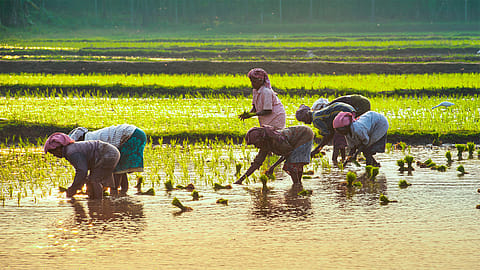
The stronger rainfall in July sharply reduced the year-on-year decline in kharif sowing to around 3% as of July 31 from nearly 23% at the end of June. | Credits: Shutterstock
A sharp recovery in rainfall during July has helped narrow the deficit in kharif sowing, but below-normal monsoon forecasts for August continue to pose risks to crop output and agricultural growth in FY27, according to ICRA.
After a severe rainfall deficit of just 60% of the long period average (LPA) in June 2026, the weakest in 12 years, India received above-normal rainfall of 103% of the LPA in July, significantly exceeding the India Meteorological Department's (IMD) forecast of below-normal rainfall for the month. Despite the improvement, cumulative rainfall during June-July remained deficient at 87% of the LPA.
The stronger rainfall in July sharply reduced the year-on-year decline in kharif sowing to around 3% as of July 31 from nearly 23% at the end of June. However, ICRA expects total kharif acreage to decline by 1-2% this year, as sowing during the remainder of the season would need to rise by over 13% year-on-year to match last year's final acreage of 112.1 million hectares.
August rainfall remains critical
The ratings agency flagged IMD's forecast of below-normal rainfall (less than 94% of LPA) in August as a key concern, noting that the month accounts for nearly 29% of India's southwest monsoon rainfall and about one-fifth of total kharif sowing.
ICRA estimates that if rainfall during August-September comes in at 93% of the LPA—the upper end of IMD's forecast—the overall southwest monsoon rainfall for 2026 would end at around 90% of the LPA, in line with the lower end of IMD's second long-range forecast issued in May.
Pulses, coarse cereals remain most affected
The recovery in sowing has been uneven across crops. Acreage under pulses and coarse cereals remained 6-8% lower year-on-year at the end of July while rice and cotton registered relatively modest declines of 2.2% and 2.4%, respectively. In contrast, sugarcane and oilseeds recorded an increase in acreage over the previous year.
ICRA noted that pulses and coarse cereals remain the most vulnerable to weak monsoons because of lower irrigation coverage compared with crops such as rice and sugarcane.
Maharashtra, Karnataka lag in sowing
The improvement in sowing has also been uneven across states. As of July-end, kharif acreage remained significantly lower in Maharashtra (-8%), Karnataka (-26%), and Odisha (-12%), which together account for nearly a quarter of India's total kharif cultivation.
The agency said adequate rainfall in these states during August would be crucial not only for improving kharif output but also for replenishing reservoirs ahead of the rabi season.
Reservoir levels improve but remain below last year
Reservoir storage improved to 44% of full reservoir level (FRL) by July 30, up from 26% at the end of June, aided by stronger July rainfall. However, storage remained well below the 68% recorded during the corresponding period last year, though only marginally lower than the historical average of 48%.
ICRA warned that below-normal rainfall during the remainder of the monsoon could limit further reservoir replenishment, potentially affecting rabi crop prospects.
{{#most-powerful-women-snapshot-individual.slug}} {{/most-powerful-women-snapshot-individual.slug}} {{^most-powerful-women-snapshot-individual.slug}} {{/most-powerful-women-snapshot-individual.slug}} {{#showRanking}} {{current-rank}} {{/showRanking}} {{#photo.0.url}}
{{name}}
Agriculture GVA growth seen at 1.2% in FY27
Despite weaker crop prospects, ICRA retained its FY27 agriculture, forestry and fishing gross value added (GVA) growth estimate at around 1.2%, compared with 3% growth in FY26.
The agency expects the non-crop segments—including livestock, forestry, and fishing—to continue supporting overall agricultural growth, as seen during previous El Niño years when crop output weakened but broader agricultural GVA remained relatively resilient. However, it cautioned that risks to the FY27 outlook remain tilted to the downside.
NEXT STORY