Modi-Putin mark 25 years of strategic partnership, renew push for peace and deeper trade ties
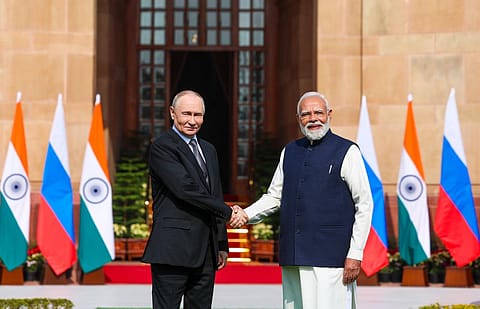
Modi-Putin mark 25 years of strategic partnership, renew push for peace and deeper trade ties
Marking 25 years of strategic partnership, Modi and Putin emphasised peace and deeper trade ties. They discussed enhancing economic cooperation, energy collaboration, and logistics connectivity. Both leaders reiterated their commitment to a multilateral trade system and agreed on joint manufacturing initiatives under the Make-in-India program, aiming to strengthen bilateral relations and global peace efforts.
The leaders discussed energy collaboration, logistics, and joint manufacturing under Make in India. Emphasising a transparent multilateral trade system, they agreed to deepen cooperation in nuclear energy, education, and defence, aiming to strengthen bilateral relations and contribute to global peace efforts.
Prime Minister Narendra Modi, during his meeting with Russian President Vladimir Putin, said it has now been 25 years since his first visit to India in 2001, when a strong foundation of the Strategic Partnership was laid. “After the crisis in Ukraine began, we have been in constant touch. You have consistently kept us informed as a true friend. I believe this trust is a great strength. I have stated publicly before the world, the welfare of the world lies in the path of peace.”
At the invitation of Prime Minister Narendra Modi, Putin paid a state visit to India for the 23rd India-Russia Annual Summit, marking the 25th anniversary of the Declaration on Strategic Partnership between India and Russia.
During their meeting today, the PM said the world must all work together to find the road to peace. “Recent efforts give me confidence that the world will once again move towards peace. In recent times, whenever I have spoken in detail with leaders from around the world, I have always said that India is not neutral, India has a clear stand, and that stand is peace. We support every effort for peace, and we stand shoulder to shoulder with all initiatives aimed at achieving peace.”
Putin, in his statement, said Russia is ready to continue uninterrupted shipments of fuel for the growing Indian economy. He hoped that the world would soon be free from these concerns and that the global community would find new hope on the path of meaningful progress. “I am confident that today we will discuss many important issues. India and Russia will further expand our economic ties and reach new heights. With this optimism and confidence, we take this meeting forward.”
Key highlights:
The two leaders underlined the importance of an open, inclusive, transparent and non-discriminatory multilateral trade system, with the World Trade Organisation (WTO) at its core. Russia and India have agreed to continue jointly developing systems of bilateral settlements through the use of national currencies in order to ensure the uninterrupted maintenance of bilateral trade.
The two sides discussed and commended their wide-ranging cooperation in the energy sector as a significant pillar of the Special and Privileged Strategic Partnership. They noted the current and potential cooperation between Indian and Russian companies in fields such as oil and oil products, oil refining and petrochemical technologies, oilfield services and upstream technologies and related infrastructure, LNG and LPG related infrastructure, various existing projects in their countries, underground coal gasification (UCG) technology, nuclear projects, etc.
They agreed to deepen cooperation in building stable and efficient transport corridors, with the focus on expanding logistics links for improving connectivity and enhancing infrastructure capacity to support the International North-South Transport Corridor (INSTC), the Chennai–Vladivostok (Eastern Maritime) Corridor, and the Northern Sea Route.
The leaders also confirmed their readiness to intensify trade and investment cooperation in the Far East and the Arctic zone of the Russian Federation. The Program of India-Russia Cooperation in Trade, Economic and Investment Spheres in the Russian Far East for the period from 2024-2029 provides the necessary framework for further cooperation between India and the Russian Far East region, especially in the sectors of agriculture, energy, mining, manpower, diamonds, pharmaceuticals, maritime transport, etc.
They also confirmed their intention to broaden cooperation in nuclear energy, including fuel cycle, life cycle support for operating Kudankulam Nuclear Power Plant (KKNPP) and non-power applications, as well as to elaborate a new agenda of interaction in the field of peaceful use of atomic energy and related high technologies.
The two countries also agreed to encourage joint manufacturing in India of spare parts, components, aggregates and other products for maintenance of Russian origin arms and defence equipment under the Make-in-India program through transfer of technology and setting up of joint ventures for meeting the needs of the Indian Armed Forces, as well as subsequent export to mutually friendly third countries.
Recognising the traditionally strong cooperation between India and Russia in the sphere of education, both sides appreciated efforts to ensure the well-being of students and agreed to continue their efforts in promoting educational linkages between universities and educational institutions.
They agreed to continue the development of joint approaches to addressing global economic challenges, mobilising increased access to climate finance and technologies for developing countries and economies in transition, and ensuring a reasonable reform of international institutions of economic governance, in particular multilateral development banks.
They also noted that the declaration aims to cover the main concerns surrounding the terrorist exploitation of Information and communications technology, such as payment technologies, social media platforms and fundraising methods and misuse of unmanned aerial vehicles (UAVs or drones).