National developers quadruple NCR supply share to 13% as branded housing wave reshapes regional real estate market: Anarock
/ 2 min read
From under 3% in 2022 to over 13% in 2025, national developers rapidly scale presence in NCR amid luxury-led demand, infra push and buyer shift toward trusted brands
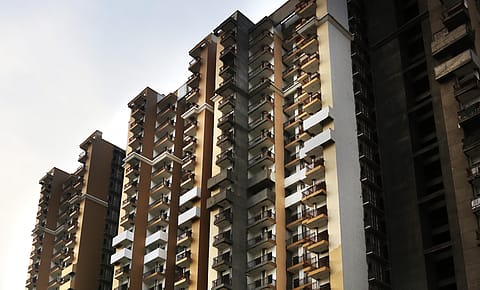
According to Anarock, this expansion comes as NCR continues to attract capital from listed developers traditionally concentrated in Mumbai, Bengaluru, Pune and Hyderabad | Credits: Sanjay Rawat
The National Capital Region (NCR) residential market is undergoing a structural shift as national developers aggressively expand their footprint, quadrupling their share of new housing supply in just four years. According to Anarock Research, their contribution has risen from under 3% of total new launches in 2022 to more than 13% by end-2025, signalling a clear pivot toward branded, institutionalised housing in one of India’s largest real estate markets.
This expansion comes as NCR continues to attract capital from listed developers traditionally concentrated in Mumbai, Bengaluru, Pune and Hyderabad. The shift reflects rising buyer preference for execution-led, brand-backed housing, alongside sustained infrastructure expansion across key micro-markets.
“Of approx. 25,355 residential units launched in NCR in 2022, national developers spoke for just 3%, or less than 700 units,” said Santhosh Kumar, Vice Chairman, Anarock Group. “In 2025, out of approx. 61,775 units launched, nearly 8,100 units were by national players. Their participation reflects increasing institutionalisation and growing homebuyer preference for trusted brands with strong execution capabilities.”
Godrej leads NCR expansion; Gurugram remains demand epicentre
Between 2022 and Q1 2026, national developers collectively launched over 15,130 units across NCR. Godrej Properties accounted for the largest share at 47%, followed by Prestige Estates at 27% and Sobha Ltd at 10%. Other active players include Tata Housing, Adani Realty, Mahindra Lifespaces, Shapoorji Pallonji Group and Birla Estates, largely focused on premium micro-markets.
Geographically, Gurugram dominates supply absorption, accounting for 47% of launches by national developers. Ghaziabad follows at 27%, while Noida and Greater Noida account for 13% and 12% respectively. Gurugram’s dominance is underpinned by corporate demand, infrastructure upgrades and proximity to the airport and key employment hubs.
Luxury-led supply strategy defines market positioning
A defining feature of national developers’ NCR strategy is their sharp tilt toward large-format, premium housing. Most projects feature 3BHK, 4BHK and 5BHK configurations, with average sizes of ~1,830 sq. ft., ~2,600 sq. ft. and ~4,465 sq. ft. respectively, indicating a clear focus on affluent end-users.
“Average pricing across these developers’ projects falls within the premium category, with several positioned in the luxury and ultra-luxury segments,” Kumar noted. “Buyer preference is shifting toward credibility and execution, especially in higher-ticket housing where trust, quality and timely delivery are critical.”
Infrastructure boom reshapes NCR’s growth corridors
The NCR growth narrative is being reinforced by large-scale infrastructure development, including Dwarka Expressway, Noida International Airport, Delhi–Mumbai Expressway, RRTS and metro network expansions. These projects are unlocking new residential corridors and deepening the region’s long-term investment appeal.
At the same time, regional developers continue to hold structural advantages, including land bank strength and local market knowledge. However, rising competition from national brands is lifting overall standards across design, governance and execution.
As NCR transitions toward a more organised residential market, the growing presence of national developers is not just reshaping supply dynamics—it is redefining what homebuyers expect from the region’s housing ecosystem.
Follow Fortune India
NEXT STORY