NCR Regional Plan 2041 may unlock ₹20 lakh crore investment, accommodate 3 crore more residents and create new real estate growth hubs: Knight Frank India
/ 2 min read
Draft regional blueprint proposes 5-8 smart townships, 30-minute connectivity across NCR and transit-oriented development corridors, with Sonipat, Meerut, Jewar, Bhiwadi and Alwar emerging as potential investment hotspots.
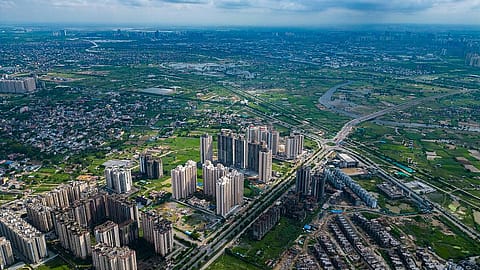
Representational Image | Credits: Shutterstock
The proposed NCR Regional Plan 2041 could trigger over ₹20 lakh crore of investment in housing, transport and civic infrastructure while reshaping the growth trajectory of northern India’s real estate market, according to a research report by Knight Frank India. The draft plan aims to accommodate more than three crore additional residents by 2041 through a combination of new urban centres, high-speed transit connectivity and large-scale infrastructure development.
Covering Delhi, Haryana, Uttar Pradesh and Rajasthan, the plan proposes the development of 5-8 greenfield smart townships and seeks to reduce pressure on the national capital by creating self-sustaining growth hubs across the wider NCR region. It also envisages a transit network capable of connecting Delhi with major NCR cities within 30 minutes, a move that could significantly alter residential, commercial and industrial investment patterns.
New growth hubs beyond Gurugram and Noida
Knight Frank India believes the most significant long-term impact of the plan could be the emergence of new investment destinations such as Sonipat, Meerut, Alwar, Bhiwadi, Rewari and the Jewar region. The proposed CRE-II and CRE-III orbital corridors are designed to divert industrial, logistics and residential demand away from the saturated Gurugram-Noida belt and into relatively underdeveloped markets.
“NCR is projected to absorb an additional population larger than Spain’s between now and 2041—a scale of demographic pressure that demands a fundamentally different planning response,” said Ankita Sood, National Director-Research, Knight Frank India.
“What sets this plan apart is the quantum of physical infrastructure already committed, the operational Delhi-Meerut RRTS, the KMP corridor running from Kundli to Palwal, and the Noida International Airport under development, which gives this plan more real-world anchors than its predecessors had,” she added.
Transit-oriented development to drive real estate activity
A key pillar of the draft plan is transit-oriented development (TOD). The proposal expands high-density development opportunities to a 1-km influence zone around RRTS, MRTS, dedicated freight corridors, expressways and national highways, potentially unlocking substantial land value appreciation along future transit routes.
Knight Frank noted that the Delhi-Meerut RRTS corridor is currently the strongest proof point for the model, while proposed links such as Gurugram-Manesar-Rewari and Sonipat-Panipat could emerge as major development corridors over the medium term.
“For the first time, Sonipat, Bhiwadi, Meerut and Alwar are being planned as deliberate growth destinations and not peripheral towns, connected to Delhi through transit rather than dependent on it. If even partially executed, that shift will change the investment geography of northern India,” Sood said.
Execution remains the critical challenge
Despite the ambitious vision, Knight Frank cautioned that implementation risks remain significant. Previous NCR plans have often struggled to translate policy intent into on-ground execution, while transit-oriented development norms and floor area ratio benchmarks will still need to be adopted individually by participating states.
The consultancy noted that the plan should be viewed as a long-term directional roadmap whose success will depend on timely corridor notifications, coordinated policy execution across states and sustained infrastructure funding.
NEXT STORY