The FAQs are AI-generated, and Fortune India is not responsible for its content or any associated copyright issues.
New IIP series reflects India's evolving production structure; industrial growth accelerates to 4.9% in April: HSBC Global Research
/ 3 min read
The updated series expands the scope of industrial activity beyond the traditional sectors of mining, manufacturing and electricity to include gas supply and water supply, sewerage and waste management, bringing it in line with international statistical standards.
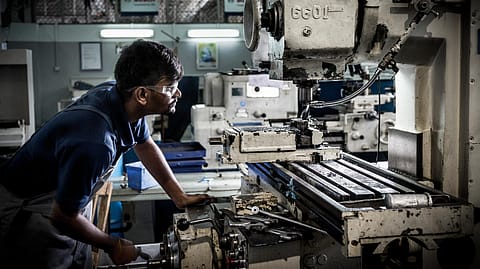
The release of the new series coincided with an improvement in industrial activity, with IIP growth accelerating to 4.9% year-on-year in April from 3.2% in March. | Credits: Narendra Bisht
India's revamped Index of Industrial Production (IIP), with a revised base year of 2022-23, is designed to better capture the country's changing production landscape through the inclusion of new sectors, a broader item basket and methodological improvements, according to a report by HSBC Global Investment Research.
The updated series expands the scope of industrial activity beyond the traditional sectors of mining, manufacturing and electricity to include gas supply and water supply, sewerage and waste management, bringing it in line with international statistical standards.
The release of the new series coincided with an improvement in industrial activity, with IIP growth accelerating to 4.9% year-on-year in April from 3.2% in March. The reading was broadly in line with HSBC's forecast of 5% and significantly above market expectations of 3.9%.
On a seasonally adjusted basis, industrial production grew 1.4% month-on-month in April after remaining flat in March.
According to HSBC, the rebound was aided by the easing of natural gas supply constraints that had weighed on industrial activity in March. The government had rationed gas supplies following disruptions in global energy markets caused by the conflict in West Asia. Fresh energy imports from diversified sources helped normalise supplies in April, allowing industrial production to recover.
The report noted that manufacturers also front-loaded production amid concerns over supply disruptions. Output of intermediate goods and consumer goods recorded strong sequential growth, mirroring trends seen in the Manufacturing Purchasing Managers' Index (PMI), where new orders, production and employment strengthened sharply during April.
However, HSBC cautioned that the underlying growth momentum appears to be plateauing. The stockpiling-driven boost to manufacturing may fade in the coming months, with quarter-on-quarter momentum already showing signs of moderation.
New series shows stronger industrial growth
Compared with the previous series, the revised IIP data paint a stronger picture of industrial activity. Average industrial growth during FY25 and FY26 stands at 5.4% under the new series, compared with 4.1% under the old framework.
Even so, growth in FY26 has moderated relative to FY25, primarily due to weaker manufacturing output, especially in consumer durables. HSBC attributed this to softer demand from the urban formal sector as wealth effects from equity market gains diminished.
In contrast, capital goods production has been significantly stronger in the revised series, reflecting robust public-sector capital expenditure. Consumer non-durables have also shown average growth of around 2% during FY25-FY26, compared with a contraction under the old series, indicating resilience in rural and informal urban demand supported by favourable monsoons and lower commodity prices.
Divergence with GDP data
The report highlighted a weakening correlation between the revised IIP and GDP series. While the new IIP data indicate rising mining activity and softer manufacturing output between FY25 and FY26, GDP estimates show growth in both sectors.
RANK
COMPANY NAME
REVENUE
(INR CR)
(INR CR)
{{#current-rank}} {{current-rank}} {{/current-rank}} {{^current-rank}} {{rank}} {{/current-rank}} {{name}} {{#revenue}} {{revenue}} {{/revenue}} {{^revenue}} {{noi}} {{/revenue}}
The divergence is particularly evident in manufacturing, where the correlation between IIP manufacturing and manufacturing gross value added (GVA) has weakened substantially. HSBC expects this gap could narrow as future revisions are made to the national accounts data.
Key changes in the new IIP framework
The revised IIP incorporates several structural and methodological changes aimed at improving accuracy and relevance.
The number of item groups covered by the index has increased to 463 from 407 earlier, making the basket more representative of India's production structure. Within manufacturing, 120 new item groups have been added, 64 removed and 343 retained from the previous series.
Mining coverage has been expanded to include one rare-earth mineral and nine minor minerals in addition to existing fuel, metallic, and non-metallic minerals. The electricity segment has been disaggregated into renewable and non-renewable power generation, while gas distribution through pipelines has been introduced as a separate item category.
Sector weights are now based on shares in gross value added at current prices under the National Accounts Statistics (NAS) 2022-23 series.
The six existing use-based categories—including capital goods, intermediate goods, and consumer goods—have been retained, although classifications of individual products have been reviewed and updated.
The revised methodology also introduces a formal mechanism for replacing factories that shut down or alter production patterns. Additionally, it recommends a chain-linked IIP alongside the traditional fixed-base index, allowing weights to be updated more frequently as the economy evolves.
For value-based reporting, the Wholesale Price Index (WPI) will continue to be used for deflation. Once a producer price index (PPI) with a 2022-23 base year becomes available and demonstrates stability, it may be adopted for this purpose.
Frequently Asked Questions
NEXT STORY