Government rules out separate policy for flex-fuel vehicles; says no incentive study conducted on FFVs, EVs
/ 2 min read
Heavy Industries Ministry defends the E20 ethanol blending programme, saying extensive testing found no adverse impact on vehicle performance while balancing energy security, food security and water sustainability.
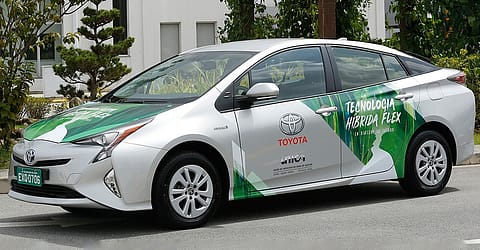
Credits: Toyota Kirloskar Motor
The Centre has clarified that it has not formulated a separate phased national policy to incentivise flex-fuel vehicles operating on petrol blended with more than 20% ethanol, while also stating that no study has been undertaken to assess incentives for either flex-fuel or electric vehicles.
The clarification, made by the Ministry of Heavy Industries on Tuesday, comes amid the government's continued push to expand ethanol blending as part of its strategy to reduce crude oil imports and strengthen India's energy security. The ministry also reiterated its support for the Ethanol Blended Petrol (EBP) Programme, asserting that extensive testing has found no evidence that E20 fuel adversely affects vehicle durability or performance.
No dedicated incentive framework for flex-fuel vehicles
Responding to queries, the ministry said it has not framed any separate phased policy to promote flex-fuel vehicles capable of operating on fuel blended with more than 20% ethanol. It further stated that no study has been conducted on incentivising flex-fuel or electric vehicles, indicating that the government is currently relying on existing policy mechanisms rather than introducing a dedicated incentive regime.
The clarification comes as India accelerates its biofuel roadmap while encouraging automobile manufacturers to introduce vehicles compatible with higher ethanol blends.
Government, SIAM back E20 programme
Defending the E20 rollout, the ministry said extensive laboratory testing and large-scale field experience have found no evidence of abnormal engine wear, corrosion or reduced vehicle life due to the use of petrol blended with 20% ethanol.
The clarification comes days after the Society of Indian Automobile Manufacturers (SIAM) addressed media reports on chloride and sulphur content in ethanol-blended fuel. SIAM said fuel quality testing is a "rigorous and comprehensive process" covering over 150 parameters and described the communication cited in the reports as part of routine technical discussions among automakers, oil marketing companies (OMCs) and testing agencies.
SIAM also said the Ministry of Petroleum and Natural Gas's 3 ppm guideline for chloride and sulphur in ethanol, along with enhanced quality checks at over 87,000 fuel outlets, adequately addresses the industry's requirements. Reiterating its support for the E20 programme, the industry body said there was "no cause for concern" for consumers and added that it had withdrawn its earlier communication pending wider data validation and consultations with member companies.
According to the government, the ethanol blending programme has not only reduced dependence on imported crude oil but has also helped shield consumers from global oil price volatility. It added that the policy has been designed to balance energy security, food security, water sustainability and farmers' interests.
Multiple feedstocks approved for ethanol production
The ministry said ethanol production under the National Policy on Biofuels is supported through multiple approved feedstocks, including sugarcane-based raw materials, maize, damaged foodgrains, broken rice, foodgrains unfit for human consumption, surplus foodgrains approved by the National Biofuel Coordination Committee (NBCC), and other approved agricultural feedstocks.
It also noted that an expert committee constituted by the Ministry of Agriculture and Farmers Welfare in 2024 had examined the water requirements of various ethanol feedstock crops. The committee's recommendations are currently under consideration as the government continues to implement and fine-tune the ethanol blending programme while addressing concerns related to sustainable resource use.
NEXT STORY