Railways emerging as India’s logistics backbone, capacity gaps persist: ASSOCHAM
/ 3 min read
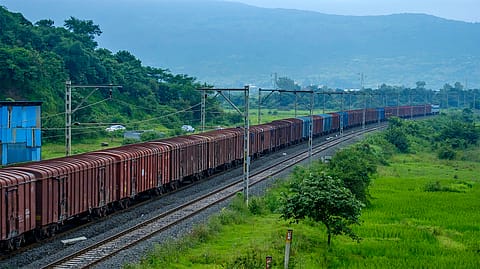
The report also highlights the growing importance of sustainability | Credits: Shutterstock
Railways emerging as India’s logistics backbone, capacity gaps persist: ASSOCHAM
ASSOCHAM’s latest report says Indian Railways is undergoing a structural, technology-led transformation to become the backbone of India’s logistics ecosystem, with ambitious plans to triple freight capacity and raise its modal share by 2030. Yet capacity saturation, weak last-mile links and low private participation still threaten to slow progress despite major corridor, digital and policy reforms.
This summary is AI-generated, and Fortune India is not responsible for its content or any associated copyright issues.
The report outlines an ambitious roadmap for Indian Railways, with a target to scale freight handling capacity to 3,000 million tonnes by 2030 and increase its modal share in freight movement
The report also highlights the growing importance of sustainability | Credits: Shutterstock
Indian Railways is undergoing a structural transformation and is poised to become the backbone of the country’s logistics ecosystem, though significant gaps in capacity, connectivity, and private participation continue to pose challenges, according to a latest report by the industry body ASSOCHAM.
The report, titled Future Ready Railways for Viksit Bharat, outlines an ambitious roadmap for Indian Railways, with a target to scale freight handling capacity to 3,000 million tonnes by 2030 and increase its modal share in freight movement.
“Railways are no longer viewed only as a mode of transport, they are emerging as a strategic backbone of India’s logistics ecosystem,” the report said, highlighting the sector’s evolving role in supporting economic growth.
At present, railways account for a relatively low share of freight movement compared to global benchmarks, even though rail transport is significantly more cost-efficient than road. The report highlights that improving rail’s share is critical to lowering India’s overall logistics costs and enhancing competitiveness.
Infra push and tech to drive growth
The transformation is being driven by large-scale infrastructure initiatives such as Dedicated Freight Corridors (DFCs), the PM GatiShakti National Master Plan, and expanding multimodal logistics networks. These efforts are already improving transit times, increasing capacity, and enhancing reliability.
“From the commissioning of the Dedicated Freight Corridors to the rollout of Kavach… the transformation underway is both structural and generational in its ambition,” the report noted.
Technology a key enabler in transition
Technology is emerging as a key enabler in this transition. The adoption of digital tools such as predictive maintenance, AI-based monitoring, and smart signalling systems is helping improve operational efficiency and safety. At the same time, initiatives such as Kavach and integrated command centres are strengthening rail safety and reliability.
The report also highlights the growing importance of sustainability, noting that increased electrification and a shift from road to rail could significantly reduce carbon emissions. Railways are expected to play a central role in achieving India’s long-term net-zero goals.
Structural gaps, low private participation remain concerns
However, the report flags several structural bottlenecks that could hinder progress. These include capacity saturation on key corridors, shortage of specialised wagons, high turnaround times, and inadequate last-mile connectivity to industrial hubs.
“Indian Railways operate one of the world's largest freight networks, yet its modal share has been declining for decades, while road transport dominates,” it said, pointing to a persistent imbalance in the logistics mix.
Private sector participation also remains constrained due to regulatory challenges, pricing issues, and operational inefficiencies, limiting investment in freight infrastructure and services.
{{#most-powerful-women-snapshot-individual.slug}} {{/most-powerful-women-snapshot-individual.slug}} {{^most-powerful-women-snapshot-individual.slug}} {{/most-powerful-women-snapshot-individual.slug}} {{#showRanking}} {{current-rank}} {{/showRanking}} {{#photo.0.url}}
{{name}}
On the policy front, recent reforms such as the Railways (Amendment) Act, 2025 and the new public-private partnership framework are expected to improve project viability and accelerate infrastructure development. The report notes that faster approvals and longer concession periods could boost investor confidence.
The paper calls for a more integrated and market-driven approach to rail logistics. This includes better multimodal connectivity, pricing reforms, development of urban freight solutions, and greater use of digital platforms.
“The momentum is real. The ambition is right. What lies ahead is the work of translating both into lasting impact,” the report added.
NEXT STORY