RBI Governor Malhotra has kept monetary policy flexibility alive
/ 4 min read
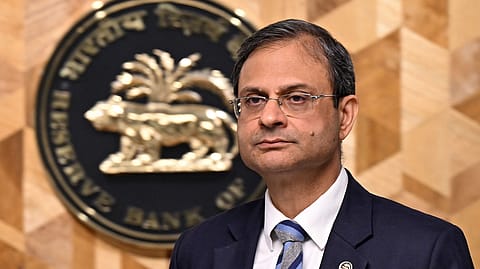
Sanjay Malhotra, Governor, Reserve Bank of India. | Credits: Getty Images
RBI Governor Malhotra has kept monetary policy flexibility alive
RBI Governor Sanjay Malhotra struck a cautious-to-dovish tone, keeping rates unchanged at 5.25% while stressing policy flexibility amid West Asia war risks and $130-per-barrel crude. Economists say future moves in FY27 will be decided policy-by-policy, as the RBI balances potential supply shocks to both growth and inflation against a still-robust 6.9% growth forecast and buoyant markets.
This summary is AI-generated, and Fortune India is not responsible for its content or any associated copyright issues.
The central bank needed to maintain a cautious tone on both growth and inflation, due to the still evolving macro-economic conditions and crude volatility, where the durability of the current ceasefire is unclear.
Sanjay Malhotra, Governor, Reserve Bank of India. | Credits: Getty Images
The Reserve Bank of India (RBI) Governor Sanjay Malhotra on Wednesday presented a ‘cautious to dovish’ tone in the monetary policy commentary, while emphasising that both growth and inflation could be impacted due to future supply shocks from the West Asia war, despite the current ceasefire.
Thus, economists, see that Malhotra has kept the policy flexibility alive. Most economists also said it would be more prudent to evaluate future rate action for FY2y, on a policy-to-policy basis, due to the lack of clarity on how the current ceasefire could play out and how crude oil prices move.
The Indian basket of crude oil—a mix of high-sulfur sour grade and low-sulfur sweet grade, is being approximately priced at near $130 per barrel.
The RBI maintained the status quo on interest rates at 5.25% in its latest policy announcement and projected economic growth at 6.9% for FY27. This is lower than the 7.6% economic growth recorded in the previous fiscal year.
Investors have cheered both the sudden ceasefire and the RBI policy inaction, with both the Sensex index and the Nifty 50 up over 3.5% over the previous close at 77,431 points and 23,962 points in early afternoon trade.
Policy flexibility alive
Sakshi Gupta, principal economist at HDFC Bank said “This was a very balanced, commentary. slightly cautious and dovish and definitely not hawkish. He was balanced, emphasizing that the supply shock can have a dual impact. both on growth and inflation. He has thus kept the policy flexibility alive,” she told Fortune India.
On interest rate action in FY27, she said it would be a “wait and watch” approach, depending on the durability of the current US-Iran war ceasefire and whether El Nino returns in the second half of the year, to impact crops and food inflation.
Indranil Pan, chief economist at YES Bank, however said Malhotra’s tone was more cautious, leaning towards inflation. “He has not taken into consideration the weather related issues, either growth and inflation related. Beyond the war, that may be a risk factor. But this is the best he could do due to the uncertainty,” he told Fortune India.
Going forward, he said he would evaluate RBI’s future rate action on a policy to policy basis, with no change in rates expected on June 5, 2026. “Inflation has an upside. Food will have a bigger implication inn terms of inflation expectation,” Pan said.
No pre-emptive action
Dipti Deshpande, principal economist at Crisil, said: “The RBI has taken a cautious approach in its monetary policy decision - an appropriate approach given the evolving global macro-economic condition. At this stage, it is prudent to avoid pre-emptive actions.”
In the new series this is their first ever growth forecast. “At 6.9%, there is possibly a greater adverse impact on growth— from a supply shock perspective -- than on inflation in the near term. But they will be vigilant on input cost pressures and the possible upside to inflation if crude prices remain persistently high.”
{{#most-powerful-women-snapshot-individual.slug}} {{/most-powerful-women-snapshot-individual.slug}} {{^most-powerful-women-snapshot-individual.slug}} {{/most-powerful-women-snapshot-individual.slug}} {{#showRanking}} {{current-rank}} {{/showRanking}} {{#photo.0.url}}
{{name}}
“Both fiscal and monetary policy will have a calibrated approach to making announcements, as they take measures to mitigate the adverse impact of the West Asia shock. But they will also have to keep policy space and buffers ready in case of weather shock due to El Nino/weather shock,” Deshpande said.
“In the short term there appears to be greater growth concern, but beyond a few months there might be more concern on inflation as pass-through of input costs to retail prices begins,” she added.
Deshpande added that the MPC’s clear commitment to stay proactive and pre-emptive in liquidity support is encouraging in the current scenario which is otherwise filled with uncertainty. Amid a large government borrowing program and some expected pick-up in private sector capex (and borrowing), active liquidity management clearly provides comfort to the bond markets.” India’s 10-year bond yields are at 6.91%.
A day prior to the MPC decision, Pranjul Bhandari, chief India Economist/Strategist at HSBC, had mentioned the need for a neutral fiscal and monetary policy. “A lesson which needs to be learnt from the pandemic is to not simulate demand before supplies mend. The blend of neutral fiscal and monetary policy may work best,” she said in a note to clients.
Though the US President Donald Trump on Tuesday suddenly announced a ceasefire in the West Asia war, it is difficult to gauge the extent of the damage the war could inflict on both inflation and growth, going forward.
For India, the impact of a weakening currency, the supply shocks of crude oil to key industries -- large corporates and small businesses, reverse migration fearing a clamping up of work in urban centres and a loss of jobs, resulting in weak consumer spending could all play out in coming months.
NEXT STORY