RBI MPC: Central bank raises FY27 GDP growth forecast to 7.5%; inflation seen at 5.1%
/ 2 min read
The RBI projected GDP growth at 7.8% in the first quarter, 7.2% in the second quarter, 6.9% in the third quarter and 6.8% in the fourth quarter of the current financial year.
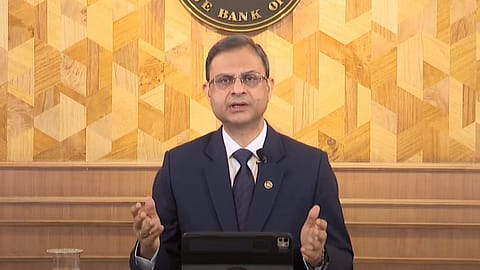
RBI Governor Sanjay Malhotra-led MPC raises repo rate by 25 bps in Oct policy meeting | Credits: Fortune India
The Reserve Bank of India (RBI), in its October policy meeting, projected real GDP growth for the current financial year at 7.5%, citing resilience in domestic economic activity despite global headwinds.
The central bank projected GDP growth at 7.8% in the first quarter, 7.2% in the second quarter, 6.9% in the third quarter and 6.8% in the fourth quarter of the current financial year. Growth in the first quarter of the next financial year is projected at 7.1%.
RBI Governor Sanjay Malhotra said economic activity had remained resilient, supported by private consumption and investment.
“Domestic economic activity has exhibited resilience against global headwinds, as evidenced from real GDP growth of 7.8% in Q1,” Malhotra said in a statement after the six-member MPC concluded its three-day meeting on Wednesday.
Growth was driven by resilient private consumption and strong investment, while net exports continued to make a positive contribution, he said.
High-frequency indicators also suggest that economic activity is holding up, although there has been some moderation compared with the previous year.
“Manufacturing activity, despite cost pressures, is holding well,” the Governor said, adding that services sector activity remained steady and broad-based.
He said private consumption remained broadly resilient, supported by government spending, while fixed investment remained strong.
Looking ahead, global economic uncertainty and supply-chain disruptions are expected to weigh on economic activity. However, favourable monsoon conditions, sustained momentum in services and broadly stable employment conditions are expected to support urban demand.
The Governor said continued momentum in infrastructure spending, a rebound in private capex and improving credit conditions are expected to support investment activity.
Merchandise exports are also expected to remain buoyant, while recently operationalised bilateral trade agreements should support exports, he said.
{{#most-powerful-women-snapshot-individual.slug}} {{/most-powerful-women-snapshot-individual.slug}} {{^most-powerful-women-snapshot-individual.slug}} {{/most-powerful-women-snapshot-individual.slug}} {{#showRanking}} {{current-rank}} {{/showRanking}} {{#photo.0.url}}
{{name}}
Inflation pegged at 5.1%
On inflation, the Governor said headline CPI inflation increased to 4.5% in August from 4.0% in July, largely driven by higher food and fuel prices.
“Price pressures are increasingly becoming visible across the range of commodities within the food component,” Malhotra said.
Core inflation, excluding precious metals, rose to 2.9% in August, while the diffusion index also pointed to continued supply-side pressures.
Considering all factors, inflation for the current financial year is projected at 5.1%, with quarterly inflation projected at 5.2% in Q2, 5.3% in Q3 and 5.7% in Q4.
Inflation for Q1 of the next financial year is projected at 5.6%, with the risks evenly balanced.
The RBI has "unanimously" decided to raise the benchmark repo rate by 25 basis points to 5.5%, marking the first rate hike since February 2023, when it increased the policy rate by 25 basis points to curb post-pandemic inflation.
The central bank has also changed its policy stance from ‘Neutral’ to ‘Calibrated Tightening’, citing the sudden re-escalation of the West Asia conflict in September, the consequent hardening and volatility in global crude oil prices, worsening global economic sentiment and heightened financial market volatility.
Follow Fortune India
NEXT STORY