RBI MPC minutes: Governor Sanjay Malhotra backs status quo on rates, cites inflation risks and global uncertainty
/ 2 min read
Despite supporting policy continuity, the RBI Governor cautioned that inflation risks remain elevated.
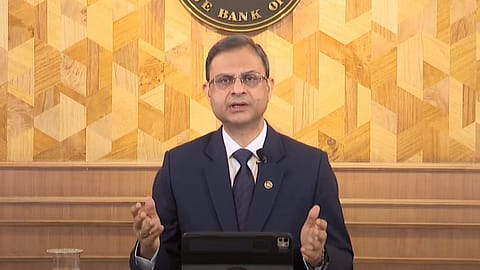
Sanjay Malhotra, Governor, RBI.
Reserve Bank of India (RBI) Governor Sanjay Malhotra has advocated a “wait-and-watch” approach on monetary policy, arguing for maintaining the policy rate and retaining a neutral stance despite inflation projections moving above the central bank’s target in FY27.
In the minutes of the RBI’s Monetary Policy Committee (MPC) meeting released on Friday, Malhotra said India’s macroeconomic position remains resilient despite emerging global and domestic uncertainties.
“On the whole, our economic situation is quite strong and healthy vis-à-vis many of our peers. We are in a much better position today not only in terms of the current shock but also with respect to earlier shocks,” Malhotra said, while adding that India continues to remain among the fastest-growing major economies, supported by relatively benign inflation over the past year.
Inflation projected above target
While headline inflation remains within the RBI’s target band at present, Malhotra noted that consumer price inflation (CPI) for FY27 is now projected at 5.1%, with inflation expected to peak at 5.9% in the third quarter, close to the RBI’s upper tolerance threshold of 6%.
Although the upward trajectory could justify monetary tightening, Malhotra said current conditions warrant caution.
Why RBI prefers to wait
Explaining his position, the Governor outlined four key reasons for favouring policy status quo.
First, he highlighted elevated uncertainty around inflation and growth projections due to factors including the duration of geopolitical conflicts, supply-chain disruptions and the intensity and spread of the monsoon season, all of which could influence food, energy and commodity prices.
Second, he pointed out that core inflation remains relatively contained. Core inflation for FY27 is projected at 4.7%, and when precious metals are excluded, underlying inflation is even lower than the target level.
Third, Malhotra noted that most of the increase in headline inflation projections since the April policy review is being driven by food and fuel prices, which are largely supply-side factors and may not necessarily translate into broader inflationary pressures.
Fourth, he stressed that while monetary policy is forward-looking, current inflation trends also deserve attention. Headline inflation remained within the target in April, with the increase largely driven by food inflation, while core inflation continued to remain subdued.
Fuel, monsoon, and crude oil remain key risks
Despite supporting policy continuity, the RBI Governor cautioned that inflation risks remain elevated. He said the revision in retail petrol and diesel prices in May could contribute to higher fuel inflation in the coming months.
{{#most-powerful-women-snapshot-individual.slug}} {{/most-powerful-women-snapshot-individual.slug}} {{^most-powerful-women-snapshot-individual.slug}} {{/most-powerful-women-snapshot-individual.slug}} {{#showRanking}} {{current-rank}} {{/showRanking}} {{#photo.0.url}}
{{name}}
Although food prices currently remain supported by a healthy rabi crop and adequate stocks, risks have increased due to forecasts of a below-normal monsoon and the possibility of El Niño conditions.
Malhotra also flagged the sharp rise in global crude oil prices relative to assumptions made during the April policy review and elevated wholesale price inflation (WPI), warning that higher energy and input costs could eventually spill over into core inflation. “We would continue to be data dependent and remain vigilant about inflation getting generalised, which can unhinge inflation expectations,” he said.
Summing up his position, Malhotra said the RBI should remain cautious and monitor inflation dynamics closely in the months ahead.
The Monetary Policy Committee held its 61st meeting from June 3 to June 5, under the chairmanship of RBI Governor Sanjay Malhotra. Other members were Dr. Nagesh Kumar, Saugata Bhattacharya, Prof. Ram Singh, Dr. Poonam Gupta, and Indranil Bhattacharyya.
Follow Fortune India
NEXT STORY