Show of India-EU bilateral collaboration shines high amid Trump tantrums
/ 2 min read
The trade partners have agreed to a comprehensive partnership plan including FTA and several other collaborations like security and defence partnership as against Trump’s attempt to prefer unilateral decisions
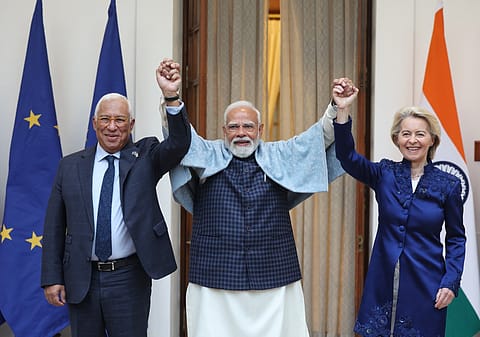
(L t R): European Council President António Costa and European Commission President Ursula von der Leyen and PM Modi | Credits: @narendramodi
The unpredictable tariff policies of United States President Donald Trump has increased the significance of the successful conclusion of India-European Union (EU) Free Trade Agreement (FTA) talks, jointly announced by Prime Minister Narendra Modi and EU President Ursula von der Leyen in New Delhi today.
The trade partners have agreed to a comprehensive partnership plan including FTA and several other collaborations like security and defence partnership as against Trump’s attempt to prefer unilateral decisions.
VDMA, a body that represents 3600 German and European mechanical and plant engineering companies, has said the conclusion of India-EU FTA gives the ‘much-needed oxygen’ for global trade.
“Export-oriented mechanical and plant engineering needs rule-based trade like it needs air to breathe. The free trade agreement between India and the EU brings much-needed oxygen to a world increasingly dominated by trade conflicts, Thilo Brodtmann, Executive Director, VDMA said.
“The EU has delivered. With this agreement, Europe is sending a clear signal in favour of rules-based trade and against the law of the jungle. Today is a day of celebration for export-oriented mechanical engineering”, the European industry body said.
Gulzar Didwania, Partner, Deloitte India also noted that EU being India’s second largest trade partner, the FTA comes at a moment of geoeconomic realignment and strategic urgency. “While tariff reductions provide a competitive advantage to both economies for sectors such as auto, textile, capital goods, gems and jewellery etc. it also offers an opportunity to address non-tariff barriers through regulatory alignment”, Didwania said.
The other outcomes of the India-EU Summit which saw the conclusion of the FTA talks include the finalization of an overarching document covering all aspects of India-EU Strategic Partnership, an MoU between Reserve Bank of India and European Securities and Market Authority (ESMA), MoU on Comprehensive Framework on Co-operation on Mobility, constitution of a Green Hydrogen Task Force and the launch of negotiations for an India-EU Security of Information Agreement.
The EU is India’s one of the largest trading partners, with bilateral trade in goods and services growing steadily over the years. In 2024–25, India’s bilateral trade in goods with the EU stood at $ 136.54 billion) with exports worth $ 75.85 billion and imports amounting to $ 60.68 billion. India-EU trade in services $ 83.10 billion) in 2024.
Follow Fortune India
NEXT STORY