States’ expenditure rises 131% in 10 yrs on welfare, development: CAG report
/ 2 min read
Committed expenditure and subsidies consistently absorbed more than half of revenue expenditure, reaching 53.31% in 2024-25, with subsidies growing particularly rapidly.
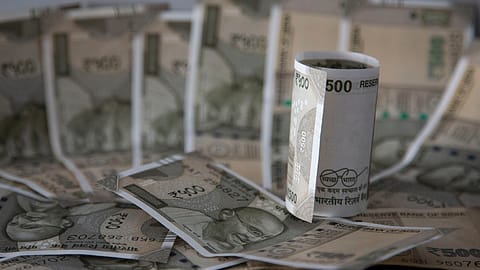
Total expenditure of the states increased from ₹22.18 lakh crore in FY2015-16 to ₹51.20 lakh crore in 2024-25, an increase of 131%. | Credits: Sanjay Rawat
States’ aggregate expenditure rose sharply by 131% between 2015-16 and 2024-25, keeping pace with economic growth, as they focused on welfare and development activities, said a CAG report on Tuesday.
Revenue expenditure continued to dominate budgets, averaging over 83% of total spending while capital expenditure increased in absolute terms but remained a relatively smaller share.
"Social and economic services together accounted for about two-thirds of total expenditure, reflecting states’ focus on welfare and development," said the CAG's Publication on State Finances 2024–25.
The report was released by the Comptroller and Auditor General of India (CAG), K Sanjay Murthy.
Committed expenditure and subsidies consistently absorbed more than half of revenue expenditure, reaching 53.31% in 2024-25, with subsidies growing particularly rapidly.
At the disaggregate level, states’ expenditure remained concentrated in 8 object categories -- including 3 types of grants-in-aid, salaries, pensions, interest payments, subsidies and major works -- accounting for nearly 78.46% of total spending and about 12.38% of combined Gross State Domestic Product (GSDP).
This reflects the continued dominance of committed and obligatory expenditures in state budgets, the report said.
Total expenditure of the states increased from ₹22.18 lakh crore in FY2015-16 to ₹51.20 lakh crore in 2024-25, an increase of 131%.
"Over the period 2015-16 to 2024-25, despite a substantial increase in total expenditure, the expenditure structure remained largely unchanged, with salaries, pensions, interest payments, subsidies and grants together absorbing a substantial share, indicating fiscal rigidity," it added.
A 10-year trend analysis over 2015-16 to 2024-25 shows that states’ budgetary spending ranged between 15.78% in FY25 and 17.49% in FY17 of the total combined GSDP.
In 2024-25, the sectoral expenditure on the general sector, social sector and economic sector accounted for 29.79%, 39%, and 28.68%, respectively, of the total expenditure of ₹51.20 lakh crore.
{{#most-powerful-women-snapshot-individual.slug}} {{/most-powerful-women-snapshot-individual.slug}} {{^most-powerful-women-snapshot-individual.slug}} {{/most-powerful-women-snapshot-individual.slug}} {{#showRanking}} {{current-rank}} {{/showRanking}} {{#photo.0.url}}
{{name}}
The composition of expenditure across sectors showed that capital outlay accounted for 5.28% of spending in the general sector, 31.60% in the social sector, and 62.71% in the economic sector.
"This pattern highlights that the economic sector -- covering areas such as infrastructure, industry, and trade -- attracts the bulk of capital investment, while the general sector, which includes administrative and fiscal functions, is predominantly revenue-oriented in nature," the report said.
States’ Own Tax Revenue (SOTR) is the largest component of revenue receipts, rising significantly in absolute terms and increasing its share from about 49.55% to nearly 50.13%, although its buoyancy weakened in FY2024-25 over 2023-24.
NEXT STORY