Tharoor questions India–US trade pact, labels it ‘pre-committed purchase deal’
/ 2 min read
The Congress Lok Sabha member from Thiruvananthapuram questioned how it could be called a “reciprocal tariff” when one side imposes 18% and the other charges 0%
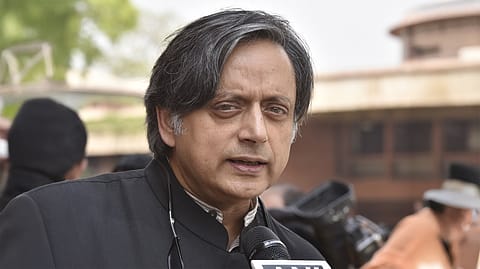
Congress leader Shashi Tharoor
Congress leader Shashi Tharoor on Tuesday chaired a meeting of the Parliamentary Standing Committee to discuss the India–US trade deal, saying that so far only the framework of the agreement has been announced. However, speaking later during the Parliament session, Tharoor sharply criticised the proposed pact, terming it a “pre-committed purchase deal.”
Briefing reporters after the meeting, he said the discussion saw record participation from members and involved detailed deliberations on various aspects of the proposed agreement.
“The bulk of the discussion was on India-EU trade agreement and India-US trade agreement, 17-18 MPs had questions. We engaged the foreign secretary, and chief negotiator from the Commerce Ministry, they responded in great detail... There is a rule of confidentiality, the most important is, given what they told us, we are looking forward to the interim agreement being finalised by the middle of next month, when that comes out, the doubts may be addressed,” he said.
On reports that India could purchase goods worth $500 billion from the US, Tharoor said the matter was examined in detail by the committee.
“It was talked about in detail, how $500 billion will be achieved, but there are answers, we do about ₹42 billion worth imports, they are saying it will not be difficult to double it... ₹500 billion is not a hard and fast commitment, we will be trying... There won't be a sanction, we will be trying to achieve that,” he said.
‘Pre-committed purchase agreement’
However, during the Parliament session, Tharoor strongly criticised the India-US trade deal, calling it a “pre-committed purchase agreement” and arguing that it overturns the very principle of reciprocity in trade.
Initiating the debate on the Union Budget in the Lok Sabha, he said the government’s claim that India had secured a “better deal” than China, Vietnam or other Asian countries does not withstand closer scrutiny.
“While India may have obtained tariff reductions of one or two percentage points, no East Asian economy has agreed to deliberately dilute its trade surplus with the United States through guaranteed purchase commitments," he said.
The Congress Lok Sabha member from Thiruvananthapuram questioned how it could be called a “reciprocal tariff” when one side imposes 18% and the other charges 0%.
At a time when India’s total bilateral trade with the U.S. stands at roughly $130 billion and a trade surplus of nearly $45 billion, the government has surprisingly promised to buy $500 billion worth of American goods over five years, he said.
"No major economy has ever neutralised its own trade leverage in this manner. While the U.S. continues to impose import tariffs of up to 18% on Indian exports, we have committed ourselves to lower tariffs to near-zero levels, open agriculture, dilute data localisation, soften intellectual-property safeguards, and even redirect strategic energy imports, especially away from Russia, to meet purchase targets. This is not strategic balancing; it is economic pre-emption," Tharoor added.
Follow Fortune India
NEXT STORY