VB-G RAM G Bill set to revamp rural jobs scheme with focus on efficiency: SBI Report
/ 2 min read
The new framework aims to fix structural issues in MGNREGA and push for higher productivity, better income generation, and stronger local participation
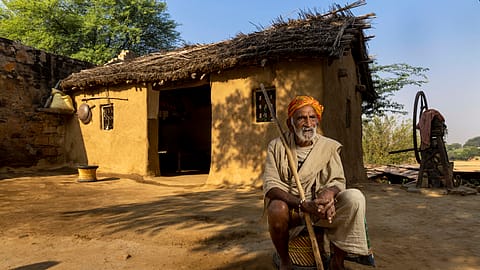
The rural job scheme MGNREGS saw minimal change in wage rates. | Credits: Narendra Bisht
SBI Research has said that the Viksit Bharat- Guarantee for Rozgaar and Ajeevika Mission (Gramin) or VB-RAM G Bill marks a major overhaul of the Mahatma Gandhi National Rural Employment Guarantee Act (MGNREGA), aiming to fix long-standing structural weaknesses while strengthening transparency, planning, and accountability in rural employment.
According to the report, the new framework seeks to bring “transformative practices” in project selection, productive asset creation, income generation, and monitoring — areas where the current system has often struggled.
Under the redesigned scheme, central assistance is expected to rise to nearly Rs 96,000 crore by FY27.
The states’ contribution will also increase, but SBI Research pointed out that nearly 55% of the Centre’s gross tax revenue is already shared with the states through devolution and grants.
“States may need to reorient their expenditure towards more productive purposes,” the report suggested.
Based on a simulated scenario assessing seven parameters of equity and efficiency, SBI Research estimated that states could collectively gain around Rs 17,000 crore compared to the average allocations of the past seven years. Most states are likely to emerge as net gainers, it added.
The revised Act also expands the scope of permissible works, which could help increase the average employment days to 125 from the current 50.4 per household (against the guaranteed 100 days). Stronger state participation and a stricter penalty mechanism are expected to reduce the gap between work demanded and work provided, which has hovered around 14% since FY20.
Addressing wage concerns — a key weakness of the earlier system — the report said compensation hikes had been uneven over the years, leading to poor demand-supply balance. The VB-RAM G design aims to fix this mismatch with better wage alignment and efficiency measures.
Currently, 266 types of work are permitted under MGNREGA — 150 in agriculture and allied sectors, 58 in natural resource management, and 58 in rural infrastructure. Between FY21 and FY26 (till December), around 55% of total spending went into agriculture and allied works.
SBI Research also highlighted the government’s strong focus on water conservation, noting that the number of water-stressed rural blocks fell by 35% over the last decade — from 2,264 to 1,456. Under Phase I of the Mission Amrit Sarovar, over 68,000 ponds were built, and Phase II is now underway with greater community participation.
To improve livelihood opportunities, the report cited the government’s Project UNNATI, launched in December 2019, which trains MGNREGA workers in employable skills. By March 2025, over 90,000 workers had been trained.
{{#most-powerful-women-snapshot-individual.slug}} {{/most-powerful-women-snapshot-individual.slug}} {{^most-powerful-women-snapshot-individual.slug}} {{/most-powerful-women-snapshot-individual.slug}} {{#showRanking}} {{current-rank}} {{/showRanking}} {{#photo.0.url}}
{{name}}
SBI Research also noted progress in wage payment systems, with 97.81% of fund transfer orders being generated on time by states and UTs, ensuring timely wage payments.
NEXT STORY