West Asia tensions, crude volatility pose downside risks to Indian economy: RBI Governor
/ 3 min read
The sudden re-escalation of the West Asia conflict in September and the consequent hardening and volatility in global crude prices soured global economic sentiments and heightened financial market volatility, RBI Governor Sanjay Malhotra said.
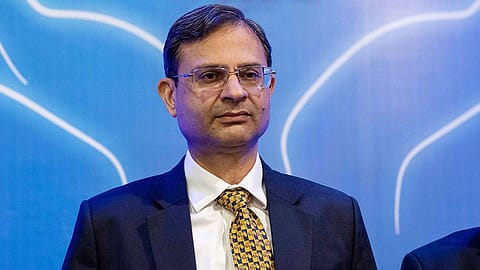
RBI Governor Sanjay Malhotra
The Reserve Bank of India (RBI) on Wednesday raised the benchmark repo rate by 25 basis points to 5.5%, marking the first rate hike since February 2023, and changed its policy stance from ‘Neutral’ to ‘Calibrated Tightening’, citing inflationary pressures amid heightened global uncertainty.
The central bank attributed the heightened risks to the sudden re-escalation of the West Asia conflict, volatility in global crude oil prices, tariff-related uncertainties and elevated bond yields.
“The sudden re-escalation of the West Asia conflict in September and the consequent hardening and volatility in global crude prices soured global economic sentiments and heightened financial market volatility,” RBI Governor Sanjay Malhotra said in his statement after the policy announcement.
He said the global growth outlook remained resilient, but rising energy costs and food prices could push global inflation higher in the near term.
“The West Asia conflict, tariff related uncertainties, elevated bond yields and risks of an unwieldy correction in valuation of AI stocks are keeping global economic sentiments edgy with risk-off sentiments on EMEs,” Malhotra said.
He added that these factors were weighing on the domestic growth-inflation outlook, although the resilience and strength of the Indian economy were helping it navigate the challenging environment.
Global headwinds may weigh on domestic growth
“Looking ahead, global economic uncertainty and supply chain disruptions are expected to have some bearing on domestic economic activity,” Malhotra said.
He said a weak southwest monsoon, along with strong El Niño conditions, may impact the upcoming rabi season and rural demand. However, resilient non-farm activity is expected to continue supporting rural consumption.
“Sustained momentum in services, and broadly stable employment conditions are expected to sustain urban demand,” he said.
The Governor said the government’s continued thrust on infrastructure spending, a rebound in private capex and strong credit flows are expected to bolster investment activity.
While services exports are expected to remain buoyant, recently operationalised bilateral trade agreements should support merchandise exports, he said.
{{#most-powerful-women-snapshot-individual.slug}} {{/most-powerful-women-snapshot-individual.slug}} {{^most-powerful-women-snapshot-individual.slug}} {{/most-powerful-women-snapshot-individual.slug}} {{#showRanking}} {{current-rank}} {{/showRanking}} {{#photo.0.url}}
{{name}}
“Global headwinds from protracted geopolitical tensions, elevated international commodity prices, additional frictions in global trade and tightening of global financial conditions may weigh on growth outlook,” Malhotra said.
Taking these factors into consideration, the RBI projected real GDP growth for 2026-27 at 7.1%, with growth estimated at 7.2% in the second quarter, 6.9% in the third quarter and 6.8% in the fourth quarter. Real GDP growth for the first quarter of 2027-28 is projected at 7.1%.
The RBI said the 40-basis-point upward revision in its growth forecast further underscored the strength of economic activity despite significant headwinds. The risks to the growth outlook are evenly balanced.
On inflation, Malhotra said the near-term outlook pointed to continued supply-side pressures due to the deficient southwest monsoon, El Niño conditions and high volatility in international oil prices.
“Price pressures are increasingly becoming visible across a range of commodities within the food component, apart from oil,” he said.
He added that early signs of inflation becoming generalised were also evident from an increase in core inflation and higher inflation across a larger segment of the CPI basket.
The RBI projected CPI inflation for 2026-27 at 5.2%, with inflation at 4.9% in the second quarter, 6% in the third quarter and 5.7% in the fourth quarter. Inflation for the first quarter of 2027-28 is projected at 5.6%, while core inflation is projected at 4.4% for 2026-27.
The risks to the inflation outlook are evenly balanced.
The MPC also decided to change its policy stance to ‘Calibrated Tightening’. The central bank said that, given the current conditions, rate cuts were off the table in the near term, while future policy action could be either a rate hike or a pause depending on evolving conditions and the outlook.
The duration and extent of the rate hike cycle would depend on actual growth-inflation developments and the outlook, particularly underlying inflation, the broadening of price pressures, second-round effects of the supply shock and the impact of demand impulses.
Follow Fortune India
NEXT STORY