Government’s EV policy has found no takers: What went wrong with the scheme designed to attract global carmakers?
/ 2 min read
More than two and a half years after the scheme was announced, the government is yet to receive a single application from a global electric passenger vehicle maker.
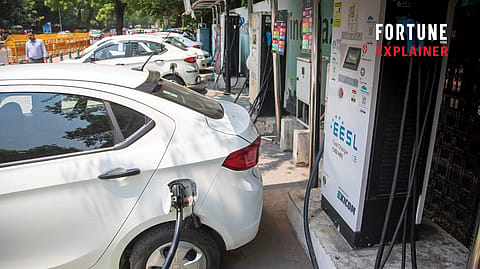
An electric vehicle being charged at a public charging station. The government’s EV manufacturing policy aims to attract global automakers and boost local EV production.
More than two and a half years after the government announced its electric passenger vehicle manufacturing policy, the scheme is yet to attract a single applicant. The outcome raises questions over whether the investment, localisation and duty incentives offered under the scheme are aligned with what global carmakers are willing to commit to the Indian market.
What is the government’s EV policy?
The Scheme to Promote Manufacturing of Electric Passenger Cars in India (SPMEPCI) was notified in March 2024 to attract global EV manufacturers and encourage local production. Under the scheme, an approved company must invest at least ₹4,150 crore, set up a manufacturing facility within three years and achieve domestic value addition of 25% by the third year and 50% by the fifth year. In return, it can import eligible electric cars at a concessional 15% customs duty for five years.
Was the policy designed for Tesla?
Tesla was one of the key companies in focus as the government worked on the policy, given the US EV maker’s plans to enter India. However, the scheme was not meant only for Tesla. The government also engaged with other global automakers, including Hyundai, Kia, Mercedes-Benz and Volkswagen Group companies.
Why did no automaker apply?
The investment requirement appears to be one of the main concerns. Automakers have questioned whether committing at least ₹4,150 crore in fresh investment makes commercial sense when India’s electric passenger vehicle market is still developing. Existing manufacturers have also sought clarity on whether their investments can count towards the requirement.
The localisation targets have added to the concerns. Manufacturers need to source more components locally within a relatively short period, while several important EV components remain dependent on global supply chains. Rare-earth magnet availability has also been a concern.
Did Tesla’s India plans change the equation?
Tesla eventually entered India with imported vehicles rather than committing to local manufacturing under the scheme. This highlighted the gap between the government’s manufacturing objective and automakers’ approach to entering India.
What is the status of the policy now?
The application window closed on October 21, 2025, without a single application. The government confirmed this in Parliament in February 2026. A parliamentary committee has since recommended a comprehensive review of the investment threshold, value-addition timelines and incentives.
However, the scheme has not been scrapped. The government now has to decide whether changes can attract global carmakers while retaining its objective of bringing investment, manufacturing and greater localisation to India.
Follow Fortune India
NEXT STORY