Cabinet clears ₹10,000 crore SME Growth Fund, integrated transport authority
/ 3 min read
Under the new framework, the government will provide an aggregate commitment of ₹10,000 crore to an Alternative Investment Fund established under the SGF framework.
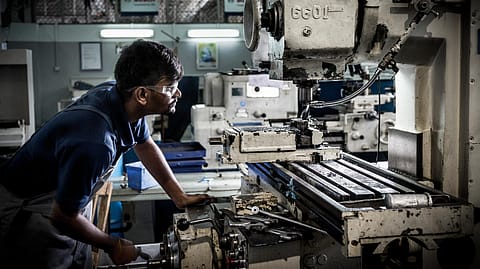
The SME Growth Fund is part of the measures announced in the Union Budget 2026-27 to improve access to equity, liquidity and professional support for the broader MSME ecosystem. | Credits: Narendra Bisht
The Union Cabinet, chaired by Prime Minister Narendra Modi, on Tuesday approved a ₹10,000 crore government commitment towards setting up the SME Growth Fund (SGF), aimed at providing growth-stage equity capital to small and medium enterprises and helping create a new generation of Indian companies capable of competing globally.
The Cabinet also approved the establishment of the Integrated Transport & Logistics Authority (ITLA) as a special purpose vehicle to strengthen integrated planning, research, project appraisal, monitoring and impact assessment across India’s transportation and logistics sectors.
₹10,000 crore fund to plug SME growth capital gap
The SME Growth Fund is part of the measures announced in the Union Budget 2026-27 to improve access to equity, liquidity and professional support for the broader MSME ecosystem.
While several existing funds provide equity support to businesses, the government said most are focused on early-stage enterprises and largely cater to micro enterprises. This has left a structural gap in the availability of growth-stage equity capital for small and medium enterprises.
Under the new framework, the government will provide an aggregate commitment of ₹10,000 crore to an Alternative Investment Fund established under the SGF framework.
The fund is intended to provide patient, long-term growth capital to SMEs with demonstrated business viability and the potential to scale. The capital can be used by businesses to expand capacity, invest in technology, enter international markets, undertake acquisitions and integrate into global value chains.
Manufacturing, smaller cities to get focus
A majority of the SGF allocation will be directed towards small and medium manufacturing enterprises. The fund will also consider companies operating in industrial clusters in Tier-II and Tier-III cities.
The government expects the initiative to improve productivity and scale among Indian SMEs while strengthening export competitiveness. Investments in industrial clusters are also expected to support regional industrial development, local supply chains and employment generation.
SMEs account for a significant share of India's employment, exports, manufacturing output and innovation. However, while access to credit has improved through various government initiatives, the availability of long-term risk capital remains a challenge for companies at critical stages of expansion.
The SGF is intended to address this gap by supporting businesses that have moved beyond the early stage but require substantial capital to scale.
New authority to coordinate transport planning
Separately, the Cabinet approved the setting up of the Integrated Transport & Logistics Authority (ITLA) to address fragmented planning and implementation across multiple transport ministries and agencies.
{{#most-powerful-women-snapshot-individual.slug}} {{/most-powerful-women-snapshot-individual.slug}} {{^most-powerful-women-snapshot-individual.slug}} {{/most-powerful-women-snapshot-individual.slug}} {{#showRanking}} {{current-rank}} {{/showRanking}} {{#photo.0.url}}
{{name}}
ITLA will function as a national apex institution for integrated transport and logistics planning, research, project appraisal, monitoring, policy support and data analytics.
The authority will prepare a National Transport Master Plan with a planning horizon of at least 10 years, covering roads, railways, ports and shipping, civil aviation, inland waterways, coastal shipping, urban mobility and logistics. It will also evaluate five-year sectoral plans and annual plans of transport ministries to ensure they are aligned with the national master plan and promote multimodal infrastructure development.
ITLA will undertake the technical appraisal of central government infrastructure projects costing ₹500 crore or more. Financial appraisal will continue through existing mechanisms. The authority will also monitor the implementation of transport and infrastructure projects above the ₹500 crore threshold, facilitate coordinated resolution of issues and undertake post-implementation impact assessments.
A key component of ITLA will be the creation of a National Transport Data Repository (NTDR). The repository will bring together transport and logistics data from multiple sources, including GSTN e-way bills, FASTag, VAHAN, GPS-based systems, and urban traffic management systems.
Follow Fortune India
NEXT STORY