From policy to production: India now has 5 operational semiconductor units, eyes $200bn market
/ 2 min read
The milestone, showcased at SEMICON India 2026 in New Delhi, marks a shift in the country’s chip strategy from laying the policy foundation to building manufacturing capacity, localising the supply chain and developing indigenous design and technology capabilities.
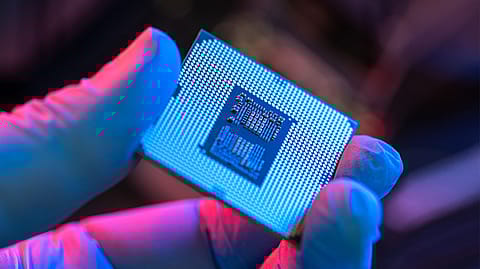
Representational Image | Credits: Getty Images
India’s semiconductor story is moving from policy announcements to commercial production, with five semiconductor units now operational as the country seeks to build an ecosystem capable of serving a market projected to reach $200 billion by 2035.
The milestone, showcased at SEMICON India 2026 in New Delhi, marks a shift in the country’s chip strategy from laying the policy foundation to building manufacturing capacity, localising the supply chain and developing indigenous design and technology capabilities.
The EY-IESA report released during the event projects India’s semiconductor market to grow more than threefold from around $64 billion in 2026 to $200 billion by 2035.
From policy to production
Prime Minister Narendra Modi virtually inaugurated commercial production lines at CDIL Semiconductor in Mohali and Suchi Semicon in Surat, taking the number of operational commercial semiconductor ATMP units under Semicon 1.0 to five, alongside Micron, Kaynes Semicon and CG Semi.
Ashok Chandak, president of SEMI India and IESA, said the industry had crossed an important threshold.
“The semiconductor story in India has moved from ambition to action, from announcements to commercial production—and from individual projects to an ecosystem.”
He said India was moving from “credibility to capability”, with investments increasingly translating into manufacturing, partnerships and commercialisation.
“The most exciting development is that the semiconductor story is no longer about individual fabs or packaging plants. It is becoming an ecosystem story,” Chandak said, referring to the development of capabilities spanning design and IP, fabs, advanced packaging, equipment, materials, logistics, talent and electronics manufacturing.
$200 billion opportunity
The scale of the opportunity is reflected in the EY-IESA projection of a $200-billion semiconductor market by 2035. The report said India’s market has expanded from about $27 billion in 2021 to nearly $64 billion in 2026, with consumer electronics, automobiles and industrial applications among the key demand drivers.
The government is now widening the policy focus through Semicon 2.0, approved with an outlay of ₹1.275 lakh crore. Unlike the first phase, which concentrated heavily on fabs and ATMP/OSAT facilities, the second phase covers six pillars — design, equipment and materials, fabs, advanced packaging, applied R&D and talent.
Union Electronics and IT Minister Ashwini Vaishnaw said the next phase was about building the wider ecosystem around the manufacturing capacity already created.
{{#most-powerful-women-snapshot-individual.slug}} {{/most-powerful-women-snapshot-individual.slug}} {{^most-powerful-women-snapshot-individual.slug}} {{/most-powerful-women-snapshot-individual.slug}} {{#showRanking}} {{current-rank}} {{/showRanking}} {{#photo.0.url}}
{{name}}
Building beyond chips
Chandak said India’s opportunity extended beyond semiconductor manufacturing itself.
“Semiconductors are not the destination; they are the foundation for the next generation of electronics manufacturing.”
The objective, he said, is to “design in India, make chips in India, surround them with India components, integrate them into products made in India”, while increasing domestic value addition and eventually exporting those products globally.
SEMICON India 2026 saw 54 MoUs and strategic announcements, more than 600 exhibitors and investment commitments of around $7 billion, according to the event release. The government has separately said emerging investment commitments under Semicon 2.0 are around ₹1 lakh crore, with close to one lakh new employment opportunities expected across the ecosystem.
Chandak said the next challenge was now clear: “to convert this momentum into scale, global competitiveness and value creation.”
Follow Fortune India
NEXT STORY