GFF 2026: India's next-gen reforms must focus on deregulation: NITI Aayog's Rajiv Gauba
/ 4 min read
Asked what should define the next-generation reform architecture as India works towards becoming a developed economy and a $30 trillion economy by 2047, Gauba had a one-word answer — “deregulation.”
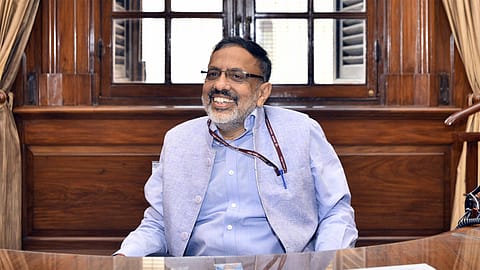
India’s next generation of reforms must focus on deregulation and making the everyday task of doing business simpler, Rajiv Gauba, member of NITI Aayog and former Cabinet Secretary, said at the Global FinTech Fest 2026.
Speaking to Kunal Guha, managing director, commerce partnerships, APAC, Google, Gauba said India had already completed several major structural reforms and was now entering a phase where smaller, more granular changes could have a significant impact.
Asked what should define the next-generation reform architecture as India works towards becoming a developed economy and a $30 trillion economy by 2047, Gauba had a one-word answer — “deregulation.” “The next-generation reform architecture has to be defined by deregulation,” he said.
Guha, who opened the discussion by pointing to India’s ambition of achieving 8% annual GDP growth, said the scale of the Vision 2047 target would require structural reforms across the economy.
From big-ticket reforms to ‘nuts and bolts’
Gauba said the country had already undertaken several “big-ticket” reforms over the past decade. GST had created a unified national market, while the insolvency framework allowed capital and assets that were earlier locked up to be redeployed. The FDI regime had also been significantly liberalised, with sectors such as defence, space and nuclear energy opened up to greater private participation.
“A whole lot of reforms have happened,” Gauba said. “Of course, there can never be a full stop.”
The focus now, he said, should be on the regulatory burden faced by businesses and citizens. Gauba argued that while India abolished industrial licensing in 1991, the underlying culture of permissions and inspections had persisted.
“We abolished industry licensing in 1991. But, License Raj did not go. Inspector Raj has survived and flourished,” he said. “Licenses have appeared in many different avatars. As permission, approval, mandatory registration, which is not automatic. Frequent renewal requirements. Across a multitude of laws and rules.”
The next phase, he said, should therefore be about freeing businesses and citizens from this regulatory maze.
“The next generation reform has to be to liberate the industry and citizens at large from this stifling chokehold of rules, regulations, permissions,” Gauba said.
He described the exercise as “granular work” that may not necessarily produce headline-grabbing announcements. “It may be unglamorous. It is not the headline grabbing stuff. It is what I call nuts and bolts,” he said.
{{#most-powerful-women-snapshot-individual.slug}} {{/most-powerful-women-snapshot-individual.slug}} {{^most-powerful-women-snapshot-individual.slug}} {{/most-powerful-women-snapshot-individual.slug}} {{#showRanking}} {{current-rank}} {{/showRanking}} {{#photo.0.url}}
{{name}}
NITI Aayog pushes for automatic approvals, risk-based inspections
The framework being developed by NITI Aayog proposes that licences should be retained only where they are justified by national security or serious risks to human health or the environment. Otherwise, registrations should be automatic.
“Not subject to yes or no,” Gauba said.
Where licences are necessary, he said, they should have perpetual or long-term validity, while inspections should be risk-based rather than random.
“This is a paradigm shift which we are trying to bring about,” he said, describing the intended change as moving towards “permitted unless prohibited” rather than “prohibited unless permitted.”
The reform agenda, he added, cannot stop at the Centre. State and municipal governments control several important permissions involving land use, building approvals, pollution clearances and local licences.
“Some areas, centres and states have to work together for deregulation to become a reality,” he said.
Gauba cited work already undertaken to streamline environmental regulations and reduce compliances for MSMEs. He also pointed to changes around building regulations that could unlock more construction and land supply, potentially helping hospitals, hotels and affordable housing.
Fintech, AI regulation and the next phase of digital growth
On fintech, Guha highlighted how India’s digital infrastructure has allowed innovation to scale rapidly. Gauba said the country is now home to more than 10,000 fintech firms, with nearly $40 billion invested over the past decade.
But the bigger achievement, he said, was not the numbers.
“Much more important than the numbers is the fact that our fintech ecosystem, it has truly democratized access and financial inclusion,” Gauba said. “Payments have been revolutionized. They have democratized insurance. They made it possible for ordinary Indians to participate in stock market like never before.”
He said the next opportunities lay in making credit more accessible to small shopkeepers and MSMEs, expanding insurance penetration and using AI to strengthen systems against fraud and make financial decisions more customised.
At the same time, regulation must not choke innovation.
“Over-regulation will push innovation offshore,” Gauba said. “On the other hand, under-regulation can produce a crisis and the loss of confidence.”
“We have to strike the right balance which is not static but dynamic,” he added.
Gauba said regulation should be “principle-based, technology neutral, and scaled with risk” rather than applying identical obligations to every player. New entrants should also be able to enter and exit markets without unnecessary friction, while consumers and regulators should have timely access to reliable information.
As AI and other technologies accelerate, he said government would need to work more closely with the private sector and continuously build its own technological capabilities.
“Essentially, you can say PPP in governance, not just projects,” Gauba said.
He also called for greater capacity building within the civil service and more lateral induction of professionals to bring contemporary skills into government.
Ultimately, Gauba said, India’s 2047 ambition would require participation beyond government.
“Viksit Bharat is not a Government of India mission. It is a national enterprise,” he said. “We are at an inflection point and we must make the most of this opportunity.”
Follow Fortune India
NEXT STORY