GFF 2026: Sebi chairman Pandey highlights importance of balancing innovation and risks
/ 2 min read
The market regulator is working towards making supervision increasingly predictive and capable of identifying emerging risks early, says Pandey
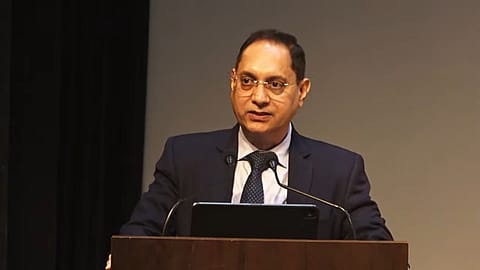
Tuhin Kanta Pandey, Chairman, Sebi
The Securities and Exchange Board of India (Sebi) chairman Tuhin Kanta Pandey on Thursday reiterated on Thursday the importance of toolkit supervisory technology (SupTech). Where market participants use advanced technologies at greater speed and scale, regulators are able to supervise with comparable sophistication. "This is where SupTech offers tremendous opportunity," he told an audience at the Global Fintech Fest 2026, talking about regulating the capital markets.
Pandey said that regulatory opportunity before India is to enable technology to make our markets faster, broader, and more efficient while ensuring that the foundations of confidence, integrity, and resilience become stronger, not weaker, as India's capital markets grow.
"These point towards greater intelligence, programmability, and computational power," he said. "Yet, they raise a common question: how do we make innovation scalable without making risk scalable at the same pace? That's the challenge of growing fast, growing safe."
"India offers a useful perspective on this question. Our security markets have grown rapidly, and technology has been central to that growth. Digital onboarding, electronic payments, robust clearing and settlement, and the ability to trace transactions to the ultimate investor have made participation wider and more secure," Pandey said.
Pandey said that the objective is not simply to automate supervision, but to use data, analytics, and AI to identify patterns that may not be visible to traditional methods. "At Sebi, we are moving in this direction, with the aim of making supervision increasingly predictive and capable of identifying emerging risks early."
Later Thursday evening RBI Governor Sanjay Malhotra will symbolically launch a pilot project on tokenization of corporate bonds under DMAT 2.0 in the Indian securities market. It explores whether distributed ledger technology can bring the security and settlement legs closer together, enable faster settlement, and in fact atomic settlement, and automate parts of asset servicing. The project brings together tokenized securities, digital settlement assets through CBDC, the Central Bank Digital Currency, and smart contract functionality, while building on existing market infrastructure and preserving legal certainty around ownership.
The broader significance is that we are exploring a market architecture where securities, settlement, and servicing can become more integrated and programmable.
Pandey also said that technology may be outsourced, but regulatory responsibility cannot. "Market intermediary or institution cannot transfer responsibility, compliance, resilience, or market integrity to a technology provider. Oversight should be risk-based and proportional. Oversight should rise with proximity to trading, settlement, sensitive data, and investor outcomes."
Tajinder Singh, deputy secretary general, International Organization of Securities Commission (IOSCO), at the same forum added that "organizing supervision is no longer a future ambition. It is already underway."
"Good regulation creates the trust that allows innovation to grow sustainably. Our task as regulators is therefore neither to stand in the way of innovation nor to run. It is just as important to. And that is as important role to play," Singh said.
Singh also said that Innovation in financial markets will continue, and it will probably continue faster than any of us can predict. The fundamental objectives of security regulation do not change simply because technology changes. "Investor protection, market integrity and financial stability remain our anchors. Regulation and innovation should not be seen as opposing forces," he said.
Follow Fortune India
NEXT STORY