Supreme Court refuses to stay UPI MDR above ₹2,000, seeks Centre, RBI, NPCI response
/ 2 min read
The court was hearing a public interest litigation (PIL) filed by advocate Anjan Datta challenging the Centre's September 14 notification and the MDR framework announced on September 15.
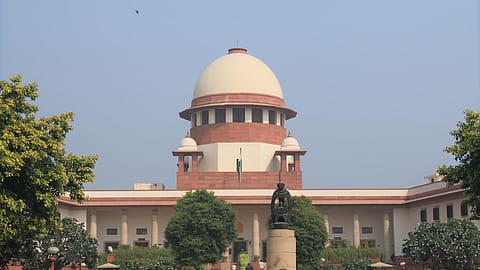
Supreme Court of India | Credits: Fortune India
The Supreme Court on Monday refused to grant an interim stay on the imposition of merchant discount rate (MDR) on specified UPI person-to-merchant (P2M) transactions above ₹2,000, which is set to take effect from October 15.
A bench comprising Chief Justice Surya Kant and Justices Joymalya Bagchi and V Mohana issued notices to the Centre, the Reserve Bank of India (RBI) and the National Payments Corporation of India (NPCI), seeking their responses within four weeks.
The court was hearing a public interest litigation (PIL) filed by advocate Anjan Datta challenging the Centre's September 14 notification and the MDR framework announced on September 15.
SC questions legal basis for MDR
During the hearing, the bench sought clarity on the legal basis for imposing the charge and questioned whether the MDR should be treated as a tax or a fee.
“Is it a tax or a fee? If not a fee, then what is the executive basis for making this expropriation?” the bench asked.
Additional Solicitor General N Venkataraman, appearing for the Centre, said the charge was neither a tax nor a fee and that the government would not receive the money.
“It is neither a tax nor a fee,” he said, adding that the charge was a settlement fee between payment aggregators and banks.
“The government is several steps away from this money,” Venkataraman said.
The bench asked the Centre to file a short counter affidavit explaining the basis for the framework, observing that the issue was “less a legal issue and more a technical issue”.
October 15 rollout remains in place
The petitioner sought an interim stay on the MDR framework after the court issued notice. However, the bench declined to grant one.
This means the framework remains scheduled to come into effect from October 15.
{{#most-powerful-women-snapshot-individual.slug}} {{/most-powerful-women-snapshot-individual.slug}} {{^most-powerful-women-snapshot-individual.slug}} {{/most-powerful-women-snapshot-individual.slug}} {{#showRanking}} {{current-rank}} {{/showRanking}} {{#photo.0.url}}
{{name}}
The government has introduced a 0.4% MDR on specified P2M UPI transactions above ₹2,000. The MDR will be capped at ₹300 for payments of ₹75,000 and above.
Essential and thin-margin sectors such as railways, telecom, insurance, fuel and agricultural inputs will attract a flat ₹5 MDR on transactions above ₹2,000.
Payments involving mutual funds, securities, stockbrokers and dealers will attract MDR of 0.02%, also capped at ₹300.
P2P payments remain free
Person-to-person (P2P) UPI transactions will continue to attract zero charges irrespective of transaction size. The Centre told the court that 96% of users of the payment system would remain exempt.
“The Government of India is not taking even a single rupee out of it,” Venkataraman told the bench.
The petitioner has challenged the framework on grounds including lack of adequate statutory safeguards, transparency and public consultation. It has also questioned the distinction between UPI transactions and RuPay debit card payments and sought safeguards for micro and small enterprises.
The plea has sought quashing or suspension of the MDR framework or, alternatively, reconsideration after transparent consultation, publication of empirical data and an impact assessment.
Follow Fortune India
NEXT STORY