‘Time is not on our side’: CEA Nageswaran says India must build ‘strategic indispensability’
/ 3 min read
CEA says India must identify critical supply-chain choke points and step up manufacturing in engineering, chemicals, electronics and semiconductors
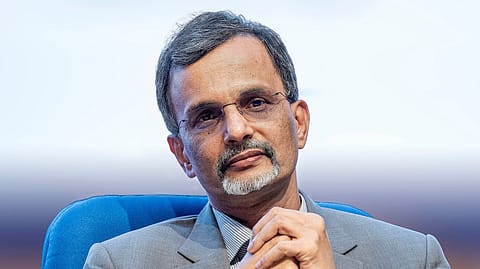
Chief Economic Advisor V. Anantha Nageswaran (File image) | Credits: Narendra Bisht
India cannot afford to take its time in building manufacturing capabilities and strengthening its position in global supply chains, Chief Economic Adviser V Anantha Nageswaran said, warning that “the time is not on our side” as geopolitical tensions, trade fragmentation and artificial intelligence reshape the global economy.
Speaking at the 13th SBI Banking and Economics Conclave in Mumbai, Nageswaran said India needs to move beyond simply becoming self-reliant and work towards “strategic indispensability” — developing capabilities in areas where global supply chains cannot easily do without the country. The Economic Survey 2025-26 has also laid out this progression from import substitution to strategic resilience and, ultimately, strategic indispensability.
“We need to keep doing some of the things we have started doing, but have to intensify them because the time is not on our side,” Nageswaran said.
Choke points to decide manufacturing priorities
Nageswaran said India should not try to pick a single manufacturing sector but should identify areas where the country can build capabilities that are difficult to replace.
“I don't think there is any need for us to be exclusive here. I mean, we have everything that is open to us, whether it is pharma or electronic goods or engineering or chemicals,” he said.
“The decision has to be taken in the light of where our choke points are, and that will give us the clue as to which ones we need to prioritize,” he added.
The CEA said engineering and chemicals would be among the key priorities, while electronic components and semiconductors can build on the momentum already created.
“I would think engineering and chemicals would top the list,” Nageswaran said.
For labour-intensive manufacturing, he identified textiles and footwear, while also calling for greater focus on agro-processing.
“We should also take agro-processing very seriously,” he said.
Nageswaran said India has already taken steps through production-linked incentives and other measures, but these efforts need to be intensified. Recent trade agreements can also provide a push to manufacturing and exports, he said.
{{#most-powerful-women-snapshot-individual.slug}} {{/most-powerful-women-snapshot-individual.slug}} {{^most-powerful-women-snapshot-individual.slug}} {{/most-powerful-women-snapshot-individual.slug}} {{#showRanking}} {{current-rank}} {{/showRanking}} {{#photo.0.url}}
{{name}}
AI raises another challenge for jobs
The manufacturing push also has a second objective — creating jobs at a time when AI is beginning to alter the entry-level employment ladder.
Nageswaran's presentation cited a study covering 41 countries, 1.25 billion job postings and 154 million employment records, which found that AI-adopting companies were reducing the share of junior workers while increasing senior employment.
For India, where millions of young people enter the workforce every year, the challenge is not simply preventing job losses but creating new jobs that either use AI or are less exposed to automation.
Nageswaran said recent trade agreements could help generate some of these opportunities, particularly in labour-intensive sectors.
“FTAs serve as the catalyst,” he said.
Pointing to India's recent UK agreements and the expected EU agreement, he said they could provide the incentive for companies to increase production in sectors where India has an opportunity to expand.
“We should wait and see what happens as a result of that before we try to come up with an incentive, because I think the market will provide the right incentives,” he said.
Less dependence, more strategic strength
Nageswaran also cautioned against relying too heavily on government support as India builds buffers against external shocks.
Commodity stockpiles, energy security and supply-chain diversification will require resources, he said, but fiscal support cannot be the answer to every vulnerability.
“As far as possible, we need to rely on natural market incentives and disincentives rather than looking to the government for fiscal support,” he said.
As Nageswaran puts it, the broader strategy is not simply to produce more within India. It is to build capabilities in areas where India can become a critical part of global supply chains. And with trade, technology and energy reshaping the global economy, his message was clear: “The time is not on our side.”
Follow Fortune India
NEXT STORY