West Asia conflict sparks 60% gas price hike for fertiliser plants
/ 3 min read
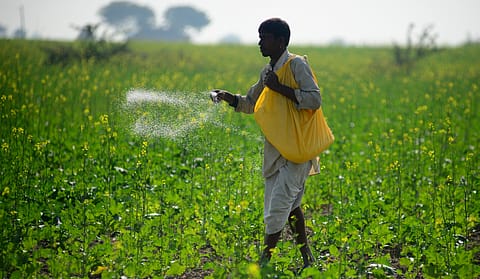
Domestic urea production has also been affected, though steps have been taken to minimise the impact. | Credits: Getty Images
West Asia conflict sparks 60% gas price hike for fertiliser plants
The widening West Asia conflict has pushed feedstock natural gas prices for Indian fertiliser plants up by 60%, squeezing supplies to 80% of demand and forcing costly LNG spot purchases. While domestic urea output has been hit and the subsidy bill may rise by ₹20,000-25,000 crore, the government insists farmers will get fertilisers at unchanged prices and that Kharif needs will be met through buffers and imports.
This summary is AI-generated, and Fortune India is not responsible for its content or any associated copyright issues.
The Gulf region, which met 20-30% of India's urea needs, 30% of DAP and 50% of LNG needs, remains impacted, leading to a surge in input costs such as LNG, ammonia and sulphur, along with higher freight expenses.
Domestic urea production has also been affected, though steps have been taken to minimise the impact. | Credits: Getty Images
The widening conflict in West Asia has driven a sharp 60% surge in feedstock natural gas prices for fertiliser plants which is expected to raise the government's subsidy burden.
With the conflict disrupting energy supply lines, supply of natural gas -- a primary feedstock for producing ammonia, which is the building block for nitrogen-based fertilisers -- has been restricted to 80% of the demand.
To meet the deficit, fertiliser companies are buying liquefied natural gas (LNG) from spot or current market.
At an inter-ministerial briefing on the West Asia developments, Aparna S Sharma, Joint Secretary in the Department of Fertilisers, said the country has adequate stocks of fertilisers to meet the agriculture demand in the coming Kharif season.
"The prevailing situation is vulnerable situation, which we have dealt in a very strategic way," she said.
The Gulf region, which met 20-30% of India's urea needs, 30% of DAP and 50% of LNG needs, remains impacted, leading to a surge in input costs such as LNG, ammonia and sulphur, along with higher freight expenses, she said.
Domestic urea production has also been affected, though steps have been taken to minimise the impact.
She said the total fertiliser requirement for Kharif 2026 is estimated around 39 million tonnes, compared to 36.1 million tonnes last year. Current stock levels stand at about 18.0 million tonnes, higher than 14.7 million tonnes in the corresponding period last year, she said, adding that April and May, typically lean agricultural months, are being utilised to build buffer stocks.
To support domestic production, gas supply to urea plants -- initially cut to about 60% -- has been scaled up to 75-80% through alternative arrangements, boosting output and reducing production losses, she said, and added that the deficit was being met by buying LNG from spot market.
Of the 52 million standard cubic meters per day of gas requirement of fertiliser plants, about 15 mmscmd was being procured from spot market.
The spot purchases have been made for $19.5-19.6 per million British thermal unit, as compared to $11-12 per mmBtu rate in the pre-crisis era, she said.
{{#most-powerful-women-snapshot-individual.slug}} {{/most-powerful-women-snapshot-individual.slug}} {{^most-powerful-women-snapshot-individual.slug}} {{/most-powerful-women-snapshot-individual.slug}} {{#showRanking}} {{current-rank}} {{/showRanking}} {{#photo.0.url}}
{{name}}
She, however, insisted that the government continues to make available fertilisers to farmers at existing prices despite global volatility, and emphasised that there is no immediate shortage or cause for panic.
The higher feedstock cost will leader to higher subsidy bill but the farmers will continue to get urea at ₹266 per 45 kg and ₹1,350 for 50 kg bag of DAP.
In March, urea production stood around 1.8 lakh tonnes, while P&K fertiliser output was estimated at 0.9-1 million tonnes, she said, adding that this was lower than 2.4 million tonnes monthly production last year.
Some fertiliser plants, she said, had taken annual maintenance shutdown in March and are now starting production again.
Of the existing stock of 18 million tonnes, 6.2 million tonnes is of urea, 2.33 million tonnes of DAP and 5.6 million tonnes of P&K fertilisers, she said.
On the import front, the government has stepped up efforts to diversify sourcing and secure supplies. A global tender for 13.07 lakh tonnes of urea has been floated, while long-term arrangements have been tied up with countries such as Saudi Arabia and Oman.
"Proactive measures are being taken to diversify sourcing with other than Gulf countries, including Russia, Morocco, Australia, Indonesia, Malaysia, Jordan, Canada, Algeria, and Egypt," she said.
A dedicated task group and a contingency 'war room' have been set up to monitor availability, production, imports and logistics on a real-time basis. Coordination with states has been intensified to prevent hoarding, black marketing and diversion under the Essential Commodities Act.
Follow Fortune India
NEXT STORY