Amazon’s Prime play
/ 16 min read
Amazon doubles down on Prime, bundling value to win Indian consumers.
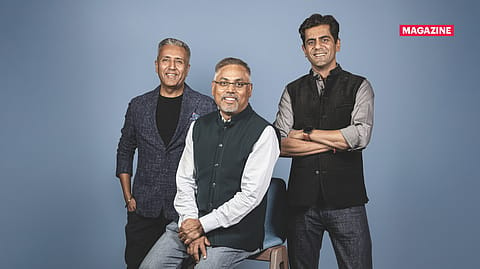
(From left) Gaurav Gandhi, vice president, Asia-Pacific and ANZ, Prime Video; Samir Kumar, country manager - India, Amazon; and Akshay Sahi, vice president, Prime and Customer Fulfilment Experience, India and Emerging Countries, Amazon | Credits: Sanjay Rawat
This story belongs to the Fortune India Magazine July 2026 issue.
WHEN AMAZON CEO Andy Jassy sat down with Prime Minister Narendra Modi in New Delhi last month, the e-commerce and cloud giant pledged another $13 billion towards expanding AI and cloud infrastructure in India by 2030, taking its cumulative investments in the country to more than $88 billion over two decades. It is one of Amazon’s biggest bets anywhere, reaffirming that India is no longer just another growth market. It is central to the future of Amazon that reported global revenues of nearly $717 billion in 2025.
And why shouldn’t it be? With nearly 1.5 billion people, India accounts for around 18% of the global population. And, says ICICI Securities, its e-commerce market is expected to nearly triple to $174-214 billion by FY30 from around $70 billion in FY25, driven by rising internet penetration, a growing base of online shoppers, deeper adoption in rural markets, and an expanding digital payments ecosystem.
Yet, despite the large opportunity, Amazon is still chasing its biggest rival. Walmart-backed Flipkart remains India’s largest e-commerce player with an estimated 50-60% share of gross merchandise value (GMV) and a user base of around 220-240 million. Amazon follows with an estimated 25-30% GMV market share and nearly 150 million monthly active users. Hence, the relentless investments make sense.
For a country with a massive consumer base, a booming digital economy, and an increasingly important role as a global technology and manufacturing hub, Amazon spotted the opportunity in 2013 when e-commerce was still finding its feet in India. And at the heart of that long-term bet sits Prime, which completes a decade in India this year. What began in 2016 as a membership programme promising faster deliveries and exclusive deals has evolved into Amazon’s biggest customer retention engine here. Today, Amazon says its Prime member base in India is on track to double from its 2023 levels, with nearly 70% of new members coming from Tier II and III cities. While the company did not officially share its Prime user base with Fortune India, industry estimates peg the number at around 50 million. Globally, Prime had an estimated 260 million members in 2025.
How Prime unfolded
When Amazon launched Prime globally in 2005, current India head Samir Kumar was in the HQ’s finance team. In The Everything Store: Jeff Bezos and the Age of Amazon, Brad Stone tracks the birth of Prime in late 2004 and early 2005 — at a time when Wall Street was already screaming at the Amazon founder for his low margins, and internal finance executives were terrified that rapid, unconstrained two-day shipping would bankrupt it.
Despite the financial models showing massive, unsustainable losses, Bezos famously pushed the spreadsheets aside and told Amazonians: “If we do this right, it’s going to change the way people shop. The volume will follow.”
More Stories from this Issue
Years later, the origins of Prime in India were similarly shaky. After moving into the category business in India, Kumar found Akshay Sahi, who is leading Prime, knocking on his door almost every day to ask if they had reached the “Prime worthiness bar” they had set for the programme.
“Initially, there was a lot of scepticism,” says Sahi, vice president, Prime and Customer Fulfilment Experience, India and Emerging countries, Amazon, adding that sceptics within Amazon said that nobody in India would pay for a subscription.
Rather than functioning as a standard loyalty programme built on a “breakage model” — where companies profit from unused memberships — Prime was designed with a customer-first ethos where the value compounds the more a customer engages with it. The ultimate goal was to make the offering so seductive that “it would be irresponsible for you to not have a Prime membership,” Kumar says emphatically.
“Prime is all about the more you use it, the better it gets,” is a refrain echoed by Amazon’s leadership across businesses.
{{#most-powerful-women-snapshot-individual.slug}} {{/most-powerful-women-snapshot-individual.slug}} {{^most-powerful-women-snapshot-individual.slug}} {{/most-powerful-women-snapshot-individual.slug}} {{#showRanking}} {{current-rank}} {{/showRanking}} {{#photo.0.url}}
{{name}}
How Prime is powering Amazon’s growth
If Amazon’s e-commerce business is its engine, Prime is the accelerator. “It is the lifecycle accelerator,” explains Sahi. Once customers build trust in Amazon and become Prime members, “it accelerates the convenience, it accelerates your experience of the best that Amazon has to offer.” Prime was never designed as a rewards programme. It was built to change how customers shop. According to Sahi, most shoppers begin cautiously. They make a few purchases to test whether payments are secure, deliveries arrive on time, and returns are hassle-free. Once that trust is established, Prime fundamentally changes their behaviour. Instead of shopping occasionally, members begin shopping whenever a need arises because they know they will receive faster delivery, exclusive savings, and cashback benefits.
Nearly a decade later, Bezos’ belief appears to have been vindicated in India. Amazon says Prime members shop five times more than non-Prime customers, while 90% of members save more than three times what they pay for the membership in a year. Among the most engaged users, the returns are even higher, with the top 10% saving more than 10 times their annual membership fee. Overall, Prime members save around 2.5 times the cost of their annual membership.
But how does it become a financial advantage for Amazon?
The growth powered by Prime is essentially a virtuous cycle or “flywheel”, a business mechanic that Amazon has historically depended upon. Essentially, prime members not only shop more than non-Prime customers, they order more frequently, and are more predictable shoppers.
That predictability allows Amazon to regionalise inventory, improve demand forecasting and optimise logistics, bringing down fulfilment costs. Sahi explicitly says Prime members have better economics than non-Prime members because Amazon is shipping from locations closer to customers and can forecast demand more accurately.
Prime members, therefore, contribute a disproportionate share of Amazon’s orders and revenue, even though they also receive the fastest shipping benefits.
Customers who join Prime for faster deliveries gradually begin using Prime Video, Music, payment rewards, and travel offers, creating what Sahi describes as a “value multiplication” effect. Rather than introducing separate subscriptions for every service, Amazon continues to fold new benefits into Prime, making the membership more valuable over time instead of more complicated. “The ambition is that we should be a part of a member’s everyday life, not just when they’re shopping, but when they’re listening to music, watching video and wherever else we can intersect,” he says.
Why Prime’s tiers make sense
Amazon’s strategy for Prime in India is built upon three unwavering pillars that do not change over time: “price, selection, and convenience” — repeats every leader fervently. To adapt this strategy to the diverse economic realities of India, Amazon pioneered a unique tiering strategy specifically for the Indian market.
Unlike the mature markets of North America or Western Europe, which featured established networks of suburban shopping malls and reliable physical retailers, India presented a highly fragmented retail ecosystem spread across extreme socio-economic strata. As a result, the company had to rethink its standardised global subscription playbook.
To win over Indian consumers, Amazon did something it had never done before: it took apart its “all-in-one” global bundle and created affordable membership tiers. This strategy was born in India and is now being used globally.
“What we saw in India was that there are various income tiers,” says Kumar. “So we came up with a way to serve a larger set of customers who want to experience Prime, but may not be willing or able to afford the full price. And right now, it’s doing quite well for us.”
Amazon introduced three tiers to fit different budgets and needs: Prime Shopping Edition, Prime Lite and full Prime membership.
If the idea was to get customers through the door and let the experience do the rest, the numbers suggest it is working. Eight in 10 Prime members now use at least two Prime benefits, while one in five Prime Shopping Edition members upgrades to a higher tier within a year, as customers discover more value in the ecosystem.
Sceptics within Amazon initially worried that a cheaper alternative such as Prime Shopping Edition would cannibalise the more lucrative full Prime subscriber base. Instead, the opposite happened: the cheaper tiers became an easy gateway for hesitant shoppers to try the service.
Sahi explains that the lower tiers acted as a trial mechanism that successfully converted consumer scepticism into brand reliance. “The biggest learning we had almost immediately was that tiering in India was not cannibalisation on membership,” he reveals. “It actually accelerated adoption.”
Amazon is now seeing a “very healthy” rate of customers moving from Prime Shopping Edition to higher memberships, Sahi adds. Amazon records a 20% conversion rate from the budget-conscious Prime Shopping Edition straight into the comprehensive ₹1,499 full Prime plan.
Kumar says the philosophy has remained unchanged despite the different price points. “At every stage, whatever you spend, you get a lot more out of it by using that membership. We want customers to experience it because it is not built on payback. For every customer, we want them to be a Prime customer.” Also, geographic trends invalidate the old assumption that premium memberships are solely a metro phenomenon. Because mobile connectivity has democratised consumer awareness across the subcontinent, rural and small-town shoppers seek the same level of selection and convenience as urban centres. Now that the majority of new Prime members come from Tier II and III cities, Sahi calls this a Bharat phenomenon. “Everybody wants speed. Everybody wants convenience. Everybody wants savings. It really comes down to the value equation,” he says.
In 2025, same-day delivery speeds improved by around 50% across metros and Tier II cities, and serviceable pin codes for same-day and next-day delivery expanded by 7% year-on-year, Amazon says. Crucially, this user engagement directly also powers the success of third-party merchants. Amazon India now hosts a base of 1.7 million active sellers, over half of whom come from outside major metro cities.
Localised innovations fuelling the ecosystem
To uphold its strategy, Amazon had to overcome massive local infrastructure and payment challenges. In a traditional retail setup, unpredictable demand leads to higher shipping costs because products have to be flown or trucked across long distances at the last minute. Prime’s high order frequency changes that dynamic.
Abhinav Singh, vice president, operations, APAC, India and MEA-TR, Amazon, says the company realised early that India’s logistics infrastructure was not equipped to deliver the service Prime demanded. “We realised that we’d have to build our own capacity to provide the kind of service we wanted for Prime customers,” he says.
Amazon built its own logistics network called AMZL (Amazon’s in-house delivery network responsible for the “last mile”) and utilised local mom & pop stores through the highly successful “I Have Space” programme. To get sellers to participate without giving up their inventory, they invented “Seller Flex,” which installed Amazon’s warehouse management systems directly onto seller premises.
“We decided we’ll go to where the sellers are if they are not willing to part with their inventory. And it’s been hugely successful. In fact, it’s been taken to other parts of the world as well by Amazon,” Kumar shares.
In 2025, Amazon delivered nearly 570 million items through same-day and next-day delivery, up 38% year-on-year. More than 9.3 million Prime members used same-day delivery in 2025, resulting in 65% growth in delivery volumes, according to company data provided to Fortune India.
AI plays a big role now as it decides where inventory should be stocked, which fulfilment centre should serve an order, what packaging should be used and even whether a shipment should move by truck, rail, or air. Increasingly, Amazon is also using AI to localise inventory. “A customer in Guwahati will have different needs from a customer in Bengaluru,” Singh says. The goal is to stock the most relevant products closer to customers, reducing both delivery time and fulfilment costs.
These operational savings create a surplus of capital that Amazon channels back into the flywheel by reducing prices, expanding video content, and investing heavily in infrastructure. It has built one of India’s largest fulfilment networks. It invested ₹2,000 crore in its operations network last year and is spending another ₹2,800 crore this year alone. Today, the network stretches far beyond fulfilment centres and delivery stations. It includes dedicated freighter aircraft, thousands of trucks, partnerships with every major airline, more than 100 railway routes connecting 91 cities, over 2,000 delivery stations and a network of 28,000 kirana partners helping deliver packages across the country. “Our mission has been the same, that we want to build the safest, fastest, most reliable network that the country’s ever seen,” says Singh.
Amazon also had to innovate around consumer payments. India was historically a cash-dominated economy, meaning digital trust had to be created from scratch. Vikas Bansal, CEO of Amazon Pay India, remembers the initial hurdle: “When we started, we were solving some basic problems. Customers were asking, ‘How do I pay?’ The second was, ‘How do I save when I pay?’” he says, adding that this led to “kind of how do we make shopping more rewarding”.
Before UPI became ubiquitous, Amazon had to invent its way through, creating a unique Cash on Delivery (COD) method just so consumers could buy a digital subscription. However, one size never fits all in a massive market.
“We recognised early that one payment method would not be sufficient,” Bansal says. “Hence our strategy has been focussing on providing a wider suite of payment options.”
Rather than betting on a single payment method, Amazon built an entire stack spanning UPI, wallet, Pay Later, and Amazon Pay ICICI co-branded credit cards, which recently crossed a milestone of 6 million signed-up customers.
Today, Amazon Pay has over 110 million UPI users, more than 70 million active Amazon Pay Balance customers, and over 10 million Amazon Pay Later sign-ups. More than one in two Prime members choose Amazon Pay as their preferred payment method, while over two in three Prime transactions are completed through Amazon Pay. Those who use it make twice as many transactions as Prime members who don’t, and the average Prime member now makes more than 10 Amazon Pay transactions every month.
Transaction volumes among Prime members have also nearly doubled over the past two years. On Amazon’s growing reach beyond the metros, 75% of Amazon Pay customers now come from Tier II and III cities.
While Amazon Pay has carved out a strong position within Amazon’s own ecosystem, it remains a relatively small player in the broader UPI market. It accounts for approximately 0.3-0.4% of total UPI transaction volumes, according to latest data available. Data from the National Payments Corporation of India shows that Amazon Pay ranked as the 10th-largest UPI player by transaction volume in March 2026, slipping from the 8th position a year earlier. It currently trails larger rivals such as PhonePe, Google Pay, Paytm, Navi, Super.money, Axis Bank, and CRED.
Bansal, however, refuses to judge Amazon Pay by market share. “We’re not chasing market share. We’re building relationships,” he says, arguing that long-term customer engagement matters more than winning individual UPI transactions. To pull in the “next 100 million users”, Amazon Pay is heavily doubling down on affordability levers like “Pay in 3”. This features a digital pilot that lets customers without credit cards split any purchase on the site into three interest-free instalments through Amazon Pay Later. It takes away the transaction dilemma for the shopper, especially during high-velocity events. The friction-reducing impact of these payment products directly feeds back into Amazon’s growth. More than one in two Prime members now choose Amazon Pay at checkout, and they drive more than two in three of all Prime transactions in India, Amazon claims.
The compounding effect is such that a Prime member who adopts Amazon Pay triggers a 2x acceleration in both transactions and total savings compared to a Prime member who doesn’t use the payment service. “We are really after the relationship,” says Bansal. “When the relationship is established, you really go deeper and deeper into it.”
The cultural hook
“When we think about Prime, we don’t think about it only as a shopping programme,” says Gaurav Gandhi, vice president, Asia-Pacific and ANZ, Prime Video. “Prime Video has been the cultural catalyst for driving Prime in the country.” Gandhi explains the market gap Amazon spotted early on. “While India made the largest number of movies every year, we were one of the most under-screened countries,” he says. “We only had 8,000 cinema screens nationwide, and most movies only stayed in theatres for a few weeks. They rarely travelled from one part of the country to another. The opportunity was clear: could we become the home for premium original series?”
Amazon purposefully designed its video service to break through these physical boundaries. Traditional Indian cable television relied on endless, low-budget daily soap operas built to attract mass advertising. Prime Video took a different route, investing heavily in cinematic, high-quality, short-run shows like The Family Man, Farzi, Mirzapur, and Panchayat. These projects brought a level of storytelling and production to Indian homes that had never been seen before on TV. The platform also pushed a major multilingual strategy. By offering content in 10 different Indian languages and investing heavily in professional subtitling and dubbing, Amazon made regional films national sensations.
Gandhi says the objective was never simply to offer more content. It was to expand customers’ “linguistic palette” and make them comfortable discovering stories from different parts of the country. Data shows this completely transformed viewing habits: over 60% of Amazon’s audience in India now regularly watches content in four or more local languages. In fact, more than half of the total watch time for regional language movies now comes from viewers living outside those movies’ home states. Globally, India is one of Prime Video’s strongest markets for acquiring new Prime members. In fact, it also has one of the highest percentages of Prime members streaming Prime Video, which globally had 315 million-plus monthly viewers of its ad-supported service. An April 2026 report by brokerage CLSA said Prime Video had 67 million monthly active users (MAUs), excluding 78 million of MX Player, which Amazon had acquired in 2024.
Prime Video has released more than 100 original titles and has another 100-plus shows in development and production, while also working with first-time creators and women-led creative teams.
To reach an even broader audience, Amazon recently integrated the free, ad-supported streaming service MX Player directly into the Prime Video app. Alongside, its offerings of subscription service, movie rentals, add-on channel subscriptions and ad-supported content creates a massive entertainment hub, allowing premium Prime subscribers and ad-tolerant free users to browse content in the exact same place. This entertainment ecosystem acts as an incredible funnel for finding new shoppers. Around the world, people often sign up for Amazon just to watch a trending show, only to find out how much money they save by using Prime shipping. “Video has been one of our biggest acquisition drivers globally,” Gandhi confirms. “In India, it’s very balanced. Customers across 96% of the country’s pin codes have rented a movie, and our content is watched in over 99% of pincodes.”
After nearly a decade in India, Prime Video is operating in an increasingly crowded streaming market. It continues to hold an edge over Netflix, with an estimated 21 million paid subscribers compared with Netflix’s 12-15 million. However, both platforms have been eclipsed by JioHotstar, which emerged from the merger of Disney+ Hotstar and JioCinema and has crossed 300 million subscribers. Media research firm Chrome Data Analytics and Media says Prime Video generated an estimated ₹4,182 crore in revenue in FY25. Netflix, which relies solely on subscription income, earned around ₹2,900 crore. JioHotstar reported revenue of ₹8,835 crore, while YouTube remained on top with ₹14,300 crore.
As streaming economics evolve, this might be why Prime may have had no choice but to pivot globally from an ad-free experience and go in for advertising on video as a supplementary growth strategy. Sahi argues that comparing Prime Video with Netflix or JioHotstar isn’t apples-to-apples because a ₹1,499 Prime membership pays for shopping benefits first, not just video. Secondly, Prime also includes music, gaming and other services, and most significantly, producing premium content requires continuous investment. “The content investments in India do require a large investment. Hence when they’ve added ways to monetise it, for example ads, it is to make the model financially sustainable so we can keep investing behind content... while still remaining a delightful experience.”
By combining the emotional connect of movies and TV with the daily utility of fast shipping and quick commerce inside a single membership, Amazon has built a competitive moat that could become incredibly difficult to cross. Prime’s first 10 years laid down the physical tracks and cultural roots; The next decade will show how deeply it can weave itself into the daily lives of the next billion Indian consumers.
Meanwhile, Amazon Music spent its first seven years in India serving only one audience: Prime members. “The objective was to bring the best of whatever Amazon has to offer in the entertainment space to Prime customers,” says Rishabh Gupta, country head, India, Amazon Music.
That strategy helped strengthen Prime but limited Amazon Music’s reach in India’s fiercely competitive streaming market. Amazon Music is now changing course. For the first time, it is introducing its full global three-tier music strategy in India. Alongside the existing Prime Music offering, Amazon has launched Amazon Music Unlimited, its premium subscription with HD, Ultra HD, Dolby Atmos, Spatial Audio, multi-device streaming and other advanced features. Prime members can subscribe at an introductory price of ₹99 a month, compared with ₹119 for non-Prime users, creating another incentive to stay within the Prime ecosystem.
Rather than cannibalising Prime, Gupta says the premium tier broadens Amazon’s addressable market. Customers who want to listen to higher-quality music now have an upgrade path, while Prime continues to serve the masses. “When Amazon invests, they are here for the long run,” he says.
The slow pivot to quick commerce
Despite being late to the game, Amazon is making an aggressive push into quick commerce with its “Amazon Now” service. The market, estimated at around ₹64,000 crore in 2025, is projected to cross ₹1 lakh crore by 2030. To deliver everyday essentials in minutes, Amazon is setting up a massive network of micro-fulfilment centres (or dark stores) that hold high-demand products right next to residential neighbourhoods.
“Our goal is to get to the largest number of cities with the largest number of micro-fulfilment centres,” says Kumar. “We will be in 100 cities with over 1,000 micro-fulfilment centres by the end of the year. We are currently opening two to three new stores every single day.” This quick-commerce network is growing at 25% month-on-month. Orders have doubled every quarter since launch, making it the fastest-growing e-commerce business unit in Amazon India’s history. According to Amazon, Prime members who use Amazon Now triple their shopping frequency on Amazon.in.
Progressively, the plan is to expand to more than 300 cities and add more than 100 UFCs that carry four times more selection than what’s currently available on Amazon Now.
Because dark stores have limited space, Amazon’s strategic formula for quick commerce is to balance what they call the triangle of operations: offering the “widest assortment at lowest depth closest to the customer”. To solve this complex logistical puzzle, Amazon relies on its massive historic advantage. “We have 25-30 years of global experience to do just that,” Kumar says. Currently, Amazon Now clocks 470,000 daily orders, while Blinkit services 3 million orders, and Swiggy and Flipkart are at 1.25 million and 820,000 daily orders, respectively, according to Datum Intelligence.
Overall, at the current scale, India remains Amazon’s biggest unfinished opportunity. It is still the No. 2 e-commerce player, quick commerce has opened a new front in the battle for customers, and competition in streaming and digital payments is fiercer than ever. Yet Amazon — which reported 2025 revenues of ₹30,491 crore for its e-commerce marketplace Amazon Seller Services Pvt. Ltd, according to Capitaline data — continues to invest with the patience it has long been known for. Prime sits at the centre of that strategy, tying together shopping, entertainment, payments and logistics into a single ecosystem. For Amazon, the next decade in India will not be won by one business alone, but by how effectively Prime keeps all of them moving together through the effortless flywheel.
Follow Fortune India
Sign in to read full story
To access our exclusive magazine content, sign in to your Fortune India account.
Sign In NowNEXT STORY