Best Investments 2026: Luxury real estate hits the mark with homebuyers
/ 6 min read
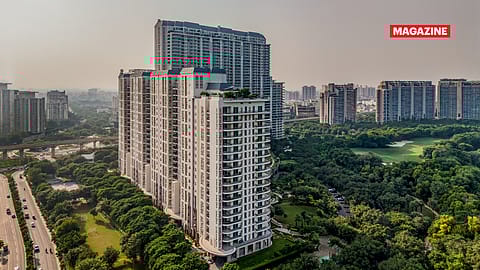
Builders in Gurugram and south Mumbai sold out marquee residential properties as soon as they were offered
Best Investments 2026: Luxury real estate hits the mark with homebuyers
In 2025, India's real estate sector saw a significant shift towards luxury and premium housing, driven by affluent buyers seeking quality and experience. Gurugram emerged as a key player, rivaling Mumbai in luxury sales. Despite challenges like high construction costs, the sector remains optimistic about reaching a $1 trillion market by 2030, with premiumisation leading the way.
This summary is AI-generated, and Fortune India is not responsible for its content or any associated copyright issues.
Tracking the great Indian shift towards upscale living and premium residential spaces.
Builders in Gurugram and south Mumbai sold out marquee residential properties as soon as they were offered
This story belongs to the Fortune India Magazine best-investments-2026-january-2026 issue.
HIGH PRICES? RISING COSTS? Who cares! India’s real estate sector sure did not. Home buyers wanted the best, never mind the price tag. They became investors focussed on quality assets, and developers offered projects that went far beyond just hearth and home.
A highlight of 2025 was a clear shift in priorities for both developers and buyers, with luxury and premium housing grabbing centre stage. The common man looked for more than just affordability, and the aspirational class became mainstream. India’s rich — the non-resident Indians, founders of startups, and senior professionals — bet on properties that offered not just space but ‘experience’, privacy, and long-term value.
Builders in Gurugram and south Mumbai sold out marquee residential properties as soon as they were offered. This shift towards quality sets the perfect tone for the real estate sector’s ambition to become a $1 trillion market by 2030 (or three times its current value). Offices, too, scripted record numbers.
Industry watchers say there’s a common thread running through the success of these segments — a combination of India’s strong economic growth momentum and favourable government policies.
Premiumisation takes centre stage
If there’s one theme that defines India’s 2025 real estate story, it’s ‘premiumisation’. Across the top cities, luxury and high-value homes are being picked up just as fast as they are developed. The residential market, which accounts for 80% of overall real estate activity, was buoyant in the first nine months of 2025, with sales crossing 2 lakh units and a similar number of new launches, according to CBRE, a commercial real estate services and investments firm.
The high-end segment led this shift, accounting for 27% of total housing demand, signalling a clear move up the value curve.
Prime markets such as Gurugram redefined luxury. Established hubs such as Golf Course Road and DLF phases, along with fast-growing corridors such as Dwarka Expressway and New Gurgaon, helped propel the National Capital Region (NCR) to the top of India’s premium property markets.
More Stories from this Issue
In Q3 2025, the top eight housing markets — Mumbai, Bengaluru, NCR, Pune, Hyderabad, Ahmedabad, Chennai and Kolkata — saw sales of 87,603 units, a marginal 1% YoY increase, while prices rose across the top cities, Knight Frank India said in its Q3 report.
Shishir Baijal, chairman and MD at Knight Frank India, calls the performance “impressive”, as it marked its fifth year of an upcycle. “Within a volatile geopolitical environment, India’s macro conditions remain stable. A notable outcome of this upcycle has been the surge in demand for premium housing, which has emerged as a key driver.”
Prop-tech platform NoBroker says luxury housing in Gurugram dominated, accounting for about ₹78,500 crore in sales, or half the share of all luxury homes sold across India; more than 2.5 times Mumbai’s figure of around ₹28,000 crore.
Akhil Gupta, co-founder and chief product and technology officer of NoBroker, says, “One of the most striking developments in recent years is Gurugram’s emergence as a serious competitor to Mumbai in luxury real estate. Homes priced above ₹5 crore have become commonplace... as a result, ticket sizes have risen sharply, making Gurugram the top destination for luxury buyers.”
{{#most-powerful-women-snapshot-individual.slug}} {{/most-powerful-women-snapshot-individual.slug}} {{^most-powerful-women-snapshot-individual.slug}} {{/most-powerful-women-snapshot-individual.slug}} {{#showRanking}} {{current-rank}} {{/showRanking}} {{#photo.0.url}}
{{name}}
Realty major DLF, which has a strong presence across Delhi-NCR, also reported overwhelming success in 2025. Privana North in Gurugram and the developer’s maiden Mumbai project, The West Park, sold out within a week of launch, generating ₹11,000 crore and ₹2,300 crore, respectively.
Aakash Ohri, joint director and chief business officer, DLF Homes, says, “…2025 was an exceptional year — not only because of the performance of our projects but also because it marked our formal entry into Mumbai. Whether it is the Privana Community with ticket sizes of ₹8-10 crore or the Dahlias at ₹70 crore and above, demand has been strong.”
Premium, luxury, and ultra-luxury housing are quietly pushing the affordable category to the margins, with homes priced above ₹1 crore accounting for over 50% of total sales across major cities. The premium and luxury segments now account for 14% of all sales (9M 2025), according to JLL.
Ultra-luxury housing also performed exceptionally well. Delhi, Mumbai, Bengaluru, Kolkata, and Goa are setting new records for trophy homes. In just three years, 49 properties priced at ₹100 crore or more have changed hands in Mumbai and Delhi-NCR alone, with a total deal value exceeding ₹7,500 crore, according to ANAROCK.
Amit Goyal, MD at India Sotheby’s International Realty, which serves affluent buyers, sellers, and investors, says 2025 was a “defining year” for Indian real estate. There was a decisive shift in buyer profiles, as founders of startups, next-gen entrepreneurs, and CXOs joined legacy industrial families as key demand drivers. “Many are monetising gains from equity markets, IPOs and PE/VC activity, and anchoring that wealth in tangible, long-term assets. This remains one of the few asset classes where capital gains can be reinvested while delivering appreciation, lifestyle value and generational legacy.”
Branded residences are booming, too. Hotels and global designers are lending their names and management to help buyers get a lifestyle, not just four walls. Tribeca Developers, which has a long-standing strategic alliance with the Trump Organisation in India, has helped bring Trump-branded luxury developments to India’s premium property market.
Rajat Khandelwal, Group CEO, Tribeca Developers, says, “We witnessed this surge first-hand when Trump Residences Gurgaon sold out within hours of launch, with a significant share of bookings coming from repeat Tribeca buyers.”
Gurugram-based premium and luxury developer Whiteland Corp. has partnered with Marriott International for its marquee residential project under the Westin brand. The companies see branded residences gaining momentum. “Branded residences are expected to expand beyond metros into Tier-II cities, as these markets begin to attract both genuine end users and long-term investors,” says Sudeep Bhatt, director, strategy, Whiteland Corp.
Pankaj Bansal, promoter, M3M India, which launched a ₹2,100 crore branded residential luxury project with Jacob & Co in Noida in October, says, “Beyond square feet, today’s luxury buyers prioritise panoramic views, wellness-focussed planning, low-density living, sustainability, smart technologies and branded residences that offer curated experiences”. The Noida project features 3 BHK, 4 BHK, and 5 BHK luxury premium homes at ₹14-25 crore — ₹35,000 a square foot.
What is so unique about these high-end properties? Sotheby’s Goyal explains that today’s buyers are looking for experience-led living: homes that promise wellness, thoughtful design, smart technology, and global-standard services, all in one place.
“There’s also an exceptionally strong demand for second homes. Hill, beach, and spiritual destinations are firmly on buyers’ radar,” says Goyal.
Major challenges in 2025
Despite strong demand across segments in 2025, India’s real estate sector faced a complex landscape. Industry leaders say resilience, balance-sheet strength and execution discipline became critical in 2025 as geopolitical crisis took centre stage.
“Elevated construction costs and relatively slow inflow of high-quality assets were temporary blips,” says CBRE’s Anshuman Magazine. “However, backed by RERA, innovative financing structures, and deeper adoption of technology, the sector is poised to stay strong in the coming years.”
Other challenges that continue to affect growth are higher borrowing and input costs, and a lack of skilled labour. Sotheby’s Goyal says real estate is capital-intensive, so a steady decline in interest rates was a relief for both the sector and end-buyers. Bansal of M3M agrees that a cautious lending environment influenced buyer sentiment and project financing, while expectations of monetary easing supported medium-term confidence.
The Modi government’s September reset of Goods & Services Tax rates could cut construction costs by 3-4% and home prices by 7-8%, though the impact has yet to be felt. Affordability also remains a key concern. The share of the mass segment dropped from 49% in H12024 to 38% in H12025.
Destination $1 trillion by 2030?
As the real estate sector eyes its $1 trillion goal, 2025 offered a glimpse of the way ahead: strong transaction volumes, rising institutional capital, and a decisive shift towards premium, future-ready assets.
CBRE’s Magazine says trends such as the preference for high-quality, experiential retail, and expansion in Tier-II cities are likely to continue.
What does the industry see ahead? Pavan Kumar, founder and CEO of Bengaluru-based luxury real estate player White Lotus Group, says premium housing will no longer be defined by abundance, but by alignment, with lifestyle, values, environment, and emotion. “Spatial clarity, natural light, and Vaastu-aligned planning will become expected baselines, not add-ons. Technology will recede into the background, integrated seamlessly to elevate comfort without disturbing the flow of life.”
As developers gain market share through strong brands, the key question is whether luxury- or premium-led momentum can add depth to India’s housing landscape, or whether achieving the $1 trillion goal will require a stronger push on affordability.
Follow Fortune India
NEXT STORY