Citykart: Fashioning growth across Bharat
/ 6 min read
The Gurugram-based firm has set its sights on becoming the go-to destination for value fashion in Tier III and IV cities across India. And the results are showing.
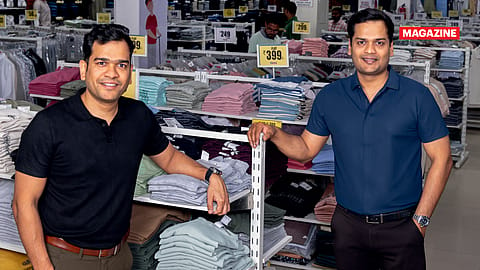
Rohit Agarwal (right) and Sudhanshu Agarwal, directors, Citykart. | Credits: Sanjay Rawat
This story belongs to the Fortune India Magazine june-2026-indias-most-valuable-celebrities issue.
AT ONE OF THE CITYKART stores, shoppers pose beside a Gucci-inspired installation, clicking photos for Instagram before heading towards stacks of crop tops and T-shirts priced at ₹139! Outside, golgappa stalls and momo carts surround the entrance; inside, families roam around for hours, their idea of an evening hangout.
These scenes are not playing out in Gurugram, Mumbai or Bengaluru, but Darbhanga, Chapra or Raebareli — places that remained obscure to India’s Big Retail for decades. And that’s where brothers Sudhanshu and Rohit Agarwal, directors of Citykart, saw a massive opportunity. “We realised these towns had aspiration but no organised retail,” says Sudhanshu. This realisation that Tier III and IV towns will lead the next consumption boom is behind Citykart’s emergence as one of North India’s fastest-growing value fashion retailers within a decade.
Sadar bazaars to malls
Sudhanshu’s understanding of retail began long before Citykart was launched in 2013. His father and uncle were among the former promoters of Vishal Mega Mart. “During my teens, I used to sit at the billing counters and visit stores with my father,” Sudhanshu recalls. “Retail was always there in the mind.”
What changed was recognising the next potential growth areas for retail. In metros, consumers had already shifted from the sadar bazaars and atta markets to malls. Sudhanshu saw the same transition taking over smaller towns. “The real growth engine is Tier II, III, and IV India,” he says.
Citykart’s own data appears to support that thesis. Some stores in tehsils and smaller towns now outperform district headquarters. Part of this shift is driven by infrastructure development and decentralisation. “People don’t necessarily want to move to Delhi anymore,” he explains. “They are finding opportunities closer home.” As economic activity spreads outward, consumption follows.
But when the founders began visiting smaller towns in Uttar Pradesh and Bihar, they noticed a massive disconnect between what consumers wanted and what local stores could supply. “Customers were looking for affordable fashion, whereas small players, because of supply chain issues, were selling at higher price points.” Plus, unlike cities, small-town consumers often have limited options for leisure and entertainment.
More Stories from this Issue
Thus began Citykart with five bootstrapped stores funded through family savings. At one point, the founders even raised capital by offering local investors a percentage of store sales. “We thought if we reached 20 stores, life would be settled,” Sudhanshu says.
Instead, the business scaled beyond expectations. The response was overwhelming. “People would queue outside the stores just to enter… Some would remove their slippers before coming in. Some even asked if there was an entry fee,” Sudhanshu recalls.
Today, Citykart employs around 4,600 and counts TPG and A91 Partners among its investors. According to data from business intelligence platform Tofler, revenue rose 39% YoY to ₹863 crore in FY25, while PAT more than doubled to ₹33 crore. FY26 figures are not yet available. The company, which procures from vendors, stocks it at its central warehouse, and then dispatches it to its stores, has an inventory holding of around 100 days.
Citykart operates 179 stores across 156 cities, mostly across Uttar Pradesh, Bihar, Jharkhand, Odisha, Madhya Pradesh, and Chhattisgarh. In many of these locations, Citykart became “the mall”. That distinction is critical to the company’s growth strategy as well as to its burgeoning bottom line. “For many people, visiting Citykart was akin to an outing,” Sudhanshu says.
{{#most-powerful-women-snapshot-individual.slug}} {{/most-powerful-women-snapshot-individual.slug}} {{^most-powerful-women-snapshot-individual.slug}} {{/most-powerful-women-snapshot-individual.slug}} {{#showRanking}} {{current-rank}} {{/showRanking}} {{#photo.0.url}}
{{name}}
And slowly, micro-economies begin forming around the stores — food vendors, mehendi artists, toy stalls, and imitation jewellery sellers. “We tell small vendors to sell categories we are not doing. Artificial jewellery, snacks, accessories — they all benefit from the traffic.” Citykart stores borrow inspiration from global retail formats, but adapt to local taste and affordability. “We don’t want our stores to feel flashy or expensive,” Sudhanshu explains. “We want to become the store of the community.” This localisation extends to everything, from store layouts to communication and marketing. Citykart extensively uses local languages and works with hyperlocal influencers instead of Bollywood celebrities. “Customers connect more deeply with local faces and local culture.”
This understanding of the consumption behaviour of Tier II, III, and IV markets is what differentiates domestic value retailers from traditional fashion chains, says Naveen Malpani, partner and consumer & retail industry leader, Grant Thornton Bharat. “Their strength lies in lean operating models, sharper price-value positioning, local merchandising, and deep distribution networks in underserved markets.”
But not everyone agrees.
“Unlike Walmart in the U.S. or ALDI in Germany, which mastered retail through curated, high-quality choices and lasting consumer trust, most consumer-facing businesses in India, chasing scale and valuation aggressively, still have a long way to go,” says Arvind Singhal, chairman, The Knowledge Company.
Consumption curve
One of Citykart’s biggest learnings has been the rapid spread of fashion awareness beyond metros, thanks to smartphones and social media. In fact, some of Citykart’s strongest-selling categories in Tier II and III markets are the same styles dominating urban Instagram feeds. “Our bestsellers are crop tops, loose-fit denims, and shorts in women’s wear,” says Sudhanshu. “Buyers in these towns are extremely fashion-forward.”
“Earlier, fashion was occasion-led. Today, it is becoming part of everyday consumption, even in smaller towns,” Rohit adds.
Consumers, however, are equally price-conscious. Citykart’s average selling price for apparels is around ₹342. It drops to as low as ₹139 for entry-level products such as T-shirts and crop tops. Unlike many fashion retailers, the company doesn’t rely on discounting. “About 85-90% of our sales happen at full price,” says Sudhanshu. “We don’t want to increase the price, and we don’t want to see a lot of our sales coming through discounts.” That approach resonates in smaller towns where shoppers remain sceptical of inflated MRPs followed by heavy discounts. “For us, the most important metric is same-store sales growth. What has given us tremendous confidence in our assortment and our stores is that, over the past three years, our same-store sales growth has been in the double digits.”
So, how does the company manage to sell products at such low price points? Rohit attributes it to execution efficiency. It starts with sourcing well, understanding fashion trends deeply, creating localised assortments, and managing inventory tightly.
“Our full-price sell-throughs are around 87%, versus significantly lower levels typically seen in the apparel industry. That efficiency allows us to offer great prices without compromising on quality. Operating at scale further strengthens that advantage,” adds Sudhanshu. When it comes to merchandising and supply chain costs, low overhead costs are an added advantage.
The company’s assortment is heavily tailored for geographies. A store in Lucknow or Allahabad carries a greater share of western wear and higher price points, while stores in tehsils and smaller towns would have a higher assortment of sarees, kurtis, and the like. “One size doesn’t fit all,” Sudhanshu says. “The contribution of lower price points becomes much higher in smaller towns.”
Nearly 90% of Citykart’s apparel assortment is private labels, giving it greater pricing control and flexibility. Its apparel brands include Athiya and Nimes, and Nimes Home, which caters to categories such as bed sheets, curtains, and utility products. For customers, however, the sub-brands matter less than the parent identity. “People are not entering Citykart looking for brands,” says Sudhanshu. “They are entering because they trust Citykart.”
The retailer has also expanded beyond apparel into categories, including cosmetics, toys, luggage, footwear, storage containers, and home furnishings, many of which are impulse purchases. “A woman may come for apparel but leave with a fridge bottle, cosmetics or toys,” says Sudhanshu. The traction for affordable beauty products sold under private labels is also strong. Nail polish packs priced at ₹99 for two are flying off the shelves in several markets. The broader strategy is clear: become a one-stop value destination for aspirational households.
Despite comparisons with a V-Mart Retail or a Vishal Mega Mart, Sudhanshu believes the competition is from the unorganised market. “That (unorganised to organised) is where the real market share shift is happening,” he says. Echoing similar views, Malpani points out that organised retail currently accounts for only about 41% of India’s apparel market, projected to reach nearly ₹16 lakh crore by FY30. “The mass segment accounted for nearly 72% of the apparel market in 2025, underlining how scale will continue to come from affordable fashion rather than premium retail alone.” Puneet Mansukhani, global head of digital and technology transformation for retail at KPMG International and sector head for retail at KPMG in India, says the sector is expected to remain one of the fastest-growing segments within Indian retail, “supported by expanding organised retail penetration, digital adoption, private label growth, and omnichannel expansion”.
The transition is happening rapidly. Landlords who once rented buildings to smaller shops are now leasing to organised retailers, Rohit quips in. “Vendors are also shifting from unorganised supplies to organised supplies. They are now filing GST returns and have their SOPs in place… Everyone is moving towards structure and organisation. The ecosystem is changing.”
The striking aspect of Citykart’s rise is the quiet growth. The company now plans to open roughly 100 additional stores over the next year, aggressively deepening its presence across the Hindi-speaking belt. “Our focus is not just expansion; we want to reach a state where we are impossible to be displaced in these regions.”
And somewhere inside a Citykart store, beside a Gucci-inspired installation and stacks of ₹139 T-shirts, Bharat is shopping for its future.
Follow Fortune India
Sign in to read full story
To access our exclusive magazine content, sign in to your Fortune India account.
Sign In NowNEXT STORY