Companies that have put all their eggs in one basket struggle today: ABB Global CEO Morten Wierod
/ 9 min read
Electrification and energy security are no longer mutually exclusive. Wierod believes ABB’s next leg of growth will come from sitting at that intersection.
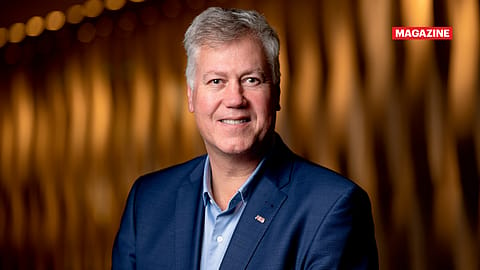
Morten Wierod: “It’s not about where we put money today; it’s more about where we put the money today so we will have the outcome many years from now.” | Credits: Padmini B
This story belongs to the Fortune India Magazine june-2026-indias-most-valuable-celebrities issue.
How do you make sense of the business environment amid the current geopolitical strife?
I probably make more sense of the business environment than of geopolitics these days. That’s just how the world has become. From a business point of view, I’m quite optimistic, and the reason for that is that we can deal with crises as a global world and a global society in a very different way than we did before. I often say we’ve been in constant crisis management: with Covid, with the semiconductor crisis, with wars in many parts of the world, and with tariffs, which was the hot topic of last year. So, crisis management, in a way, has become the new normal.
How is ABB finding its way in this new normal?
We haven’t really changed that much. At ABB, we have always tried to be more local for local.(1) That means we have built not only manufacturing capacity but also technology, R&D know-how, and skill sets in the main markets where we operate. If you look at how we support customers, it’s very local, of course. Historically, we’ve always done that in Europe, which is the company’s historical home base; about 98% of what we sell in Europe is produced in Europe. But if you look at India, we’re also there now in the high 80s. With further investments, we want to go above 90%. In many areas, we are fully localised… [like]… in China and… the U.S. This local-for-local strategy has been a journey we have been on for many years, and that has served us well during the crises we have faced.
Does having a strong local presence build resilience within global operations?
Absolutely. Companies that have put all their eggs in one basket struggle today. For us, as a large multinational company, I would also say we are in a fortunate position. I don’t want to come across as arrogant by saying ‘we figured it out,’ but the reality is that we have the scale to do so. We can have manufacturing in so many countries because we are a large company and we have enough volume. Of course, for a smaller, very specialised niche player, this is difficult to do. You cannot have manufacturing or R&D centres in every part of the world. It may come as a surprise to many that the winners of the globalisation era were often large companies, and even today, in a deglobalisation era, the winners are still the larger companies because they have the scale in many places. So, it’s tough to be a smaller company today, and that’s the sad, flip side of deglobalisation.
ABB has repositioned itself strategically from time to time. How would you describe the company today?
More Stories from this Issue
Today, we are a very focussed company on electrification and automation. The whole world is going electric, and we need more automation. So, this is a good market to be in. That focus on long-term, strong-growth markets is also reflected in the results of the company over the past few years, and in terms of valuation. The ABB operating model is more decentralised. That means we give much more responsibility to the local businesses and to the operating divisions: we have 16 of them in ABB. They have a full product strategy, manufacturing strategy, and a go-to-market strategy, based on the customer base they serve. And this is what brings agility and speed within an organisation, which has become increasingly important today.
Globally, ABB has said it is moving to a new operating margin and a new ROCE target. Can you elaborate on that?
I’m of the opinion that you set a target and then you reach it. And then you set a new target and then you reach it. That’s the say-do factor I like to see in the company. We have been doing very well in recent years. In the previous strategy period, we said we wanted to operate at 16-19% operational Ebitda. We reached 19% in 2025. Now we have upgraded that target to 18-22% operational margin. We are giving 18% as the lower range but we will not go below that. Our target, of course, is to reach 22%.
While capital allocation is a key role for a CEO, today it has become even more important. How have you warmed up to that role since taking over?
{{#most-powerful-women-snapshot-individual.slug}} {{/most-powerful-women-snapshot-individual.slug}} {{^most-powerful-women-snapshot-individual.slug}} {{/most-powerful-women-snapshot-individual.slug}} {{#showRanking}} {{current-rank}} {{/showRanking}} {{#photo.0.url}}
{{name}}
I’ve been in the company for several years, and I have learnt and seen with experience what takes longer time and what takes shorter time, because capital allocation is very much about a long-term bet. It’s not about where we put money today; it’s more about where we put the money today so we will have the outcome many years from now. So, what I’m looking at are the long-term trends that I believe will make sense — the key growth markets, both from a geographical and a segment point of view — and that’s where we allocate. So, it’s about making sure that we allocate most capital to the areas where we’ll find the best growth outlook, and the biggest profit pools.
Power generation continues to be driven by traditional fossil assets. So, how confident are you of the narrative that electrification will be the central theme, led by renewables?
The future is indeed electric. Fossil fuels that we use today are mostly used to generate electricity. Coal and gas consumption today is the same as it was in 2019. [In] many countries, even in India, the share of renewables is much higher today than it used to be, which I think is a good thing because this builds resilience over time. We need to reduce the dependency on gas, because gas used for generating electricity is probably needed for cooking lunch tomorrow instead. So, it is important to get that balance within the whole energy system, because in the end, most of this fossil fuel is used for producing electricity that is then used in industries.
The current geopolitical context has exacerbated the energy crisis? Do you think that makes the compelling case for renewables much stronger than it was?
I think every company, and we see this quite clearly today, every country, will look at how to build resilience in their country. This is why the U.S., which today is self-sufficient in oil and gas, sees that this is for them the best way forward right now. If you look at China as well, having no oil and gas, they don’t want to be dependent on imports that come from the Middle East or from Russia for that matter. So, they also see this massive ramp-up in renewable energy, but also in nuclear. And it is the same in India. You need to look at how to reduce dependence and be more self-sufficient, and there I think renewables will play a big role. Also, new technologies such as small modular reactors in the nuclear space is a topic that will gain momentum in India.(2) There is no one-size-fits-all or one solution to this equation. There will be multiple solutions that will need to be implemented to drive self-sufficiency, and I think this is something that every region or every large market, be it the Americas, Europe, India, or China is looking at today. But the outcome could be a bit different based on the geography.
How are you looking at capitalising on the AI opportunity?
This is the biggest opportunity as a business right now, but, of course, the much bigger impact for us as a company is how it will change how we operate, how we work. It really affects all 110,000-plus people in ABB in their daily lives: how we use the tools in our network, how we serve customers, and how we integrate AI into our products, software, and solution sets.
With AI, sometimes I get a bit of the same feeling as I had, 25 years ago or even more. When the internet came in the late ’90s, there were some questions that are still being asked today which we would find a bit funny: what’s the business model of the internet, what’s the internet economy going to look like? Today, that’s a very strange question to come up with. If you listen to the early days of AI, it is the same. It’s the same as we talked about digital, the same as we talked about IoT, a decade back. This is a new technology that will impact everything we do, and it will be used across companies, and by individuals.
But AI seems more of an efficiency tool, rather than a revenue multiplier?
It will be both, but the earliest examples are always easier on the cost side, on efficiency. You must do that, because if you don’t, everybody else will, and you will be the loser. I don’t think you will have AI companies and non-AI companies; the companies that don’t apply AI technology will die, and the others will succeed and move forward. So that’s the simple equation.
I have a good example: a spec reader. In our industry, we often get these specifications, and we can now use an automatic system, like a scanner, that reads a 200- or 300-page request for quotation and is then able, with a tool, to come up with an engineering proposal with deviation lists, with price, terms and conditions, all of these things that we have engineers doing today. It’s difficult to find good engineers, and it’s not very inspiring to do this year by year, and it often takes about two weeks to come up with this full quotation.
This is a typical example of a great AI tool. Now the engineers are checking more and going through some of the deviations where the know-how is needed. But then we’re able to send out the quotation in a couple of days instead of weeks. So, that’s a real customer advantage: they get a better quotation with higher quality, and they get it faster than in the past. That’s a clear efficiency gain, but I believe it will also increase our hit rate, which means it will have an impact on revenue, too.(3) Today about 9% of our revenue comes from data centre market. So, some of the hyperscalers are our largest customers today.
Will datacentres emerge as the next big bet for ABB?
It will be a very important part of ABB because it’s the highest growth rate in the company. We’ve been growing more than 30%, in fact, 35% year over year since 2019 in this segment. Now it’s more than $5 billion in orders for us. But it’s 9%, and not 91%. We are serving so many industries, and even without data centre, we are doing very well as a company. So, I’m happy with that balance we have. But, of course, it’s always a question of how we get even more exposure to some of these high-growth segments.
Where do you see the momentum right now?
We see both electrification and automation growing very well, but we have had a higher growth rate in electrification over the past two years. I also believe that in the next three to five years there will be a higher growth momentum there. With the need for more electricity online, we need increased grid resilience.(4) This is another challenge that we face today.
On a visit to Spain in April last year, on the 28th, the whole country (65 million people in Spain and Portugal) lost electricity. That shows how dependent we are on electricity today: when elevators don’t run, when water is not available, when high-speed trains stop in the middle of nowhere, and it was on a hot day, and it was difficult to evacuate people. You could see how society really stopped, and it lasted for eight hours.
It was a big wake-up call for many European and global utilities. I see that the interest now is in grid automation, some of the software and the automation solutions we have to build, but even some of the large what we call synchronous condensers, which is large machinery that is used in the power grid that builds inertia, the strength of the grid, so that the system doesn’t fall like a domino. So, this is a long-term track that will benefit both automation and electrification, and we are well placed in it.
How keen are utilities or governments in terms of improving the grid resilience or efficiency, because it comes at a cost, right?
It comes at a cost, but it’s like insurance: that also comes at a cost! But most people and most companies have it because not having it, especially when you talk about grid resilience, becomes a part of national security. We’ve seen that with some of the wars we have seen in the world of late, how electrical grids were targeted to take out critical infrastructure because that is what brings the biggest pain to the population in the country. This is unfortunately what we’ve seen over the past four years in Ukraine, and you see it elsewhere, too. So, it’s critical infrastructure that needs to be resilient, and it needs to have more backup and stronger systems to support it.
How do you see the China versus India opportunity?
China and India are both important markets for us. China is the second largest, India is No. 4. I’m pushing harder that India should soon be the third-largest market for ABB. They’re still behind Germany, so it’s a bit of an internal challenge that you need to get there sooner rather than later, at least before 2030, because with all the opportunities you have here, this should be ahead.
We see, especially with investment in infrastructure, that a lot of those investments happened in China earlier. For example, they don’t need more new airports or more buildings than they have today. So that’s where India is in a very different position. Also, the whole demographic profile of the two countries is very different. China is starting to have more of an ageing population, while in India it’s still a very young population, which gives it a higher GDP growth. So, we have been allocating more capital to India than to China, because we haven’t seen the same growth rate.(5) The basis of our discussions about the regions is about where we see the biggest future growth, that is the decisive factor.
Follow Fortune India
NEXT STORY