Decoding the IndiGo turbulence and the airline’s next flight path
/ 9 min read
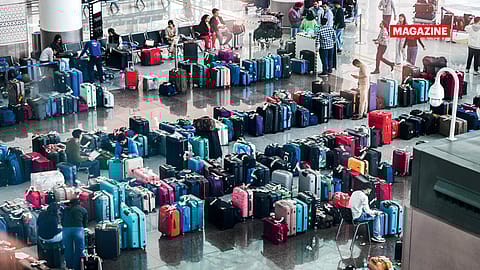
As IndiGo cancelled flights, airports were jammed with flyers, turning air travel into an absolute nightmare. | Credits: Getty Images
Decoding the IndiGo turbulence and the airline’s next flight path
IndiGo, India's largest airline, faced a major crisis in December due to new crew rest regulations, resulting in thousands of flight cancellations. Despite the chaos, the airline's solid foundation and market dominance indicate a promising future as it works to overcome regulatory challenges and rebuild its reputation.
This summary is AI-generated, and Fortune India is not responsible for its content or any associated copyright issues.
Stabilising operations, restoring trust, and recalibrating growth will be on the radar for the airline that is too big to fail.
THIS STORY FEATURES
As IndiGo cancelled flights, airports were jammed with flyers, turning air travel into an absolute nightmare. | Credits: Getty Images
This story belongs to the Fortune India Magazine best-investments-2026-january-2026 issue.
IT WAS ONLY A GLIMPSE, a trailer of sorts, into the nightmare that would befall if India’s largest airline ever folded up, without a warning. And in that, there are also some lessons for the country’s 350 million-odd flyers. That emotions, and emotionally charged statements — often made in the aftermath of a crisis — are usually forgotten within months, or even days, when you are just too big to fail.
For IndiGo, the $22-billion airline behemoth, December has been something of a nightmare. Quite often, with the northern parts of India seeing dense fog, flight operations across airlines become chaotic during the month. But what unfolded for IndiGo in early-December seemed more like a mismanaged affair.

It all began on December 2, when IndiGo started cancelling flights even as passengers experienced inordinate delays, sometimes up to seven hours. Then, by December 5, it spiralled out of control in ways even IndiGo hadn’t fathomed. By that day, over 1,600 of its scheduled 2,200 flights had been cancelled, turning air travel into an absolute nightmare. India’s key airports were jammed by exasperated flyers, some of whom vented their anger on employees of the Gurugram-based airline, forcing the central government to act swiftly.
Soon enough, the government capped air fares and even publicly rebuked the airline and its management for the situation. Officials of the airline were called in for meetings and issued show-cause notices, even as the Directorate General of Civil Aviation (DGCA) put on hold a policy that sought to increase rest for pilots. The crisis, which saw as many as 5,000 flights being cancelled by the airline till December 12, was caused by the implementation of the Flight Duty Time Limitations (FDTL), aimed at ensuring adequate rest for airline crew.
“Let these three days (December 3-5, 2025) not define what we have collectively built over 19 years,” Pieter Elbers, the airline’s CEO, said on December 18. “Today, we are 65,000 proud IndiGo colleagues, and in these 19 years, over 850 million customers chose to fly with us.”
Jitender Bhargava, a former ED at Air India, says it will all be forgotten in a few months. “India cannot do without IndiGo, and no other airline in India has been able to do what IndiGo has done. It is inexplicable what went wrong with them, and I believe it was a brain fade, and for that, they are responsible. But that doesn’t take away the fact that their future continues to look bright because their foundations are firm,” he tells Fortune India.
Alok Anand, chairman of Acumen Aviation, an aircraft asset management and leasing company, says flyers will forget this crisis, adding, there are likely to be some regulatory implications, though. The Competition Commission of India has already initiated a probe into the events that unfolded in December.
More Stories from this Issue
“A multitude of unforeseen operational challenges, including minor technology glitches, schedule changes linked to the winter season, adverse weather conditions, increased congestion in the aviation system and the implementation of updated crew rostering rules (FDTL) had a negative compounding impact on our operations in a way that was not feasible to be anticipated,” an IndiGo spokesperson tells Fortune India.
The airline’s two-decade-long journey
In many ways, the recent crisis at IndiGo is only a tiny blip in an otherwise impeccable track record in its two-decade-long path in the often-bloodied Indian aviation space. India’s skies are often a cemetery of sorts, with one airline going down almost every five years in the past few decades.
IndiGo has not only stayed afloat but also remained profitable and grown at breakneck speed, adding aircraft and acquiring more passengers as others were collapsing. Much of the early years were spent pioneering a sale-and-leaseback model, in which an airline acquires aircraft, sells them to a lessor, and then leases them back for use.
By 2015, the company was making profits of more than ₹1,300 crore annually. Today, IndiGo’s profits have swelled to ₹7,253 crore, with revenues exceeding ₹80,800 crore. For comparison, look at SpiceJet, another airline that began operations around the same time. The airline today holds just 2.5% of the market, less than half the market share held by the upstart Akasa.
{{#most-powerful-women-snapshot-individual.slug}} {{/most-powerful-women-snapshot-individual.slug}} {{^most-powerful-women-snapshot-individual.slug}} {{/most-powerful-women-snapshot-individual.slug}} {{#showRanking}} {{current-rank}} {{/showRanking}} {{#photo.0.url}}
{{name}}
“In 2011, there were six airlines,” adds Bhargava. “IndiGo had 20% market share then. Then, Kingfisher collapsed, and that market share grew to 28%. By 2019, when Jet Airways collapsed, IndiGo’s market share grew to 50%. By the time Go First folded up, the market share had grown to 60%. There were other airlines in the market, but none of them could do the same. That’s what makes the airline different. Their foundation is solid.”
Today, IndiGo is also trying hard to reinvent itself under Elbers, the KLM veteran who was brought in to helm the airline in 2022, as it increasingly seeks to shed its low-cost tag and position itself as a unique model that offers premium services as well. That’s also why IndiGo, under Elbers, has begun offering its version of business-class seats on select routes, along with a loyalty programme that lets members redeem points for flights.
“I think the downfall for the airline began with the exit of Rakesh Gangwal,” says Mark Martin, founder and CEO of Dubai-based Martin Consulting. “Gangwal had a grip on the airline. Today, it has become a board-run airline, and with Elbers, IndiGo is facing something of an identity crisis,” he tells Fortune India. Gangwal, who once held a 37% stake in IndiGo’s parent InterGlobe Aviation, parted ways with the airline in 2022 and has since exited in a phased manner. Gangwal and Rahul Bhatia, chairman of InterGlobe Enterprises, had launched IndiGo in 2005.
Today, IndiGo’s board of directors is headed by chairman Vikram Mehta, former Shell India chief; and includes lawyer Pallavi Shroff; Air Chief Marshal (Retd) B.S. Dhanoa; Bhatia; M. Damodaran, former Sebi chairman; Amitabh Kant, former head of NITI Aayog; chartered accountant Ani Parashar; Mike Whitaker, former FAA administrator; and aviation veteran Gregg Saretsky.
The genesis of the crisis
The recent crisis at the airline stems from a new policy (FDTL) by the government that mandates increased rest for crew, which came into effect in 2025. These include the total time a pilot is on duty, from reporting to sign-off, hours spent flying, special caps on responsibilities that touch the midnight–early morning window, and minimum breaks between duties and minimum weekly off-duty time.
The government was planning to introduce FDTL in June 2024, but it was deferred following pressure from IndiGo and others, delaying implementation to two phases in July and November 2025. “The DGCA’s revised FDTL regulations, if implemented, would have needed IndiGo to induct close to 974 pilots (commanders and co-pilots), make additional reservations for hotel bookings, crew transport, crew rest areas, and additional simulator checks and recurrent costs would have pushed up crew costs by at least 60%,” says Martin.
The airline has appointed consultancy firm Chief Aviation Advisors LLC to conduct an independent review of the crisis. Aviation watchdog DGCA has also set up a committee to study the reasons for the chaos. “What we witnessed seems a compounding effect of several factors,” Elbers said in a statement on December 18. “Everyone wants answers.”
“As immediate steps, we initiated calibrated adjustments to our schedule to contain the disruption and restore stability, but the situation continued to aggravate,” the IndiGo spokesperson added. “Following which, on December 5, 2025, IndiGo had no choice but to take the tough decision to reboot the entire route network leading to a significant number of flight cancellations. This was imperative for progressive improvements.”
Coincidentally, IndiGo ensured that it only cancelled a handful of international flights. Much of that is due to the higher compensation it must pay for international flights. Since he took charge, Elbers has been expanding IndiGo's international network and signing codeshare agreements with global aviation giants such as Qantas, Japan Airlines, Virgin, British Airways, and Malaysia Airlines. A codeshare agreement is an agreement to issue and accept tickets for flights operated by a partner airline.
IndiGo has also been significantly ramping up its international operations since Air India’s crash in Ahmedabad in June. The speculative nature of what caused the crash, along with Air India’s own decision to curtail its international operations, had led to fewer bookings on the airline, helping IndiGo overtake it as the largest international carrier. In the July-September 2025 quarter, IndiGo carried 4.14 million passengers, marginally ahead of the Air India Group’s combined 4.10 million, says data from DGCA.
“It’s a complex issue,” says Satyendra Pandey, managing partner of aviation finance firm AT-TV. “When it comes to compliance, it seems the simple answer is yes (IndiGo being responsible for the crisis). However, for an airline that is often admired for its planning, the scale of the meltdown and the oversight, or lack thereof, is still hard to digest. It has also exposed several weak links which have to be examined.”
DGCA has already sacked four flight inspectors who oversaw the safety and operational compliance of IndiGo. “Somebody had promised them (IndiGo) that the FDTL rules would be rolled back or assured them that they could find a way around it,” says an industry insider on condition of anonymity. “They went ahead with that hope till they ran out of time with the implementation in November.”
The fallout of the crisis and the way ahead
For now, IndiGo’s operations seem to have come back on track. The airline now flies to 138 destinations, operating 2,200 flights a day. “The worst is behind us,” Elbers said on December 18. The airline also announced refunds to all affected, and additional vouchers to those severely affected by the disruption. “The airline has also announced voluntary compensation to severely impacted customers who were stranded at the airports on December 3/4/5, 2025 in addition to the commitment under the existing Government of India guidelines, amounting to the tune of more than ₹500 crore,” the IndiGo spokesperson said.
While the government did cut IndiGo’s allotted daily operations by 10%, it isn’t likely to do much to dent its dominance in the Indian skies, even though the government has begun acknowledging the duopolistic nature of the sector. Between them, Air India and IndiGo control as much as 91.3% of the market. Incidentally, the government issued no-objection certificates to two new regional airlines, FlyExpress and AlHind Air, in December, the first of many clearances required before they can fly in India.
“It’s not very easy to start a new airline,” adds Bhargava. “Banks have burnt their hands in the airline business. While the government can be optimistic and say there is potential for new airlines, Air India and IndiGo have already placed large orders to handle the growing traffic.”
Anand of Acumen Aviation says the IndiGo fiasco is also a failure on the part of the regulator in failing to put guardrails around the autonomy given to airlines. “Long-term repercussions could be that if a flyer has now experienced a level of reliance with Air India or Akasa, he/she might switch loyalties. Also, IndiGo’s image of being a lean, clean, efficient machine is now dented.”
“Right now, the airline has lost its credibility,” says Shukor Yusuf, founder and chief analyst at Singapore-based Endau Analytics. “It’s bruised and battered, but it has a tried and tested business model. Hopefully, the government sees the positives even if it must punish the airline for this chaos.” Yet despite its might, in the short term, IndiGo could face more turbulence, especially since the regulator and the government aren’t likely to let the airline get away with it. “IndiGo faces near-term headwinds from regulatory scrutiny, competitive slot reallocation, and pilot hiring challenges,” brokerage firm Geojit said in a recent report. “While operational stability has recovered to over 91%, these factors may constrain short-term performance. However, IndiGo’s structural advantages — cost leadership, strong fleet pipeline, and scale — reinforce our positive long-term outlook.”
India remains a costly market for airlines due to high fuel costs, high taxation, and parking charges, making it difficult for new entrants. “Longer term — what options are there for the consumer? Trains continue to be packed, and there aren’t enough airlines. Within a week, the issue will dissipate, and by January, the forward bookings for IndiGo will likely rebound,” says Pandey of AT-TV.
For now, one thing is clear: The IndiGo juggernaut has flown out of turbulence. Now it’s all about ensuring a smooth journey.
Follow Fortune India
Sign in to read full story
To access our exclusive magazine content, sign in to your Fortune India account.
Sign In NowNEXT STORY