Deepfakes, brands and the AI frontier
/ 7 min read
While actors are busy protecting their personal IP against AI-generated deepfakes, brands are exploring AI-powered campaigns. What lies ahead?
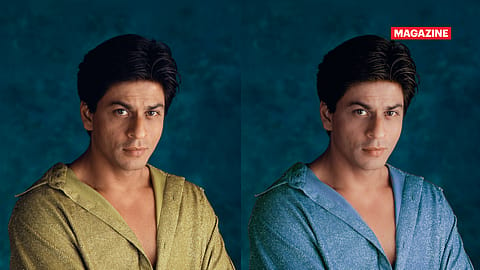
One of Shah Rukh Khan’s pics
is AI-enhanced.
This story belongs to the Fortune India Magazine june-2026-indias-most-valuable-celebrities issue.
IT IS DIWALI 2021. India, like the rest of the world, is reeling from the physical as well as financial pain induced by the pandemic. As local businessmen are bracing for yet another lacklustre festival season, a Cadbury Celebrations spot, helmed by none other than Shah Rukh Khan (SRK), takes the country by storm. But there’s a catch! SRK, in his familiar cadence, is promoting the local store down the corner.
From a Fashinova Emporium in a small town, say Indore, to a Ravi Electronics in Pune, and a Shivam Electronics in Parel, King Khan is leaving no store untouched. “Iss Diwali, apne paas waale Charu Creations se apne kapdo ki shopping karna.” But people are left perplexed. “How does SRK know Charu Creations from a small town like ours? How can they afford King Khan, that too, amid a pandemic?” they ask.
Back home in Mumbai, SRK is at ease: he knows he did not have to give a hundred voice-overs or shoot scores of hyperlocal versions of the clip.
Mondelez India’s AI-led Cadbury Celebrations campaign from Diwali 2021, called #NotJustACadburyAd was a hyperlocal experiment that used machine learning (ML), built in partnership with AI firm Rephrase.ai and adtech platform DeltaX, to personalise thousands of ads for small retailers across India. SRK’s face and voice were recreated using ML, and each ad was served across Facebook and YouTube to users near the featured shop.
The campaign reached 2,500+ local business owners across 500+ PIN codes, covering grocery, clothing, footwear, eyewear, and electronics. It went on to win the Cannes Titanium Lion and Grand Prix for Creative Effectiveness, which could be considered as advertising’s highest honours.
But Mondelez’s ad was one of the very few that saw this kind of reception at scale. Meanwhile, celebrities themselves were beginning to fight a parallel battle: deepfakes.
COURTROOM, THE NEW SET
More Stories from this Issue
In 2021, the Delhi High Court became the first high court in India to set up an intellectual property division, which got going in February 2022 following the notification of the rules. Delhi also houses the offices of tech firms such as Meta and Google, which makes it easier for aggrieved parties to call for takedown orders.
In April 2026, the court granted Telugu actor Allu Arjun a broad ex-parte interim injunction protecting his personality and publicity rights from unauthorised commercial exploitation. The defendants — online sellers, AI firms and intermediaries — were ordered to stop using his name, image, likeness, voice, dialogue, gestures, even his signature gait and the Thaggede Le gesture, for commercial or personal gain without his consent.
He is not alone. Since 2022, the list of Indian film and entertainment personalities who have approached the courts over AI-driven misuse of their identities reads like a blockbuster lineup: Amitabh Bachchan, Anil Kapoor, Jackie Shroff, Arijit Singh, Aishwarya Rai Bachchan, Abhishek Bachchan, Kajol, Nagarjuna, Karan Johar, Akshay Kumar, Hrithik Roshan.
The cases have produced incremental but significant rulings. Courts have moved from protecting a face to protecting a mannerism, from an image to an essence. “Courts in India are recognising personality as a commercially controllable bundle of attributes,” says Kirti Balasubramanian, partner, technology, media and telecom, Trilegal. “Recent decisions reflect an expanded interpretation of ‘likeness,’ which now goes well beyond image to include voice, mannerisms, and other distinctive elements that technology can replicate with increasing accuracy.”
{{#most-powerful-women-snapshot-individual.slug}} {{/most-powerful-women-snapshot-individual.slug}} {{^most-powerful-women-snapshot-individual.slug}} {{/most-powerful-women-snapshot-individual.slug}} {{#showRanking}} {{current-rank}} {{/showRanking}} {{#photo.0.url}}
{{name}}
Enforcement is another story. Weeks after the Delhi HC granted Allu Arjun an injunction, AI chatbot platforms were still hosting fake personas and interfaces that claimed to bring the actor “to life” without stating they bore no relation to him.
India does not have any standalone law governing AI-generated celebrity likenesses. Protection emerges through a patchwork of personality rights, copyright law, the Information Technology Act, and the Digital Personal Data Protection Act, none of which was written with synthetic media in mind.
“Traditional copyright law is not designed to cover AI-generated performances,” says media veteran Shyamala Venkatachalam, who has been in senior leadership roles in Sony, Star and Zee. “Everyone keeps asking who actually owns the digitally recreated performance. Is it the actor because you are using their face? Is it the studio putting money into it? Or the coders creating the tech for it? These are still open questions.”
To keep up with the times, the government has taken active steps to address the growing problem of deepfakes and AI-generated content. In October 2025, the Ministry of Electronics and Information Technology (MeitY) released draft amendments to the Information Technology (Intermediary Guidelines and Digital Media Ethics Code) Rules, 2021, seeking to bring AI-generated and manipulated media under tighter regulatory scrutiny. The proposed changes, which were formally notified in February 2026, introduced the category of “synthetically generated information” and suggested mandatory disclosures, watermarking and metadata tagging for AI-generated audio, video and images. Even response timelines to take down unlawful content were shortened from 36 hours to just three. In the second-amendment proposals on March 30, the government pushed for even tighter safeguards, calling for labels on AI-generated content to remain visible throughout its duration, alongside stronger traceability requirements for platforms.
What the courts have clarified, even without a dedicated law, is that consent must now be explicit rather than assumed, says Balasubramanian. That clarity is reshaping how contracts are being written. “The moment you leave anything to grey or interpretation, that’s where issues happen,” says Tuhin Mishra, MD & co-founder, Baseline Ventures, which manages athletes.
If the legal system is catching up, the business of celebrity endorsements is paralysed by uncertainty. Bollywood’s star system runs on scarcity, limited dates, physical shoots, exclusivity, and access. AI, if deployed fully, could disrupt all of it. “There is a lot of fear. There’s a lot of anxiety,” says Manish Porwal, group MD, Alchemist Marketing & Talent Solutions. “Celebrities are not keen to give their AI rights at all.” The anxiety is partly economic, partly existential. “If AI gets into endorsements fully, then the utilisation of celebrities changes completely,” Porwal adds. “Nobody knows how to price that right now.”
The inability to price something is, in business terms, the inability to trust it. And so a strange contradiction has taken hold across the industry — celebs are moving courts against deepfakes while brands simultaneously explore AI-powered campaigns that can scale celebrity presence infinitely. The same technology that allows a brand to place SRK in 2,500 local ads also enables an anonymous developer to clone Allu Arjun’s voice for a fake call app.
Mishra of Baseline Ventures says celebrities are open to AI integrations, but only within defined limits. “They are open. Production cost might go down. The association cost will not,” he says. Brands will save on logistics and shoot schedules by using AI, but the cost of the association itself is unlikely to decline. What is more likely, lawyers say, is a modular model. “This is likely to evolve into a more modular model, where different aspects of identity, such as voice, appearance, or even stylised traits, are licensed separately,” says Balasubramanian.
AI IS JUST A TOOL
Production houses are drawing a line between AI as a workflow tool and AI as a replacement performer. The industry is significantly more comfortable with the first. “I think that we can’t escape AI. We have to coexist with AI,” says Uday Gauri Singh, CEO of Dharma Collab Artists Agency, a talent management firm. “If AI is used for an actor who does not speak a particular language and it can translate that into one or two languages, I feel that is the right usage of AI as a technology.”
He adds that if AI is meant just to take your picture and make an ad, “that I think is something that we are still not okay with”.
AI-assisted dubbing, localisation, post-production clean-ups, and colour correction are already entering film production pipelines without significant resistance. Tasks that previously consumed hours are being compressed. “If you want to change this colour from blue to white and red and pink, that was being done in post,” Singh explains. “It would take 14 hours earlier. Now it would take 14 minutes.”
The EY-India 2025 report on GenAI’s productivity potential offers a useful frame across India’s media and entertainment sector. AI is projected to deliver a productivity impact of 15-20% by 2030, with customer engagement and content production seeing the largest gains. The biggest gains will be in multilingual localisation. Resistance to AI will be lowest in audience engagement and post-production automation. The report says 89% of media and entertainment enterprises surveyed have already initiated proofs of concept for GenAI, the highest initiation rate among all sectors. The industry may be publicly anxious about AI, but operationally, it is inside it.
The biggest worry is whether AI-generated performances can carry the emotional weight that is a hallmark of Bollywood’s star system. Unlike Hollywood, where audiences have been conditioned by decades of CGI-heavy storytelling, Bollywood’s star-audience contract is built on a more intimate basis. Fans do not simply watch stars; they feel they know them. That familiarity is what makes a celebrity’s face commercially valuable. It is also what AI cannot replicate, at least not yet.
So it is not just a technical problem; it is also a trust problem. The Cadbury campaign worked in part because audiences understood and accepted it as a creative idea. The deepfake crisis works in the opposite direction: voice cloned and likeness generated, without the star’s consent.
Who accepts the liability, legal and financial, of such AI-generated work? “The liability framework in India is still evolving,” says Balasubramanian. “Courts have been willing to grant omnibus takedown directions against unauthorised AI-generated content.” But platforms are also being pulled into the enforcement conversation.
In this framework, talent agencies can only react; they cannot pre-empt. “If those things happen, we are the first ones to reach out to Instagram, Google or X,” says Mishra.
Very few people in the industry believe AI can be stopped. The disagreement is over terms. Studios want scalability, while brands want efficiency. Actors want control, and lawyers want enforceable consent structures. Platforms want a safe harbour, and talent managers want pricing clarity.
What Bollywood is negotiating, at its core, is not simply a tech question. It’s a question about what celebrity is, whether it is a performance, a likeness, a relationship, or some combination of all three that cannot be cleanly separated and licensed in parts. Indian entertainment is trying to write new rules for an industry that did not anticipate needing them.
(With inputs from Ajita Shashidhar)
Follow Fortune India
NEXT STORY