Diljit Dosanjh: From local legend to global cultural icon
/ 5 min read
No. 12 on the Fortune India-Interbrand Most Valuable Celebrities list, Diljit Dosanjh has evolved into something bigger than a star.
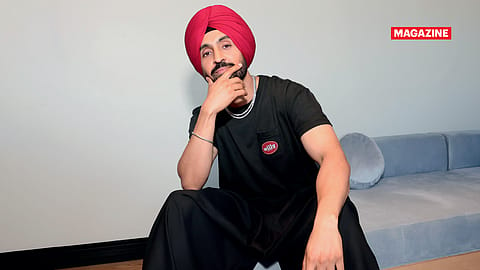
The rootedness allows Dosanjh to cut across geographies and demographics in a way many mainstream celebrities struggle to achieve. | Credits: Getty Images
This story belongs to the Fortune India Magazine june-2026-indias-most-valuable-celebrities issue.
”PUNJABI AA GAYE OYE!” And in what style they arrived.
For years, Indian popular culture exported Bollywood. Today, Diljit Dosanjh is exporting something far more specific and, in many ways, more difficult to universalise: Punjabi culture in its most unapologetic form. In 2023, Dosanjh became the first Punjabi language artist to perform at the Coachella Valley Music and Arts Festival in California.
Wearing traditional Punjabi garb on the global stage, Dosanjh’s references about pind life, Punjabi folklore, faith and local humour, and his refusal to dilute himself have become the main source of his global appeal. This ‘Cultural Bridge’ status gives him a ‘Global Multicultural RoI’, allowing brands to achieve deep emotional penetration in high-spending international markets.
His characteristic of being a ‘Unified Narrative’ asset was most visible during his Dil-Luminati India tour in 2024. In an EY report commissioned by Saregama India and Ripple Effect Studios on the socio-economic impact of the tour, Saregama India MD Vikram Mehra said the entire run was sold out in just five minutes.
Spread across 14 shows in 13 cities over two months, the tour saw more than 320,000 tickets being sold, generating an estimated economic impact of ₹943 crore, according to the EY report. Of this, ₹276 crore came from direct revenue streams such as ticket sales, sponsorships, and food and beverage sales inside venues. Another ₹553 crore came through travel, tourism, hospitality, shopping and dining. Government revenues through GST and permissions contributed another ₹114 crore.
The economic infrastructure is a testament to Dosanjh’s impact. Industry estimates place his fee at ₹4 crore for a private performance and around ₹4 crore for a Bollywood film project. Brand endorsements reportedly command close to ₹1.5 crore per campaign, while sponsored Instagram integrations are estimated in the ₹5-10 lakh range.
Dosanjh has a brand value of ₹1,497 crore, according to the Fortune India-Interbrand study of India’s Most Valuable Celebrities.
More Stories from this Issue
For Dosanjh, however, the ambition behind the Dil-Luminati India tour was larger. “From the start, I had one dream in mind, to bring the kind of live music experience to India that fans often travel halfway across the world for,” he wrote in the report. “I wanted every show to feel larger than life, yet deeply personal. Global in its scale, but rooted in our soul.”
Numbers bear testament to Dosanjh’s universal appeal. Nearly 49% of the attendees came from Tier II and III towns, while 38% travelled from other cities specifically for the concerts.
Harish Bijoor, business and brand strategy specialist and founder of Harish Bijoor Consults Inc., believes Dosanjh’s appeal lies precisely in the fact that he has resisted becoming culturally generic. “Diljit Dosanjh is a classic example of being a local in a completely global world,” says Bijoor. “The global appeal is that much deeper for anyone who wants to preserve his local roots and local pride.”
That rootedness allows Dosanjh to cut across geographies and demographics in a way many mainstream celebrities struggle to achieve. “The appeal of him being a Punjabi, and coming from a small town in Punjab, is one of the biggest appeals that criss-crosses language, culture, religion and locality,” Bijoor adds.
{{#most-powerful-women-snapshot-individual.slug}} {{/most-powerful-women-snapshot-individual.slug}} {{^most-powerful-women-snapshot-individual.slug}} {{/most-powerful-women-snapshot-individual.slug}} {{#showRanking}} {{current-rank}} {{/showRanking}} {{#photo.0.url}}
{{name}}
In fact, the frenzy during the Dil-Luminati India tour led to a 300% year-on-year increase in flight bookings to Chandigarh for domestic travel platform Ixigo. Other cities like Delhi, Ahmedabad, and Indore recorded an average 100% YoY growth in flight bookings, and a 85-90% month-on-month growth for train bookings on their respective concert dates.
“We had observed a significant shift in Indian travellers’ preferences, with more people willing to spend on experiences like music concerts and festivals,” points out Aloke Bajpai, co-founder and group CEO, Ixigo.
All these culminated into destination behaviour. Fans turned the Dil-Luminati concerts into mini holidays, combining them with tourism, shopping, and local experiences. Dosanjh’s own social media activity amplified the effect. In Lucknow, he filmed himself eating makhan malai in Hazratganj. In Kolkata, he posted from the Indian Coffee House and Dakshineswar Temple. In Jaipur, he rode through the City Palace in a horse-drawn carriage.
The tour generated more than 118,000 man days of employment and created over 40,000 social media posts, 16 million engagements and 4.5 billion impressions. In India’s entertainment landscape, few celebrities command that level of geographic and demographic spread.
Specifically universal
In fact, in an era where celebrity branding is over engineered, Dosanjh retains an odd looseness. Bijoor argues Dosanjh’s commercial value comes from specificity rather than universality. “When you are not everything to everybody, you are something to some people. That is true blue brand differentiation.”
And that differentiation is what brands such as Levi’s, Air India, and Mokobara bought into. Air India wrapped an aircraft in Dil-Luminati branding and redesigned boarding passes around the tour aesthetic. Mokobara used its suitcases as stage props during performances of the song Naina, with Dosanjh handing out the luggage to audience members during the concert. Levi’s launched an exclusive Dil-Luminati merchandise line carrying slogans such as “Punjabi aa gaye oye”. District by Zomato, the official ticketing partner, recorded 6.25 million visitors on the platform and processed over 320,000 ticket sales.
“Diljit Dosanjh has a rare way of bringing people together through his music, no matter where they are in the world. With his fans, it’s never just about listening to an album, but about feeling part of something bigger,” says Kunal Khambhati, founder and COO, events, District by Zomato.
The campaigns worked because they mirrored the tone of Dosanjh’s public persona — slightly self aware, rooted in humour and culturally specific, without being over produced. “The world believes being local is more important than being global,” says Bijoor.
It gives Dosanjh leverage beyond visibility, and in turn, he offers mobilisation. Bijoor believes Dosanjh’s endorsement value is climbing, and the singer’s selective approach will ultimately strengthen his long-term positioning.
The Diljit Dosanjh phenomenon points to a larger shift at play in India’s entertainment economy. “The future of entertainment lies in creators building durable, engaged communities around their work and their persona,” Mehra noted in the report.
India hosted 8,000 concerts in 2018. The figure is projected to rise to over 24,500 by 2030. Large-format concerts, with more than 5,000 attendees, are set to more than double during the same period.
Dosanjh himself captured the shift in the report’s foreword. “I have always believed that India deserves world class entertainment, not someday, but right now.”
Follow Fortune India
Sign in to read full story
To access our exclusive magazine content, sign in to your Fortune India account.
Sign In NowNEXT STORY